Showing posts with label UN Habitat. Show all posts

Wednesday, May 30, 2012

#ifadland – Who owns the land? Nairobi workshop tackles tough questions for Africa

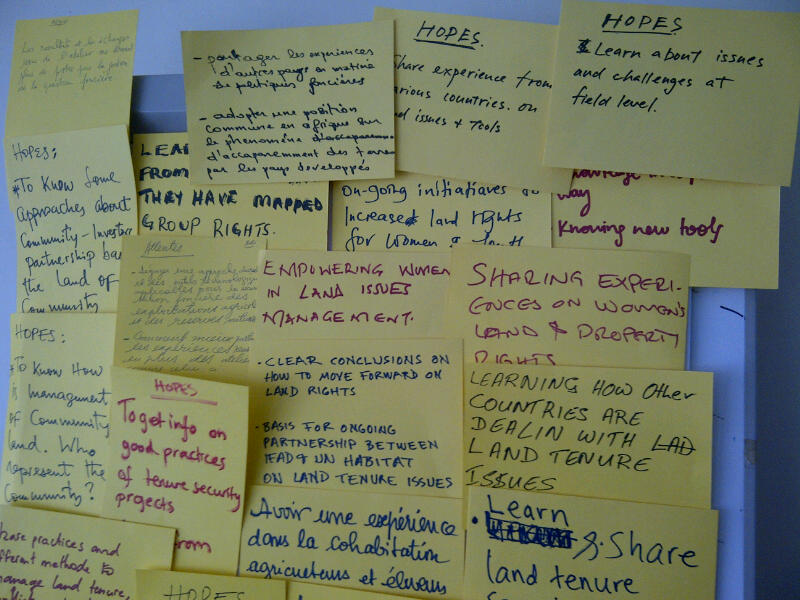
On day one, participants post their hopes for the outcome ‪
of the land tenure security workshop.
NAIROBI, Kenya – For the past two days, more than a hundred people have packed a mid-sized conference room at the United Nations compound here to grapple with one of the most fundamental questions facing the world’s poorest households: Who owns the land?

Tomorrow, they will come back to grapple some more, in a dialogue conducted in both English and French to accommodate participants from 20 nations across Africa. And when the simultaneous translators stop for their mandatory breaks, bilingual volunteers will jump into the breach so that the conversation can continue. Such is the sense of camaraderie and urgency in the air.

The forum for these discussions is the first-ever joint workshop held by IFAD and UN Habitat, the United Nations Human Settlements Programme. Organized under the auspices of the Global Land Tool Network (GLTN), the three-day workshop aims to deepen understanding of land tenure issues in sub-Saharan Africa. It also seeks to identify ways in which IFAD, UN Habitat and their partners on the ground can cooperate more closely to secure land and natural resource rights for all.

That’s a tall order, to say the least. But the stakes are high, especially for women and marginalized groups whose access to the land is most tenuous. Speaker after speaker in Nairobi has stressed that land tenure security – that is, the ability to control, benefit from and transfer the rights to land and natural resources – makes people far less vulnerable to hunger and poverty.

Land tenure and poverty

Simply put, secure land tenure is the key to the future prospects of millions of impoverished families worldwide. If anyone doubted that notion, the workshop has made it abundantly clear.

Photos from the workshop on display outside the packed
conference room in Nairobi.
The agenda kicked off yesterday with remarks by IFAD’s regional economist for East and Southern Africa, Geoffrey Livingston. “Secure land and natural resources rights are essential for rural poverty reduction, agricultural development and economic growth,” he said, noting that land and its associated resources are the primary assets of the 470 million people living in rural areas in Africa.

IFAD regional land advisor Harold Liversage added that land tenure is more secure when governments’ land administration systems are accessible and transparent. However, he cautioned, the reforms needed to create such systems require sustained political will at the country level – so there is no “one size fits all” solution to securing land rights.

But it was Clarissa Augustinus of UN Habitat and GLTN who made one of the workshop’s most sobering points. Only 30 per cent of all land outside the developed world is registered, she said, leaving 70 per cent without legally recognized ownership or security. Augustinus called this “a huge political and technical challenge” with ominous implications for the poor.

A continuum of rights
Still, it’s a challenge that must be met, amidst population growth, competition for dwindling resources and rapid urbanization in developing countries. In the absence of transparent land management, conflicts over property rights can be endemic. Large-scale land grabs by powerful interests can displace people from their ancestral homes. And smallholders who lack title to their farms can be denied access to the credit they need to move from subsistence to commercial agriculture.

Unwinding at a reception after day two of the three-day
IFAD-UN Habitat land tenure workshop.
One approach to solving this quandary involves rethinking the very definition of land ownership. As UN Habitat’s Axumite Gebre-Egziabher reported at the workshop, “a global paradigm shift” on ownership is already under way. Rather than focusing exclusively on statutory tenure, she said, more and more advocates and institutions are recognizing a continuum of land rights. These may range from traditional or customary rights to communal ownership of forests and grazing lands, as well as other intermediary forms of land tenure.

Significantly, the African Union Commission, the UN Economic Commission for Africa and the African Development Bank have endorsed just such an expansive vision of land tenure as part of their African Land Policy Framework and Guidelines, issued in 2009. The framework and guidelines also support participatory land policy processes as a prerequisite for long-term sustainable development on the continent.

Continued collaboration
Translating such declarations into effective land policy and governance is another matter, of course. Yet the participants in the Nairobi workshop – most of whom are practitioners working on development projects at the grass roots – appear determined to give it their best shot. To that end, they split up into small thematic groups, both yesterday and today, to concentrate on some of the most complex aspects of land management, including:
  • Documenting small-scale farmers’ land and water rights
  • Advocating for recognition of group land rights
  • Strengthening women’s equitable access to land and natural resources
  • Using remote sensing and mapping technology to promote land and resource rights
  • Securing land and resource rights through inclusive business partnerships between small-scale farmers and outside investors.
Each of these areas warrants exhaustive study in itself. For present purposes, suffice it to say that the land rights workshop has made a solid start on tackling each of them through Africa-wide collaboration and knowledge sharing. If the charged and serious atmosphere in the conference room is any indication, that collaboration will continue long after the workshop wraps up tomorrow, and the participants return to the lands they call home.


#ifadland – Secure land and natural resource rights are essential to reducing poverty across Africa

By Geoffrey Livingston

Yesterday in Nairobi, Kenya, IFAD Regional Economist for East and Southern Africa Geoffrey Livingston opened a joint IFAD-UN Habitat workshop on land and natural resources security with remarks on the challenges and opportunities at hand. Excerpts follow.

Smallholder farmers in the Haute Matsiatra region of
Madagascar. ©Rindra Ramasomanana
Secure land and natural resources rights are essential for rural poverty reduction, agricultural development and economic growth more generally.

In sub-Saharan Africa, about 470 million people are located in rural areas, agriculture employs 65 per cent of the labour force and the sector drives 32 per cent of GDP growth. Land and the associated natural resources are among the main assets that poor rural women and men have in Africa, along with their labour and creativity.

But land is not just an economic asset. It also has great cultural and social significance. For many Africans, land is owned on behalf of their ancestors and future generations. In general, poor people and marginalised groups have less access to land and weaker land rights – and, typically, women do not enjoy the same land rights as men.

Growing recognition
IFAD has learnt that the lack of secure land and natural resource rights is often a major obstacle to economic development and poverty reduction; is often a major cause of social instability; and often undermines good land use and land management.

In recent years, there has been a growing recognition in Africa of the importance of land and natural resource tenure security. There is also a greater recognition of the need for active citizen participation in the formulation and implementation of land and natural resource management policies. There is an opportunity to learn from an increasing number of experiences – both positive and negative.

The African Union Commission, UN Economic Commission for Africa and African Development Bank-led process of developing the African Land Policy Framework and Guidelines is exemplary. It provides us with an excellent opportunity for raising the profile of the importance of land and natural resource tenure security for long-term sustainable development – not only in Africa but throughout the world.

Collaboration with partners
But the real challenge now is in developing and implementing practical approaches for securing land and natural resource rights and, linked to this, building community and decentralised capacity to implement these approaches.

Often without realising it, IFAD-supported initiatives in the region have a wealth of experience in supporting local institutions to manage land and natural resources – and through this, to secure the rights of poor rural men and women. Typically, IFAD-supported projects and programmes are implemented by ministries responsible for agricultural development and natural resource management. And often, the lessons learnt on securing land and natural resource rights in these projects and programmes do not feed directly into land policy development.

In this regard, our collaboration with UN Habitat and other partners, under the auspices of the Global Land Tools Network, provides us with an excellent opportunity for strengthening the engagement of various IFAD-supported initiatives in sharing their experiences.

IFAD is very pleased to support this initiative. We recognise land and natural resource tenure security are key for poverty reduction and economic growth, and we welcome the opportunity to learn from others on how to better integrate measures that can strengthen tenure security into initiatives that we support.

Popular Posts