Showing posts with label vietnam. Show all posts

Friday, April 20, 2012

$100 million of climate smart smallholder #agriculture for Vietnam #CBA6

by Jeffrey A. Brez

This afternoon at the 6th Global Community-Based Adaptation conference in Hanoi, Vietnam’s Ministry of Agriculture and Rural Development (MARD) and IFAD shared their experience in making IFAD’s 2012-2017 strategic planning document for Vietnam climate smart. (these documents at IFAD are known as “Results Based Country Strategic Opportunities Programmes” or COSOPs). IFAD’s portfolio in Vietnam focuses on the poorest rural communities, including ethnic minorities and women headed households, and is now worth about US$257 million, with another USD100 million of investments anticipated over the 2012-2017 period.


MARD was represented by Prof. Dr. Trieu Van Hung, Director General of their Department of Science, Technology and the Environment. IFAD was represented by Roshan Cooke, Regional Climate and Environment Specialist for the Asia and Pacific Region.


Dr. Trieu (click above to view his 1-minute video statement) made the point that Vietnam is expected to be among the countries hardest hit by climate change, and that the agriculture sector is one of the most vulnerable. According to the National Climate Change Strategy, from 2001-2010 “damages caused by disasters like floods, storms, flash floods, landslides, inundations, droughts and saltwater intrusion have been significant: 9500 dead and missing people; and an asset loss of about 1.5% of GDP each year.” Given that the majority of Vietnam’s poor women and men live in rural areas and depend on agriculture for their livelihoods – and that agriculture is particularly vulnerable to natural disasters - supporting community-based adaptation is crucial to help buffer their livelihoods.

My colleague Roshan Cooke (in the photo above) explained IFAD’s ambitious approach. The “Climate Smart COSOP,” he said, will ensure that all of the investments that IFAD supports in Vietnam are climate-smart. This will be done through, among others, the following interventions: support to the policy making process to ensure that the climate vulnerability of poor rural communities is effectively addressed through MARD’s policy frameworks; integration of climate change adaptation responses into the provincial level Socio-Economic Development Plan (SEDP) for determining budget allocations; identification of adaptation pathways for diversification of livelihoods; and scaling up of autonomous adaptation actions that rural poor people are innovating.

Several presentations were made and the following discussion was lively. Issues raised included how to address the “surplus of rural population in farming,” how to balance focus between smallholder farming and opportunities in the rural non-farm economy (and beyond), and how to fill the knowledge gap on local level impacts of climate change in rural areas.

I have learned a tremendous amount here, through a field trip to Hoa Binh province to visit a COHED project (biogas, alternative off-farm livelihoods for women and community-based eco-tourism, disaster preparedness drills) THANK YOU TO THE COHED TEAM, and great conference sessions that included an amazing Red Cross-designed game to raise awareness about disaster risk reduction and planning THANK YOU PABLO SUAREZ and JULIE ARRIGHI, and a session to practice pitching climate change stories to journalists, led by IIED – THANK YOU MIKE SHANAHAN and DRAGONS including Pakistan's AFIA SALAM of www.speakforchange.org.

CBA6 has two more days left! Follow the LIVE WEB STREAM or enjoy the blogs and vlogs and other interactive materials - and learn and share along with the rest of us.

Find out more here about how IFAD is supporting smallholders and poor rural people in Vietnam.

Want to read the IFAD COSOP for Vietnam? You won't regret the time spent. Click here and scroll down to Vietnam 2012. Available in Arabic, English, French and Spanish.

Friday, May 20, 2011

Value of cross-continental learning route

by Nguyen Thanh Tung


After flying from Hanoi across Asian, African and Latin American countries and taking long transit hours in Kuala Lumpur, Cape Town and Buenos Aires we finally landed in Lima, Peru after 44 long hours. Our team of 11 people including provincial leaders, IFAD project directors and staffs from Vietnam then climbed to Arequipa, Chivay and Sibayo in the Andes mountains and wondered if the intercontinental trip would have learning value. “I thought farmers in my province suffer harsh conditions, but really here their livelihood is much more challenging, the area has more stones than we have ”, said Mr. Tien, Vice-Chairman of Ha Giang Province when he saw the land surface in the southern region of Peru made up only of stone like on the moon.

We were surprised from the first day of the Learning Route, by the cold climate in the highlands at altitudes of 3,800 meter and above and by such a warm atmosphere of the community’s dynamics and ownership of development. “No need for reading the project completion report or any of monitoring and evaluation, the presentation skills and understandings on business management by the women’s groups we met in the villages and during a CLAR contest showed us the successes of the IFAD project”, concluded Ms. Vien, IMPP Project Director from Tra Vinh province after the four-day visit to women’s household-tourism and handicraft associations in Sibayo and their actual participation in the final CLAR contest on poverty reduction impacts of their activities. Recalling similar Cham ethnic minority women in her province who are shy and reluctant to talk at community meetings, Ms. Vien added: “I do think that the CLAR mechanism makes the local poor women change their capacities and we need to learn from this from Peru for replication under IFAD projects in Vietnam”.


Why the CLAR mechanism was so attractive to the Vietnamese team? CLAR in Spanish is “Comité Local de Asignación de Recursos” (local resources allocation committee), in which community groups compete with their business ideas and plans for accessing pubic resources that they will own and manage to procure technical assistance and build up infrastructure they need. CLAR members are representatives of the beneficiary communities and enterprise associations and information on the CLAR process and decisions are publicly announced. Resources allocated by the CLAR are up to the 80% of the total budget of a business plan and the other 20% is invested by the local communities, so both become partners. This factor makes the community groups the real owners of their business plans, e.g. they decide to hire someone locally available to teach poor women weaving handcrafts or cooking food for tourists. There is no need to wait for training services by government staffs.


The principle of competition in the CLAR contest is also a key factor, motivating creation of new business ideas and assurance of product quality. Trade fairs, integrated with the CLAR contest, generate opportunities for producer’s associations to promote the marketing of their products in urban areas. All these factors were discussed by our team during analysis workshops conducted during the Learning Route right after each day of field visits and interviews with local stakeholders. The more we learned about the CLAR mechanism the more we fell in love with this tool and asked for its detailed guidelines. We believe that this tool may overcome the current constraints to development of producer’s associations under IFAD projects in Vietnam, in particular in their access to financial and technical assistance due to bureaucratic and top-down mechanisms of public service management.


“I found CLAR a very effective and efficient system for pro-poor public resource management. However, adopting CLAR in Vietnam will need the political commitment of local government for introducing changes like in Peru. Thank you, IFAD and PROCASUR very much for helping me in crossing the world’s continents to learn many new things that we are ready to replicate in Vietnam”, said Vice-Chairman Tien during the final workshop of the Learning Route in which each of us presented our follow-up innovation plans based on the Peru experience.

We all fully in agree with Vice-Chairman Tien that we learnt more than expected. In addition to the CLAR itself we learnt in Peru how to develop sustainable community-based tourism and off-farm activities in remote and difficult areas, how to conserve indigenous techniques among ethnic minority groups and integrate the production workshops within tourism activities, how to promote public private partnerships (PPP) in development of saving groups in cooperation with private banks, provision of training to government staffs and communities by private mining companies, etc. but there are more and more interesting things to list here. For example Vice-Chairman Tien was most happy when he saw in the Peruvian household he stayed with in Sibayo village the model of wood-saving stove that he was looking for promoting in his province.

Saying goodbye with warmest hugs with our Peruvian friends we invited them to join us soon in a Learning Route to IFAD projects in Vietnam since we believe that sharing knowledge does need to be organized focused on key innovation that we want to bring back home, and in face-to-face interactions with project stakeholders, in particular the poorest ethnic minority women in the most disadvantaged areas.

Saturday, November 13, 2010

Visit to the ethnic minority women of Bac Kan Province (Viet Nam), agents of change


When the plane landed at the Noibai international airport on 6 November morning, I was so excited to see the famous city of Hanoi that I forgot I was travelling with Dr Kanayo F. Nwanze, President of IFAD, “man of the field”. After twelve hour trip from Rome to Hanoi airport via Bangkok, I was nice to see our colleagues from IFAD Field Office in Viet Nam: Atsuko Toda and Nguyen Than Tung who together with official from Ministries of Planning and Investment and Foreign Affairs  were waiting for us at the airport. We left the airport directly for the Bac Kan Province to visit IFAD-funded supported projects in the northern part of the country.

“I like to go first to the field so when I am back to the capital, I can report to the Government officials what I saw with my own eyes” said the President of IFAD who was leading the delegation.


The delegation of IFAD was composed of the President himself, Mr Yaya Olaitan Olaniran, IFAD Executive Board Director, Atsuko, Tung and myself. After three hours driving, we finally arrived in Bac Kan. After the a short stop an the hotel, we were received by the Chairman of Bac Kan Province, Mr Houng Ngoc Duong. Chairman Houng welcomed the President and the IFAD delegation  and introduced the members of the local government.

He made a presentation on the Pro-Poor Partnerships for Agroforestry Development Project (3PAD) in Bac Kan Province which has amongst the highest concentration of minority people and is one of the poorest provinces in the country. The presentation was followed by a video on the success story of the project which started only in April 2009. The objective of 3PAD is to establish a framework for sustainable and profitable agroforestry development in the Province.

The President congratulated the Chairman for the comprehensive presentation and the Province for their achievements saying that after 18 months of the implementation, we've already started to see results. The Chairman commended the wonderful job our colleagues in Viet Nam are doing and told the President that the Province is already thinking of the second phase of the project to be extended to other districts in the Province. Chairman Duong also told the President that he would like IFAD to mobilize other development partners to support Bac Kan to reduce poverty in it remote areas.


The President was impressed of such commitment at the Province level and their long term development vision and  reassured Chairman Duong that IFAD will support Bac Kan in its quest of poverty reduction.

The long day was concluded by a dinner at the Provincial People’s Committee (PPC) Guest House where IFAD delegation met the members of PPC and the Project staff. The atmosphere was really friendly.

During the dinner the President also met Mrs Dong Thi Oanh, Chairwoman of the Provincial Women Union and Mr Dong Van Luu, Chairman of the Provincial Youth Union. During their discussion, the President informed that he is committed to support both women and youth issues.

On 7 November, early in the morning, another two hours in the car and we arrived in Ba Be District where the President met and discussed with the ethnic minority women Tay in Na Kieng village and Dao in Na Mo very remote mountain areas. In Na Kieng, the women during the meeting told the President that they need to have access to credit to buy seeds and that they could benefit from training in land management, learn about new technology for planting fruit trees, and they also desperately need improved rural infrastructure such as rural road.

Talking to Mrs Vi Thi Oanh, Vice Chairwoman of the Women Committee in the Village Na Kieng, she said that with the project, 10 households are now planting water melon in the village and their incomes are considerably increasing.


When we say IFAD works in remote areas, we really mean it. When the IFAD delegation finally reached the Na Mo, we had to walk for another 1 kilometre to actually get to the village. The village is about 600 meters above sea level. Both our Vietnamese friends and colleagues and the IFAD delegation were quite tired by the time we reached Na Mo.

In a really friendly atmosphere, the Dao women warmly welcomed the delegation in the Community House. After few minutes, the ice was broken. The representative of the Na Mo women Trieu Ghen informed the President that they would also like to include in their 2011 work plan the production of vegetables, livestock. The village leader Huu Phung said that they would also like to start planting the trees as this will help to protect the land and provide a source of  increase income and give them an opportunity to replace the trees with new plants.

Dr Nwanze, the man of rice, could not be visiting Viet Nam without visiting farmers working in rice fields! Rice and the past professional life of Dr Nwanze are inseparable. When he was the Director of the Africa Rice Center for a decade, Dr Nwanze was instrumental in introducing and promoting New Rice for Africa (NERICA). Just after lunch, we moved to Dia Linh village Yin Duong Comune, another area of IFAD project.

Here, the Dao minority women and men work in rice fields. The President interacted with the owner of the land Mrs Houng who told the delegation that she has obtained the forest and land use right certificate for 50 years in her and her husband name.

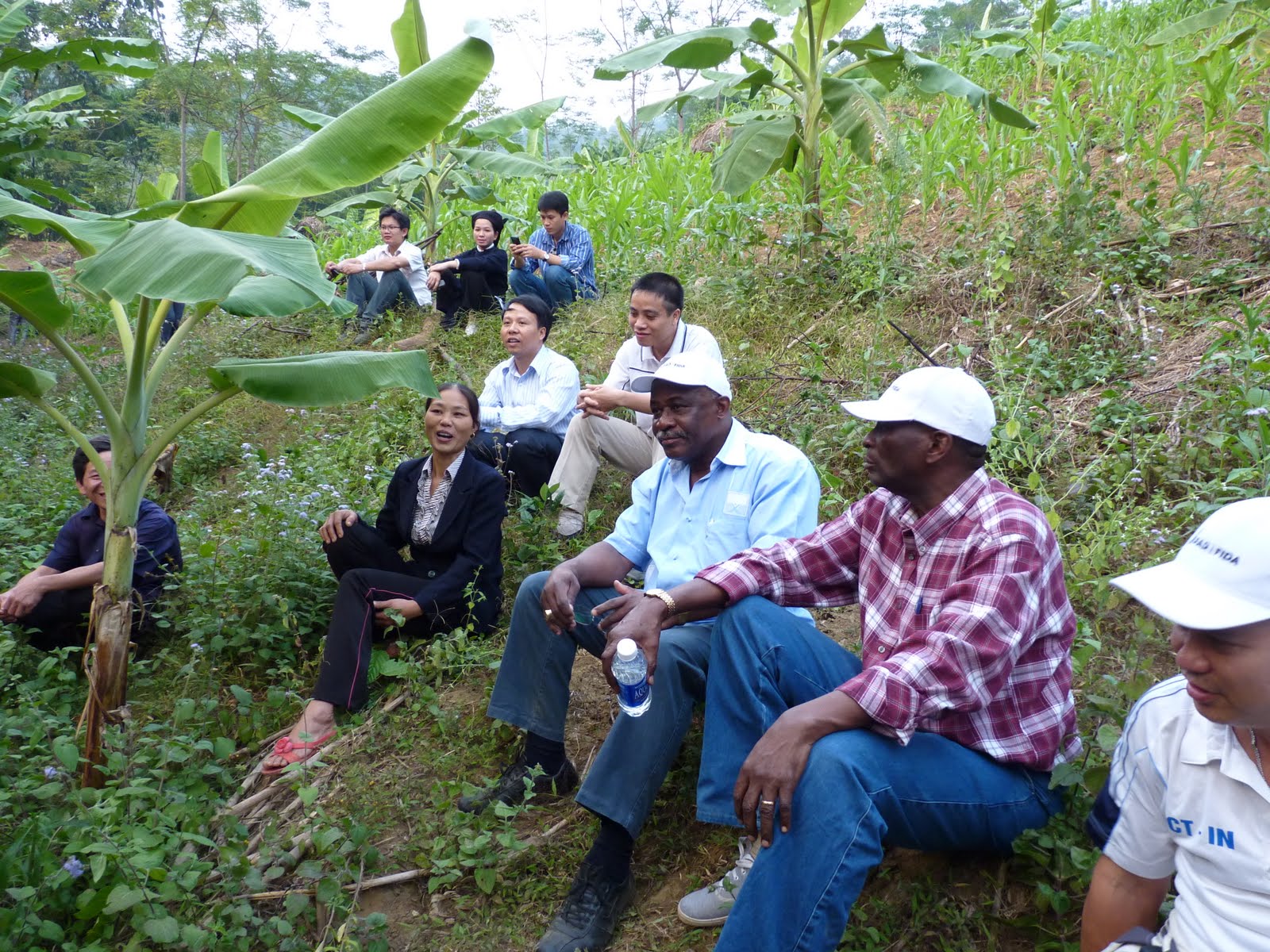
Later on we moved to the mountain to see another forest land allocated to her and her husband. She used this land to plant  banana trees and maize. She told the delegation that she will sell the banana to get more money and she'll be using maize for her family consumption, to produce the local liquor and feed the livestock so she can sell the animals at better price.

She said since the land has been allocated to her, their life condition has improved. Regarding the banana plantation, the President asked about the quantity of banana she can get from each three and how long it will take for the young plant to produce banana. The western banana as they call it in Viet Nam, takes one year before it gives fruit. The President told her that she can get a new variety of banana seed from Kenya which can give more bananas in less than 9 months.

IFAD-funded project in this area will also address the issue of land to help the poorest ethnic minority women to get land use certificate.

All rural ethnic minority women the President met  were committed to take the opportunity of the 3PAD to improve their families life conditions. The President also said that IFAD is committed to continue working with them to develop innovative methods for linking poverty reduction with market-oriented agricultural and rural development.

Popular Posts