Showing posts with label indigenous peoples. Show all posts

Thursday, April 12, 2012

Empowering Indigenous Peoples’ Voices at #rioplus20

Written by Clarissa Baldin

In April 2012, IFAD approved a grant to support Indigenous peoples’ (IPs) full and effective participation in the United Nations Conference on Sustainable Development (Rio+20). The grant will help provide 100,000 USD for several activities related to the Conference. Preparatory meetings of indigenous peoples’ representatives at regional level will serve to consolidate their perspectives and concerns for inclusion in the Rio +20 discussion text. These will also serve to assess and report on how indigenous peoples have implemented sustainable development in their own communities over the past 20 years. The reports and best practices produced will be consolidated into a book, to be completed by June 2012.

The grant will also support the establishment and functioning of the Secretariat of the Global Coordination Committee of Indigenous Peoples in Rio de Janeiro. The Secretariat will, among other things, coordinate the activities planned in Rio de Janeiro, the arrival of indigenous participants and theirs participation to influence the Third Prep-com.

Finally, IFAD’s grant will support participation of indigenous peoples’ representatives at the Indigenous Peoples Global Conference (IPGC) to be held in Rio de Janeiro from June 16-19, just prior to the Rio+20 Conference itself. The IPGC conference will cover four themes: a) the right to land and legal security; b) impact of extractive industries on the good living of indigenous peoples; c) food sovereignty and the right to food; and d) development with culture and identity.

Indigenous peoples and their traditional knowledge are key in the conservation and sustainable management of natural resources. When traditional forms of resource management collapse, the environment suffers, putting the livelihoods of indigenous peoples at risk and pushing them into poverty and undermining our global pursuit for a sustainable future. Traditional indigenous lands and territories contain some 80 per cent of the planet’s biodiversity - but they still represent 15 per cent of those living in poverty.

Enabling indigenous peoples to actively participate in major international fora allows them to advocate and shape outcomes that both preserve their cultural heritage and protect the environment. IFAD has over 30 years of experience working with indigenous and tribal peoples and ethnic minorities, and will continue to support theirs engagement in the global sustainable development dialogue through the Rio+20 process.

IFAD values indigenous peoples’ knowledge, culture and practices when designing investment projects. Based on its experience on the ground, IFAD has learned that best results are achieved when programmes and projects build on indigenous peoples culture and identity. IFAD believes that one of the most effective ways to enable indigenous peoples to overcome poverty is to support and ensure that they are the co-creators and co-managers of development initiatives – and that’s why we’ve made indigenous peoples full and effective participation in Rio+20 our commitment.

Find out more on IFAD’s work with Indigenous Peoples’, and read other featured stories here on our blog.

More about IFAD and Rio + 20.

Please note: IFAD supports indigenous peoples participation at Rio+20 through the Global Steering Committee established in Manaus in August 2011. The Committee was established by indigenous peoples' leaders to have a coordinated presence in RIO. See the agreement Moving Towards Rio+20 for additional information. IFAD’s direct contact is the UN Permanent Forum on Indigenous Issues, represented in the Steering Committee.

Thursday, February 23, 2012

World Agriculture Watch: Coming Soon FAFO12

by Jeffrey A Brez

This afternoon, after IFAD's Governing Council ended, the Farmers' Forum took advantage of the fact that so many stakeholders were still in town to have a final round of thematic events. I attended a session hosted by the FAO and CIRAD on a proposal for a World Agriculture Watch (WAW background in English French Spanish). The concept is founded on the notion that while we do have a lot of agricultural information and data available, there are important gaps in quality, quantity, availability and analysis. Particularly, we are lacking a tool with which to track and analyze trends in transformations and impacts in agricultural and farming systems that affect the world's 500 million smallholder farms. The discussion focussed on how to ensure that farmers' organizations can contribute to and benefit from the WAW. Here are the three presentations made, and below them a few thoughts on the discussion that followed.

Alessandra da Costa Lunas of COPROFAM presented thechallenges family and indigenous producers are facing in Latin America.


Alexander Muller, Assistant Director-General Natural Resources at FAO presented the rationale for a World Agriculture Watch.


Patrick Caron, General Director at CIRAD, looked at some of the mechanics of assessing structural changes and impacts in agricultural and farming systems in an integrated way.


Esther Penunia (Philippines) of the Asian Farmers Association for Sustainable Rural Development set the tone by saying that while there is potential in WAW, it must include bottom up information and data that is already being generated by farmers' organizations to be a WOW! Ousseni Ouedraogo (Burkina Faso) of ROPPA urged that existing regional initiatives such as Agrimet not be duplicated, but complemented. Carlos Sere, IFAD's Chief Development Strategist advised that any new data system set up be sustainable, use an open data model approach that allows inputs from and useability for a variety of stakeholders, know its own boundaries (what questions it can and cannot answer), and have a reliable system to guarantee data quality.

Wednesday, February 22, 2012

A delicate balance


Community and Participatory Management of Natural Resources: Experiences from Mesoamerica’s Indigenous Peoples and Forest Communities

By Jeff Brez and Greg Benchwick
In today’s side event Community and Participatory Management of Natural Resources: Experiences from Mesoamerica’s Indigenous Peoples and Forest Communities, IFAD’s Latin America and the Caribbean Division hosted a robust discussion on how international organizations, indigenous peoples, governments and other key stakeholders can come together to create sustainable livelihood solutions from the world’s forests. It’s a matter of balancing development with poverty reduction - and sustainable forestry management with economic development - to create business (and development) models that work for all involved.

What was very clear in the discussion was the strong desire of the communities to identify more sustainable livelihood solutions within the forests, both from timber and non-timber products. These types of mechanisms would allow them to continue their way of life.

There was also a lot of excitement regarding the variety of ways that some communities are managing to earn sustainable incomes - such as through the sale of resin or by tapping the still-unknown potential of the forest to provide other sources of income, for example through medicinal plants or protection of biodiversity that may have other medical applications. Strengthening of value chains was a recurring theme, and it was felt that building mutually beneficial relationships with both industry and government is still an uphill battle, although ground is being gained.

Another hot topic was carbon: Who owns it? Because of land tenure issues in many countries, ownership of the land was unclear and by corollary rights to carbon income made accessing REDD+ mechanisms and carbon markets messy business. Jesus Quintana, Regional Climate and Environment Specialist for the LAC region with IFAD, pointed out that this is of crucial importance not only for reasons of justice, but also for the practical reason that clear ownership or rights is the foundation for a sound enabling environment for investment.

A final point of difficulty for communities is the short project and contract terms for forest management. The representatives pointed out that five years is too short a time period to show proven performance in sustainably managing a forest. What they see as more reasonable are 40-year renewable contracts that are automatically renewable if the management is indeed sustainable and effective. That would give communities certainty in planning their economic and ecological future, and also a broader base from which to gain social, environmental and cultural benefits.

Video

In this insightful video produced for an event on Community and Participatory Management of Natural Resources: Experiences from Mesoamerica’s Indigenous Peoples and Forest Communities, at the International Fund for Agricultural Development’s (IFAD) annual Governing Council, indigenous community leaders and forestry experts examine the challenges and opportunities of sustainable forestry. Indigenous communities are the protectors of the world’s biodiversity. Only by providing them with the means, tools and mechanisms to protect the world’s forests can we hope to ensure a sustainable future for our little green planet. In Spanish with English subtitles. 

 
Hot links
Tackling sustainable rural development and climate change in Mexico
Mexico Going Green - Emerging trends in REDD+ and other sustainable practices 
IFAD signs US$5 million loan for ‘Community Forestry Development’ in Southern Mexico
English | Spanish
www.reddmexico.org/conafor

Share it!


Compartir en Facebook


Monday, October 24, 2011

Lila Downs – Reverence, Hope, Change


Mexico’s favourite singer-songwriter dishes on development, gender, indigenous issues, peace and music

Lila Downs is a Grammy-award winner, Academy Award nominee, singer, songwriter and activist. Her songs tap the heart of indigenous Mexican traditions, also looking to world beats and pop to create an effervescence message of reverence, hope and change.

In this videocast, we interview Lila Downs on indigenous issues, violence, music and culture in Latin America. Her frank and incisive answers provide a unique glimpse into contemporary trends in rural development, gender equality and indigenous rights. Learn more about Lila at www.liladowns.com.

Photos and music courtesy Lila Downs.
Photo credits:
Lila Downs Turquoise - ©Fernando Aceves
Lila Lagrima de Maiz - ©Luna Maran
Lila Pensando - ©Elena Pardo
Metate - ©Ricardo Trabulsi

All other photos ©IFAD/Greg Benchwick.

Monday, October 10, 2011

Using astronomy and animals, voices to predict rainfall: A Maasai practice #gyin #sfrome

There is growing recognition that indigenous peoples are affected by the economic, social and environmental impact of climate change and that their traditional knowledge may be critical for effective adaptation and mitigation strategies.

Mosses Ndiyaine from Tanzania, who was both at last month's Share Fair and now in Cotonou for the Young People Conference- Agents of Change, tells us how the Maasai use indigenous knowledge and astronomy to predict rainfall and adapt to climate change.

Tuesday, October 4, 2011

Community radio an extension to telecentre. What is the next frontier? (154)


by Antonella Cordone

John Tarawe from the E.Bario Radio, a small projects financed through the IFAD Indigenous Peoples Assistance Facility, shared his experience in setting-up the first community radio in Malaysia.
His story was about a dream that everybody thought it could not become real as the government would have not given a license for a community radio for indigenous peoples in Malaysia. John and his team thought their dream could become a reality if they were able to mobilize the right people and talk to the government….. and they were right.

Today the first licence has been issued by the government to the E.Bario Radio Broadcasting and furthermore, they are now supporting the government to design their policy on community radio. Mosses Ndiyaine from the Maasai people of Tanzania shared his experience on the importance of community radio with mobile and pastoralist peoples informing on how community radios are often the only means of communications that can provide services to the community, for instance informing on which are the areas available for mobile people to move their cattle and of conflicts/problems in one particular area.

The presentation by Joan was dynamic and well attended. There were several questions and people sharing experience from other parts of the world. A shairfair is being organized by E.Bario in November in Malaysia and already connections have been established to also invite people from Africa and link-up with on-going project with Bioversity in Malaysia. We will continue telling the stories of indigenous peoples tomorrow and day after with Mosses from Tanzania.

Monday, October 3, 2011

#sfrome: Using astronomy and animals, voices to predict rainfall: A Maasai practice (214)


There is growing recognition that indigenous peoples are affected by the economic, social and environmental impact of climate change and that their traditional knowledge may be critical for effective adaptation and mitigation strategies. At the ShareFair Mosses Ndiyaine from Indigenous Heartland Organization in Tanzania talked to our social reporter Elena DiPaola about how this is carried out, and how to integrate scientific knowledge and indigenous knowledge.

Wednesday, March 9, 2011

Cuando el empoderamiento es participación


Por Jaime Iturri
Puestos a hablar en el idioma de cada una de las naciones a las que originariamente representaban esta podría ser la torre de Babel. Había por lo menos tres decenas de lenguas ahí presentes, por ello se recurrió al francés, al inglés y al castellano. Había tanto que decir que las horas calculadas no eran suficientes. Por ello, cuando la rigidez del horario hacía que los intérpretes contratados desaparecieran, se recurría a los otros traductores, a quienes hablaban varios idiomas.

Así nos entendimos a la precisión. El resultado fue un llamamiento consensuado para la organización del foro indígena del FIDA.

El mayor acierto ha sido sin duda la participación de los propios socios de estos emprendimientos, es decir los indígenas a través de sus organizaciones y de los representantes de pequeños proyectos apoyados por el FIDA.

El reconocimiento de que además de campesinos se requiere trabajar con otra categoría más que es la de indígenas fue un gran avances de los pueblos originarios que finalmente llegó a su mayor impulso cuando se aprobó la declaratoria de derechos indígenas en Naciones Unidas.

En lo personal fue la oportunidad de reencontrarme con viejos amigos con los que estamos en esta trinchera desde hace muchos años y ver como la plantita de la inclusión va creciendo en la medida en la que abrimos la mente para ver otras realidades. Este ha sido el trabajo de generaciones.

Miles de hombres y mujeres en el mundo entero han laburado para que los indígenas sean aceptados, para que la distinción y la diferencia sean reconocidos como necesarios y no como un problema. Hemos avanzado pero todavía hay camino para andar.

Los días en Roma fueron de intenso trabajo, de deliciosas comidas típicas, de lucha contra el sueño por el cambio horario y por el doble trabajo que tenía que hacer nuestro cerebro para hablar en un idioma diferente al nuestro en muchos momentos.

Al final vino la gran fiesta. La satisfacción del trabajo bien hecho. La vieja música italiana que nos demostró que por una vez, todos los caminos conducen a Roma.

Participante en un reciente taller en la sede del FIDA en Roma que creo un foro para los indígenas, Jaime Iturri es el Presidente de la Fundación PRAIA.

Thursday, February 17, 2011

IFAD strengthens its partnership with indigenous peoples #ip2011

Indigenous peoples have repeatedly asked for a more systematic dialogue with United Nations agencies. In response to this request, IFAD has taken a series of initiatives in the past seven years and accumulated valuable experience in establishing constructive dialogue with indigenous peoples.

In 2009 IFAD developed its Policy on Engagement with Indigenous Peoples. The policy proposed to establish an Indigenous Peoples’ Forum as a concrete attempt to institutionalize a process of consultation and dialogue with indigenous peoples’ representatives at the national, regional and international levels.

From IFAD’s perspective, the objectives of such forum is to:
  • share and discuss the assessment of IFAD’s engagement with indigenous peoples among IFAD staff, Member States and indigenous peoples’ representatives;
  • consult on rural development and poverty reduction; and
  • promote the participation of indigenous peoples’ organizations in IFAD’s activities at the country, regional and international levels.

On Thursday 17 February, approximately 100 people participated in the workshop establishing indigenous people's forum. The indigenous delegated kicked off the meeting with a traditional ritual of blessing and calling on the spirits of different regions for guidance.


In his welcoming address, IFAD's President, Dr Kanayo Nwanze, reiterated that indigenous peoples have a "vast well of untapped potential, with unique forms of knowledge, practices and understanding of ecosystem management."

"Indigenous peoples’ ancestral memory is a storehouse full of thousands of different species capable of responding to new challenges and climatic conditions – just as they have done for centuries before", said Nwanze

"And we must place special emphasis on creating opportunities for the young people of indigenous communities. Theirs is a special challenge: to build a bridge between their rich cultural heritage and the demands and opportunities of today’s world. As was described in the Kari-Oca Declaration of 1992, they must be able to walk to the future in the footprint of their ancestors."

Dr Nwanze concluded that "We must listen to each other, learn from each other, and work together – today, tomorrow, and many days into the future."

Kevin Cleaver talked about IFAD's engagement with indigenous peoples, underscoring the importance of access to ancestral land and other natural resources such as water, forest. IFAD colleagues  gave an overview of situation and status of indigenous peoples in Africa, Asia and Latin America. Victoria Tauli-Corpuz, executive director Tebtebba Foundation and former Chair of the UNPFII gave a history of IFAD's engagement with indigenous peoples.

Mirna Cunningham, director of the Center for indigenous peoples’ autonomy and development and Member of the UNPFII, talked about how the important role indigenous peoples in producing food to ensure food security.  She complimented IFAD for giving indigenous peoples a voice.

Later during the day, in an interview, Mirna outlined the challenges and opportunities facing indigenous peoples. We immediately posted the interview on Facebook and tweeted about it. Some of our fans have asked us to add Spanish subtitles. We'll definitely do so!


The participants spent the rest of the day discussing issues and options for the forum's modalities, organization, participation and governance. They will be sharing the outcomes of these discussion on Friday afternoon.

The IFAD social reporting team will be reporting live from the final session of the workshop. Make sure you tune in. Follow us on Facebook and on Twitter. Follow #ip2011.

One last comment before filing this report: We often talk about bridging the digital divide and in doing so, we talk about providing the appropriate technology and locally relevant content to the people we work with. 

We also know that both modern and old information communication technologies (ICTs), be it computers, mobile phones, radio allow poor rural people and indigenous groups to take part in socio-economic activities of their respective communities. ICTs can be used to help indigenous peoples to preserve and promote their ancestral traditions and allows them to share knowledge.

So you can imagine how pleasantly surprised I was when I saw our Ethiopian indigenous delegate with an iPad! He is using it to connect to the world and also to share what he is learning with the rest of his community. Wonder which indicator we need to use to assess the impact of Steve Jobs!


See photo gallery

Tuesday, November 23, 2010

Historical Global Gathering of Women Pastoralists in Gujarat – from dream to reality!

By IFAD Reporters: Mattia, Antonella, Silvia, Judith, Soma and Luisa


On 21 November in a small village 100km from Ahmedabad, over 200 pastoral women, men and children danced, clapped and banged tambourines to the accompaniment of their jingling jewels and lowing animals. This colourful pageant - a joyous celebration of the inseparable relationship between pastoralists, their animals and land - was a fittingly emotional opening ceremony for a truly historic gathering.

Over 130 pastoral women from 27 countries are gathered together in the gujerati village of Mera to discuss the challenges they face - and how they can become forces for change. MARAG leaders had the vision to organize the gathering in a genuine Indian pastoral setting, where pastoralists have lived for several generations. After the event the mobile and permanent huts and buildings built specially for the Gathering will be used as a research and cultural centre for the maldhari (pastoral) communities themselves, where MARAG and their wide network of volunteers can preserve and encourage the continuation of pastoralism as a unique and valuable way of life.

The commitment and mobilization of the communities here is palpable – opening speeches overflow with emotion and their efforts make this a unique event. Mattia Prayer Galletti highlighted the importance of pastoralist women’s knowledge, which is needed by the world, while Carlo Petrini from Slow Food/Terra Madre, who was determined from the start to be present at the event, said that he was overwhelmed by the energy and the sense of community of this event, which would remain in his heart for a long time. Many are volunteers, from the exhausted international interpreters, furiously connecting participants in heated discussions in 12 languages, to the freelance photographer, the artist and facilitators - but most especially the pastoral men and women themselves, who spontaneously contributed more than 300 beds and blankets, and the elder women, who decorated the traditional huts to welcome their fellow pastoralists.

As key agents of their communities’ livelihoods, pastoralist women have seized this opportunity to network with alacrity. It is a breathtaking sight to see so many of them from all over the world, sharing their experiences, and swapping stories about their daily life. A Jordanian woman stood, eagerly explaining to an Indian lady the secret to making the bread typical of her region, whilst a group of colourfully clad Gujerati women demonstrated to an audience of women from Africa how to use their hand looms. Over in another corner, a delegate from the Cameroon listened with interest to the story of how a woman pastoralist from Kenya became a Member of Parliament and worked to raise the voice of other women in her situation…the power of sharing knowledge! But behind the ebullience lies a serious desire to go home with something concrete, and the break-out sessions of the first day are lively with debate.

There is tremendous diversity in the situations facing the women here, with women from highly marginalized and patriarchal communities sharing experiences with relatively well-organized womens’ groups - but they also have much in common, from problems with land rights to marginalization as pastoralist and as women, to keeping their children fed and healthy. The Gathering is a small but concrete step towards enabling women to share experience and knowledge and plan ahead strategies to strengthen their roles in pastoral societies and within the wider community.

The world gathering of women pastoralists, sponsored by IFAD, will last till 26 November. We will keep you informed on the issues emerging from the reach discussions and thematic working groups.

Saturday, November 13, 2010

Visit to the ethnic minority women of Bac Kan Province (Viet Nam), agents of change


When the plane landed at the Noibai international airport on 6 November morning, I was so excited to see the famous city of Hanoi that I forgot I was travelling with Dr Kanayo F. Nwanze, President of IFAD, “man of the field”. After twelve hour trip from Rome to Hanoi airport via Bangkok, I was nice to see our colleagues from IFAD Field Office in Viet Nam: Atsuko Toda and Nguyen Than Tung who together with official from Ministries of Planning and Investment and Foreign Affairs  were waiting for us at the airport. We left the airport directly for the Bac Kan Province to visit IFAD-funded supported projects in the northern part of the country.

“I like to go first to the field so when I am back to the capital, I can report to the Government officials what I saw with my own eyes” said the President of IFAD who was leading the delegation.


The delegation of IFAD was composed of the President himself, Mr Yaya Olaitan Olaniran, IFAD Executive Board Director, Atsuko, Tung and myself. After three hours driving, we finally arrived in Bac Kan. After the a short stop an the hotel, we were received by the Chairman of Bac Kan Province, Mr Houng Ngoc Duong. Chairman Houng welcomed the President and the IFAD delegation  and introduced the members of the local government.

He made a presentation on the Pro-Poor Partnerships for Agroforestry Development Project (3PAD) in Bac Kan Province which has amongst the highest concentration of minority people and is one of the poorest provinces in the country. The presentation was followed by a video on the success story of the project which started only in April 2009. The objective of 3PAD is to establish a framework for sustainable and profitable agroforestry development in the Province.

The President congratulated the Chairman for the comprehensive presentation and the Province for their achievements saying that after 18 months of the implementation, we've already started to see results. The Chairman commended the wonderful job our colleagues in Viet Nam are doing and told the President that the Province is already thinking of the second phase of the project to be extended to other districts in the Province. Chairman Duong also told the President that he would like IFAD to mobilize other development partners to support Bac Kan to reduce poverty in it remote areas.


The President was impressed of such commitment at the Province level and their long term development vision and  reassured Chairman Duong that IFAD will support Bac Kan in its quest of poverty reduction.

The long day was concluded by a dinner at the Provincial People’s Committee (PPC) Guest House where IFAD delegation met the members of PPC and the Project staff. The atmosphere was really friendly.

During the dinner the President also met Mrs Dong Thi Oanh, Chairwoman of the Provincial Women Union and Mr Dong Van Luu, Chairman of the Provincial Youth Union. During their discussion, the President informed that he is committed to support both women and youth issues.

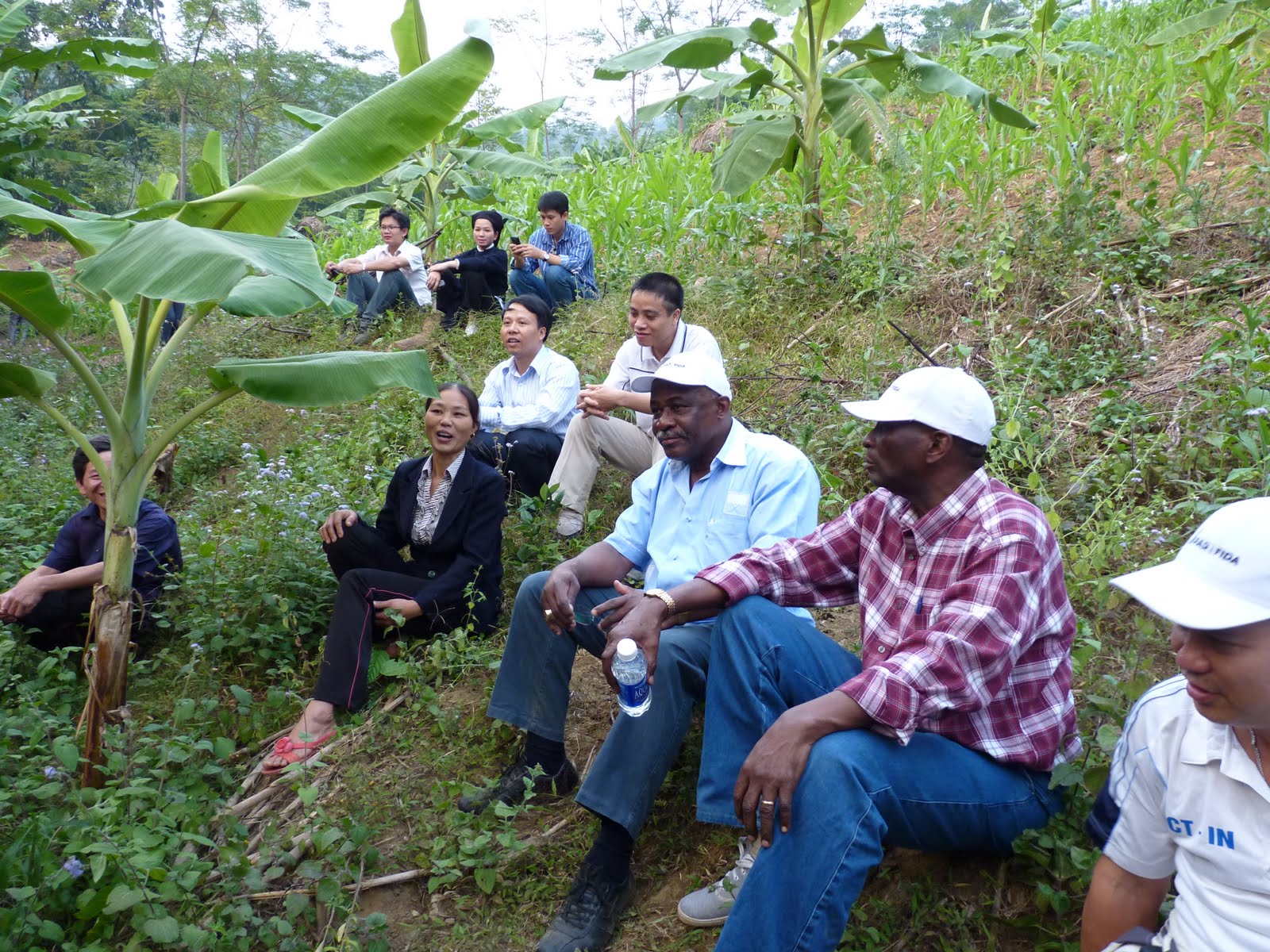
On 7 November, early in the morning, another two hours in the car and we arrived in Ba Be District where the President met and discussed with the ethnic minority women Tay in Na Kieng village and Dao in Na Mo very remote mountain areas. In Na Kieng, the women during the meeting told the President that they need to have access to credit to buy seeds and that they could benefit from training in land management, learn about new technology for planting fruit trees, and they also desperately need improved rural infrastructure such as rural road.

Talking to Mrs Vi Thi Oanh, Vice Chairwoman of the Women Committee in the Village Na Kieng, she said that with the project, 10 households are now planting water melon in the village and their incomes are considerably increasing.


When we say IFAD works in remote areas, we really mean it. When the IFAD delegation finally reached the Na Mo, we had to walk for another 1 kilometre to actually get to the village. The village is about 600 meters above sea level. Both our Vietnamese friends and colleagues and the IFAD delegation were quite tired by the time we reached Na Mo.

In a really friendly atmosphere, the Dao women warmly welcomed the delegation in the Community House. After few minutes, the ice was broken. The representative of the Na Mo women Trieu Ghen informed the President that they would also like to include in their 2011 work plan the production of vegetables, livestock. The village leader Huu Phung said that they would also like to start planting the trees as this will help to protect the land and provide a source of  increase income and give them an opportunity to replace the trees with new plants.

Dr Nwanze, the man of rice, could not be visiting Viet Nam without visiting farmers working in rice fields! Rice and the past professional life of Dr Nwanze are inseparable. When he was the Director of the Africa Rice Center for a decade, Dr Nwanze was instrumental in introducing and promoting New Rice for Africa (NERICA). Just after lunch, we moved to Dia Linh village Yin Duong Comune, another area of IFAD project.

Here, the Dao minority women and men work in rice fields. The President interacted with the owner of the land Mrs Houng who told the delegation that she has obtained the forest and land use right certificate for 50 years in her and her husband name.

Later on we moved to the mountain to see another forest land allocated to her and her husband. She used this land to plant  banana trees and maize. She told the delegation that she will sell the banana to get more money and she'll be using maize for her family consumption, to produce the local liquor and feed the livestock so she can sell the animals at better price.

She said since the land has been allocated to her, their life condition has improved. Regarding the banana plantation, the President asked about the quantity of banana she can get from each three and how long it will take for the young plant to produce banana. The western banana as they call it in Viet Nam, takes one year before it gives fruit. The President told her that she can get a new variety of banana seed from Kenya which can give more bananas in less than 9 months.

IFAD-funded project in this area will also address the issue of land to help the poorest ethnic minority women to get land use certificate.

All rural ethnic minority women the President met  were committed to take the opportunity of the 3PAD to improve their families life conditions. The President also said that IFAD is committed to continue working with them to develop innovative methods for linking poverty reduction with market-oriented agricultural and rural development.

Sunday, January 24, 2010

Basement blues


Saturday, 23 January 2010. The final day to wrap it all up. We spend the full and only day in the hotel basement, a kind of behaviour that has probably not yet been seen in Cusco, the tourism capital of Peru. Maria is back with us, having overcome the altitude sickness.

The first session, a left-over from yesterday, draws conclusions from the rural financial services in the project. The overall feeling is that the savings-based approach is very sound and sustainable, and that the combination of savings with micro-insurance, especially life insurance, is very powerful in assisting the rural poor to acquire assets while making sure no calamity throws them back to square one. It was suggested to limit the savings subsidies in time, and to include an insurance package in the savings products similarly to the credit products.

Lunch is spent preparing the innovation plans with which we hope to put the learned bits and pieces to practice in our own work, without which the entire tour is useless, as Ariel reminds us.

Making sense of it all

The Rwanda team kicks of with a joint proposal to integrate CLARs and competitions to provide capacity building grants through 2 IFAD-financed projects and one financed by Belgium. The plan would use local structures already being set up, but with a new focus on popular presentations of the proposals and results to be assessed by CLARs. An innovation would be the strong involvement of community innovation centres (CCIs) as secretariat to the CLARs supported by project staff, thereby supporting sustainability. The plan is explicit in its implementation plan, aiming at organising the first community competitions in December 2010.

Next is Venezuela. Their innovation plans promoting rural financial services, especially a savings culture, starting with a few pilot MFIs (cajas rurales), by providing subsidies to savers and additionally using competitions between savers (especially women) to allocate credit to the most performing savers that request credit. This sounds like a very interesting combination of elements of the SSDP. Marcela suggests undertaking exchange visits with Colombia.

The Colombians themselves, true ambassadors of their country, start their presentation with a publicity movie on Colombia. They continue with a talking map, evidently having learned something on the trip. It proposes:
  • a pilot activity on including cultural identity in the business promotion, also to respond to the cultural diversity of the clients;
  • the inclusion of micro-insurance with small subsidies; and
  • the promotion of local talents. Finally, Marcela from the Inter-American Institute for Cooperation on Agriculture (IICA), Colombia, plans to orient the local authorities in its development efforts, carry out exchange visits and to promote rural savings strategies.

The Irrigation and Rural Livelihoods Development Project (IRLDP) in Malawi wants to pilot some activities in 3 districts. The project team wants to move from project-driven grants for inputs and materials to CLAR-type allocation systems, include services by talents through direct sourcing in the these grants, link farmers to microfinance institutions and improve community-level marketing, and use PRAs to develop talking maps for natural resource management. Ariel suggests that convincing the authorities of the changes will be a challenge, and we propose that the project look for allies to support the cause.

Elizabeth Farmosi’s proposal is called Alliance Sierra Sur – Mother Earth. It is targeted at the Sierra Sur project, with new mechanisms for the population to access resources, alliances with public and private institutions, and improvements to the conditions of the competitions in favour of the poorer members of the participating communities. Good stuff, but possibly the recommendations are a little late for the project and can rather flow into the next design.

Maria Hartl proposes a Learning Route on rural financial services in Peru, targeted at IFAD-financed projects, IFAD staff (especially field staff) and other partners, covering savings, credit, insurance and leasing. Recommendations to Maria were to include remittances, and to match well the innovation needs and experiences available. I wonder how many of us are considering whether this should be their next route.

The final stretch is the auto-evaluation of the Learning Route, which I find really embarrassing: how can you just praise everything. In desperation, I propose organizing the background material so that it’s a little easier to work with. But honestly, the organization and contents was terrific, and now it’s on us to implement the learning plan, as otherwise Ariel will come back some day and tell us that it was all futile. I hope we can count on some ongoing support from PROCASUR and the project for that.

The last night we spend at Chicha, a restaurant specialising in refined traditional dishes. The tour ends with a fun round of surprise awards of certificates between routeros, at which it becomes clear to us that we’ve become a close group of friends that has shared a very intense experience.

I wouldn't be surprised if it turned out that this tour was the best thing I did this year.

Claus Reiner, Country Programme Manager, IFAD

Maps that can talk


Friday, 21 January 2010. After a long wait for the bus in front of our rather basic hotel on the unpaved roads of Yauri, a town that should be rich with mining revenues, we all meet for breakfast at the Katamaran restaurant with its peacocks running around outside. Bellies filled, we’re off to the Comunidad Campesina de Antaccollana, which presents its development plans that include many elements of natural resource management. A number of sub-committees manage different aspects: tractor management, irrigation, mirocredit, playschool, etc.

After this brief introduction that included not only traditional music but collective dancing, we jump in the buses to have a look at one of the small hand-dug reservoirs. Now in the rainy season, it's hard to imagine how crucial its water will be during the 9-month dry season.

As we discuss water and pasture management, our drivers turn the buses around and get them both stuck in the mud. Immediately they get different and even contradicting proposals, it seems in Africa and Latin America the approaches to this quite common situation are rather different. As the former throw stones under the wheels, the latter take them out again and replace them with grass. But somehow we push the two busses out, and continue to different families that demonstrate sound natural resource management at household level. I join the group visiting Lorenza, a lady whose exemplary improvements to her cattle, pasture, silage, compost, weaving, cooking and cheese making activities leave us all well-impressed. You name it, she's improved it.

What’s more, she goes around encouraging and teaching others all the various skills she learned from the local trainers contracted by the community. And to top it, her personal development plan, skilfully painted by her nephew, illustrates so well what she's already done and what's still up. We leave her thoroughly impressed.

Heaps of alpaca for lunch back at the Katamaran. Thereafter, it's not exactly easy to continue with a 4-person working session on the Rwanda innovation plan, with which we want to adopt the CLARs. But it's well productive, and we continue in the entire group with an analytical round on the territorial development, the talking maps and business plans. All well-appreciated tools, effectively applied by the project. Of course the group also has recommendations to make to the project team, although the heavy rain on the roof makes communication rather difficult. A particularly tough time for the interpreters.

Just before dark we board the buses for Cusco. The rid takes ages, partly due to the heavy rain, partly as the accompanying pickup has a double puncture and we stay together. I happen to be on the bus without heating, and it feels more like a mobile fridge. By midnight, we pull into Cusco, and are more than glad to be back to warmth and wireless.

Claus Reiner, Country Programme Manager, IFAD

Popular Posts