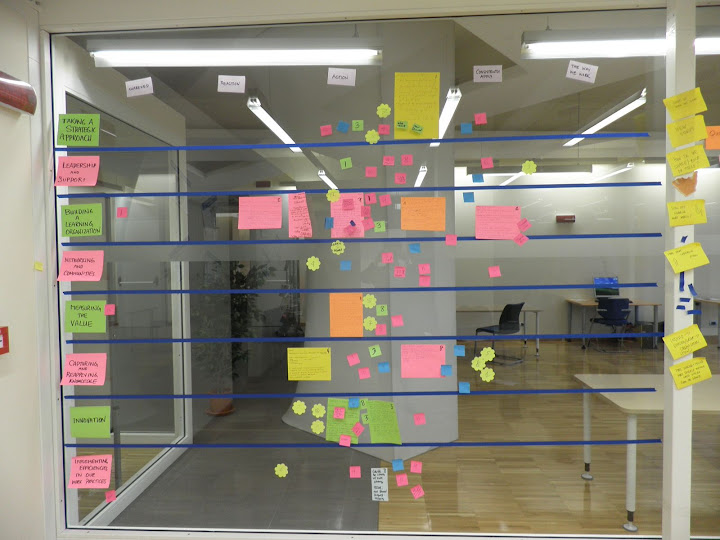
For five days, the austere and quiet Qatar Information Centre radically changed its appearance! The empty and lonely rooms were energized by a continuous flow of people. The centre became a meeting point where colleagues congregated to have a conversation and share their stories.
Every day the bare window panes came to life with beautiful drawings, colourful paper and post-its telling the story of IFAD’s knowledge management and knowledge sharing journey. In a way they reminded me of the Peruvian “talking maps”. After all, all these artefacts were telling the story of where we started, where we are and where we would like to be…. So indeed they were talking maps!
The process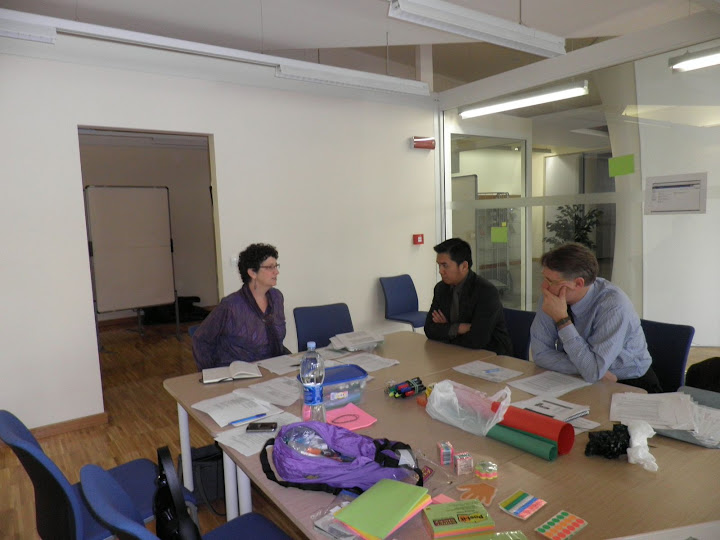
Let’s start from the beginning. Just before the Christmas holidays, the KM core team in consultation with the KM community of practice agreed that it was time to assess and reflect on the implementation of IFAD’s knowledge management strategy. Using last year’s self-assessment as a benchmark, we decided to reuse Parcell and Collinson’s KM self-assessment framework (LINK). We agreed that we needed a KM practitioner to help us with the self-assessment and got in touch with our mentor Nancy White.
Nancy and the core team had a number of teleconferences to organize the week. To set the stage and get some insight, the core team conducted numerous one-on-one interviews which were used as an input to the self-assessment exercise.
Over the course of the week we held six different sessions with a total of 50 colleagues from all over the organization and used a variety of knowledge sharing methods such as story telling, world café, after action review. It was amazing how everyone enjoyed working with these knowledge sharing methods and appreciated their utility and value. I believe the informality of the conversations allowed a lot of things which otherwise would have remained hidden to surface.
We started off on Monday afternoon with a group of 10 network and thematic group leaders. These guys acted as guinea pigs and we learnt a lot from their sessions. We used their feedback and comments to shape up the subsequent sessions.
Tuesday was an intense day. We had three sessions, starting off with a mixed group of colleagues from programme management department and communications division. The lunch session was with country programme managers and technical advisers. And we finished the day with a group of colleagues from finance, administration, communications and human resources.
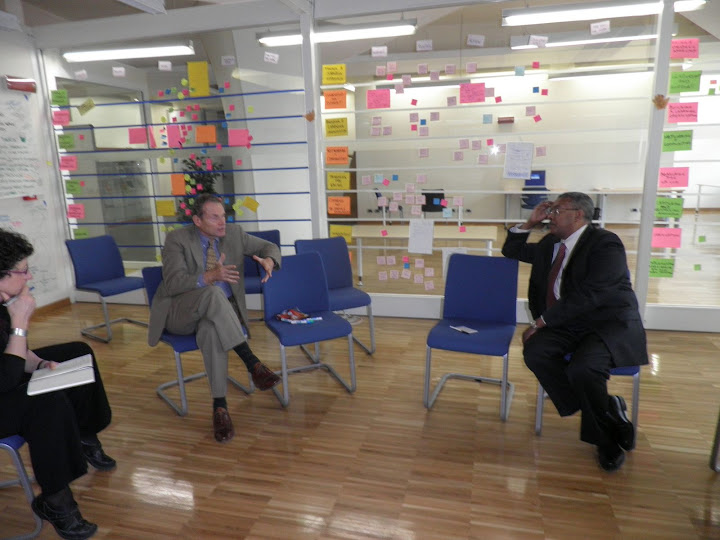
On Wednesday we had a revealing conversation with our outposted Viet Nam country programme manager and the Viet Nam knowledge management officer. In the afternoon we had a session with line managers and our new knowledge management champion, Henock Kifle.
Thursday was a reflection day and a day for Nancy to have bilateral meetings with Henock and Kevin. And finally on Friday we brought together everyone to do some “weaving” and to share the outcome and findings of the week.
Mashing up story telling and Parcell’s KM self-assessment frameworkDuring each session, participants were asked to tell a story of how in 2009 they had applied knowledge sharing to their work. We put our new toy – the cool Flipcam – to work and immortalized these stories. We now have to iron-out a small technical issue so that we can make the videos available.
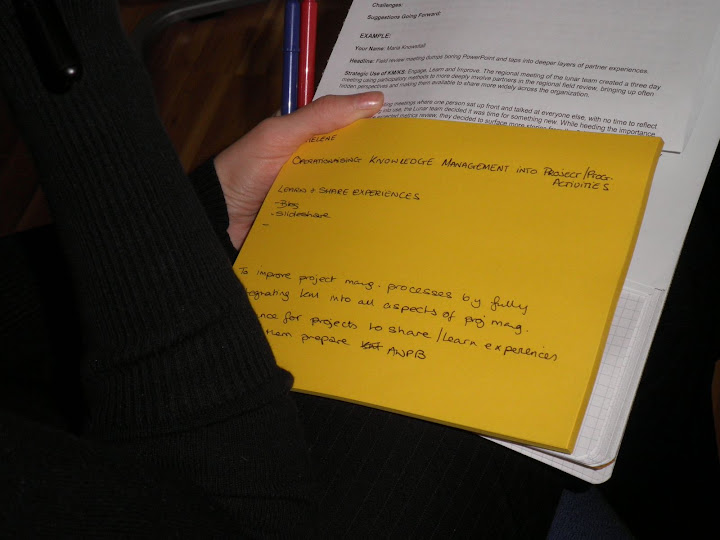
In telling their story, they were asked talk about who they shared the knowledge with, what knowledge management and/or knowledge sharing methods and approaches they used, what was their biggest challenges and what did they learn. Everyone found story telling a compelling way of sharing their knowledge.
Once they told their story, they were asked to use the KM self-assessment matrix and identify the level of maturity of their story and which of the 8 competencies best resonated with their story.
Creating a space to mingle, share and learn from each other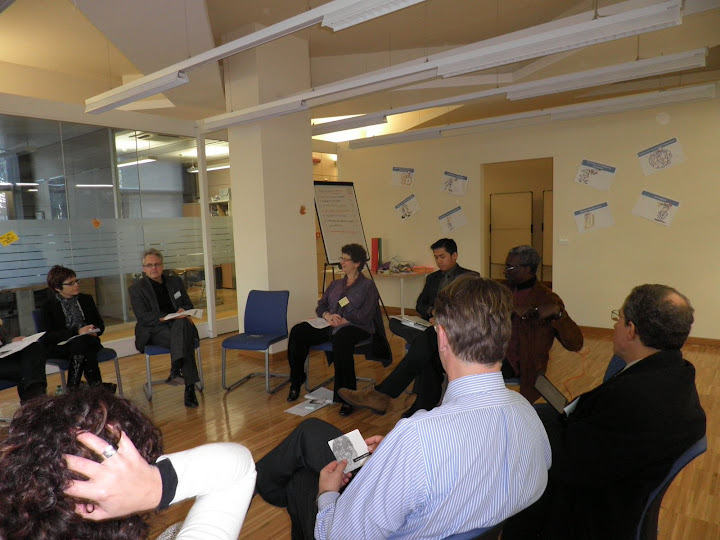
Over the course of the week, I heard 40 different stories and amazingly enough only one story was repetitive. I observed people as they told their stories and I must admit it was a rewarding experience. It was great to see people’s faces lit as they were telling their stories. I got the impression that they were so happy to have finally found someone who was giving them their undivided attention. It was amazing how everyone listened carefully to each other’s story.
What was equally amazing was that in each group, hardly anyone knew about their colleagues’ stories and when the storyteller presented his/her challenge, everyone started chiming in and providing advice and guidance based on their experience and knowledge. In one of the groups a colleague said: “I heard so many interesting stories, it is reassuring because it made me realize that we are all in the same boat”. By sharing their stories, they suddenly realized that they had lots of things in common!
This made me realize how we still lack a space for colleagues to come together face-to-face so that they can share their stories, challenges and opportunities and learn from each other.
I know we all have our informal networks and people who we use to bounce off ideas. What we’re lacking is a corporate culture of sharing and learning and a culture of sharing across functions, across divisions and departments.
I believe there is something deeper that what meets in the eye…. We use our informal networks because we trust the network members, because we know they care about us and will take the necessary time to listen to us and help us. We also do not expect them to necessarily agree with us, and we do not get on the defensive when they challenge us.
Reflecting on all the conversations during this week made me think, how seldom we walk to someone else’s office – especially someone outside of our immediate workgroup, division or department – to pick their brain or share a challenge or an achievement.
So I kept asking myself what is preventing us from expanding these informal networks so that we can leverage the knowledge of other colleagues and peers. Is it because we live in the false assumption that our challenge is unique to us or is it because we do not want to ‘disturb’ our colleagues knowing how busy they are or because we are afraid to ask for help.
I know we have brainstorming sessions and we have a culture of meeting, but I often ask myself whether our current work practices and processes are knowledge enabled. For example, how often do we go to meetings and come out saying “Gee that was a useful meeting, I learnt a lot and had an opportunity to share what I know”. How often do we experience mutual learning? How often do we say ‘I do not know, I need to learn’ and how often do we say ‘I do not know and I do not need to know’? Finally what is preventing us from taking time to stop, reflect and share what we’ve learnt before embarking on the next project and/or activity?
Level of KM maturity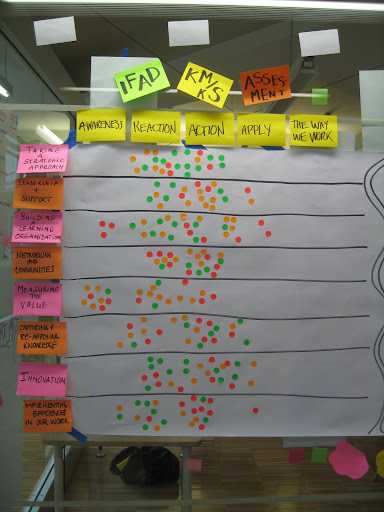
In our wrap-up session on Friday morning, we asked the participants to use the KM self-assessment framework to indicate the KM maturity level. It was good to see that for most of the competencies the collective wisdom ranked our KM maturity at “action” level. I believe that this year contrary to last year there was more awareness about what knowledge management and knowledge sharing is all about. This makes me believe that this year’s assessment reflects much more the reality.
Reflecting back on the week, I now firmly believe that the strategy has fulfilled its mission. As Nancy put it, developing the KM strategy helped us to become aware of knowledge management and knowledge sharing. The strategy itself was a reaction to a need and by implementing it we entered the action mode. Now, we need to consistently apply it so that it becomes our way of working. We know that some are applying but we’re not all applying at the same time and that the application waxes and wanes. We also know that there are isolated and small pockets where KM/KS is the way of work.
Tension between operations and service divisions and organizational silos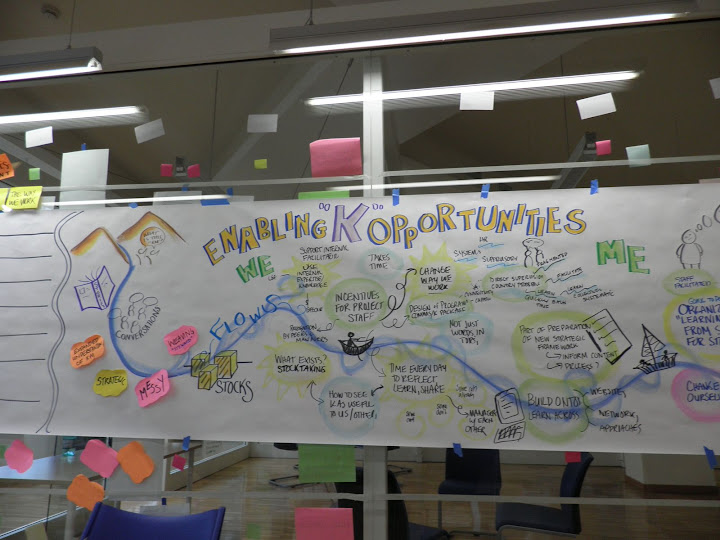
During the course of the week time and again colleagues talked about the vertical and horizontal silos. Everyone acknowledged that while some sharing happens within work units, this is not necessarily the case between and among work units, divisions and departments. So we agreed more horizontal sharing need to happen so that we can all learn from each other – and this “all” is not just operations colleague, but everyone.
Colleagues identified that there is a divide between operations and the rest of the house. As someone put it eloquently, service divisions are not considered as strategic partners. Actually, even worse, they are often seen as a nuisance.
At the same time, it was interesting to see the different perceptions and how people perceived their role as knowledge worker and the application of knowledge differently. There is a quite a bit of different interpretations of “packaging knowledge” to make it digestible and accessible (not only in terms of finding it but most importantly of understanding it!).
We all agreed that KM is messy, we need to do a lot of connecting and weaving.
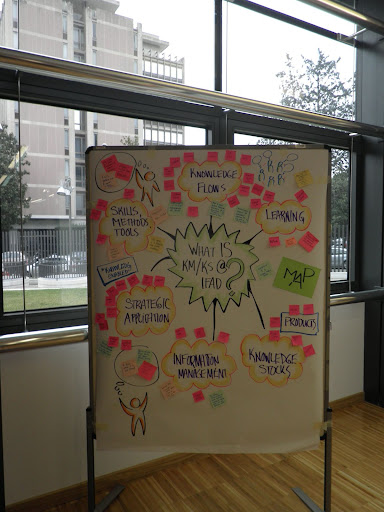
By the end of the week, the knowledge management and knowledge sharing map at IFAD looked like this:
 Soundbits, comments, observations
During the course of the week colleagues made very insightful remarks and at the same time they raised a number of issues. I am listing these in bullet format. This list is by no means comprehensive and I urge KM core team, Nancy and all those who participated to add and amend it as deemed appropriate.
- A mistake made is knowledge gained
- Knowledge dies if it is not shared
- There are many untold stories, how can we make sure they are shared and heard
- We need to move away from the blame culture
- Organization needs to accept failure… the important thing is that we learn from it
- By sharing knowledge we realize we’re not alone
- We have too many formal things to do and do not have time to do KM stuff
- KM is not part of our core function
- Knowledge is driven by hierarchy and this hinders natural knowledge flow
- There is little or no incentive to share
- Distilling information is a challenge
- Humility to learn form others
- Storage and retrieval is deemed as a general service function
- Tools are important to make sure knowledge flows
- Trust and interpersonal relationships can help or hinder knowledge flow
- Need to communicate more horizontally to foster knowledge sharing
- Need to capture scattered knowledge
- Need to acknowledge that everyone’s knowledge counts
- Need to understand that systems, tools and knowledge assets serve different purpose and needs, which means that if I am not using a system, this does not mean it is useless as it probably is useful for someone else
- How can we better digest, mine and make sense of knowledge and lessons emerging from our activities
- Reward KM initiatives, be it that they are corporate or at grassroot level
- Make our corporate processes knowledge enabled
What next
To move ahead, I believe we need to better understand how relationships between people and groups can facilitate or hinder knowledge flows. In the manager group, it was interesting to see how each one perceived KM differently and made assumptions on what was important for someone else or what others needed or wanted. In the conversation with Atsuko – who is one of our few outposted country programme managers – I was shocked to find out that she was not consulted in formulating the guidelines for outposted CPMS and equally shocked that she was not regularly in touch with and consulting with her other outposted colleagues.
I think the time we’ve reached a juncture where we can benefit from a social network analysis (SNA). SNA is about understanding who people seek information and knowledge from, whom they share their information and knowledge with. In contrast to an organization chart which shows formal relationships, an SNA chart shows informal relationships - who knows whom and who shares information and knowledge with whom. It therefore allows visualizing and understanding the relationships that can either facilitate or impede knowledge creation and sharing.
The other big next steps are:
- Creating an enabling environment where everyone’s knowledge is valued and create a space for colleagues to come together, share and learn from each other
- Embed knowledge management in strategic framework 2011-2014 to ensure that we can both bring in and generate the knowledge we need
- Review corporate processes and make them more KM enabled
- Examine information management flows and take stock of information assets
A personal reflection
Last week was a rewarding experience. I not only learnt a lot, I also appreciated the importance of weaving and connecting strands. I must admit I am left with more questions and doubts than answers. But as Bertrand Russell said: “The trouble with the world is that the stupid are cocksure and the intelligent are full of doubt.” So anyone out there willing and ready to help…. Give a shout!
 Ever since I embarked on knowledge management and knowledge sharing journey, I've been struggling to find convincing metrics to assess impact of KM/KS activities. In October 2009, I wrote this blogpost: "KM search and rescue operation: Looking for intelligent and KM-enabled indicator!" and got some good feedback. But it still was not quite the convincing indicators I was looking for.


 For five days, the austere and quiet Qatar Information Centre radically changed its appearance! The empty and lonely rooms were energized by a continuous flow of people. The centre became a meeting point where colleagues congregated to have a conversation and share their stories.
 Let’s start from the beginning. Just before the Christmas holidays, the KM core team in consultation with the KM community of practice agreed that it was time to assess and reflect on the implementation of IFAD’s knowledge management strategy. Using last year’s self-assessment as a benchmark, we decided to reuse Parcell and Collinson’s KM self-assessment framework (LINK). We agreed that we needed a KM practitioner to help us with the self-assessment and got in touch with our mentor Nancy White.
 On Wednesday we had a revealing conversation with our outposted Viet Nam country programme manager and the Viet Nam knowledge management officer. In the afternoon we had a session with line managers and our new knowledge management champion, Henock Kifle.
 In telling their story, they were asked talk about who they shared the knowledge with, what knowledge management and/or knowledge sharing methods and approaches they used, what was their biggest challenges and what did they learn. Everyone found story telling a compelling way of sharing their knowledge.
 Over the course of the week, I heard 40 different stories and amazingly enough only one story was repetitive. I observed people as they told their stories and I must admit it was a rewarding experience. It was great to see people’s faces lit as they were telling their stories. I got the impression that they were so happy to have finally found someone who was giving them their undivided attention. It was amazing how everyone listened carefully to each other’s story.
 In our wrap-up session on Friday morning, we asked the participants to use the KM self-assessment framework to indicate the KM maturity level. It was good to see that for most of the competencies the collective wisdom ranked our KM maturity at “action” level. I believe that this year contrary to last year there was more awareness about what knowledge management and knowledge sharing is all about. This makes me believe that this year’s assessment reflects much more the reality.
 During the course of the week time and again colleagues talked about the vertical and horizontal silos. Everyone acknowledged that while some sharing happens within work units, this is not necessarily the case between and among work units, divisions and departments. So we agreed more horizontal sharing need to happen so that we can all learn from each other – and this “all” is not just operations colleague, but everyone.

