Showing posts with label partnerships. Show all posts

Thursday, February 23, 2012

#ifadgc leitmotif: Transformative partnerships


 By Cheryl Morden
 
If the theme of this year’s Governing Council (GC) focused on smallholders and sustainable agriculture, a central leitmotif was surely partnerships.  The issue was with us from the start when the President, in the opening session, described partnership as IFAD’s modus operandi and underscored that our most important partners are the farmers themselves.  

The need for partnerships was often cited when GC panelists and participants talked of the complexity of effective poverty-reducing, health-sustaining, and planet-protecting agriculture and rural development.  “Effective solutions require enormous coordination,” said one delegate.  As an example, Pamela Anderson, Director General of the International Potato Center (CIP), told of an initiative in Peru that brought together diverse actors to generate new ideas for marketable agricultural products.  The idea of making potato chips from native potatoes drew the interest of Pepsico and their engagement resulted in a doubling of potato prices at the farm gate and a doubling of smallholder productivity within four years.  This illustrates the kind of  transformative partnerships that can help smallholders move from subsistence to market-oriented production that were called for earlier by Rwandan President Paul Kagame.

Much of the GC discussion pointed to the importance of getting on the same page regarding the appropriate, value-adding role of each of the many actors involved in agriculture and rural development.  The critical role of the private sector was emphasized repeatedly by representatives from farmers organizations, governments, NGOs, and the world of research.  

A host of private sector business opportunities were cited, from financial services to transportation to technical assistance to marketing and processing.  Bruce McNamer, President of Technoserve, challenged us to look for these opportunities further down the value chain – “crowding in” profit-making activities at each link in the chain.  

Governments have an equally critical role to play within the transformative partnerships that we seek.  Both Nigeria’s Agriculture Minister, Akin Adesina, and Mexico’s Ambassador, Miguel Ruiz-Cabañas, insisted that national governments must lead the process, providing enabling strategies and investment in essential public goods and research.   Governments may also need to provide investment that catalyzes private sector involvement that benefits smallholders, such as instruments for risk mitigation.

And the role of IFAD?  Among other things, IFAD can be a broker to help foster relationships and collaboration among disparate actors.  And, suggested the Turkish Agriculture Minister Mehmet Mehdi Eker, at a global level, it can join with others in the UN system to provide leadership that creates the necessary support for the efforts of member states and, most importantly, for farmers.

Our new Partnership and Resource Mobilization Office is gearing up to help IFAD more fully realize its partnership and leadership potential.  The Governing Council meeting has provided ideas, energy, and inspiration to accelerate our own contribution to transformative partnerships to feed the world and protect the planet.

Monday, January 30, 2012

The Private Sector Development Strategy back story

From Mylene Kherallah of IFAD's Policy and Technical Advisory Division:

“Oh no, not again” was my first reaction when asked to lead the preparation and write-up of IFAD’s new Private Sector Development Strategy. I had already been through that experience in 2005 for the old strategy, and it was not exactly a pleasant memory.
A programme in Sri Lanka links smallholder farmers with
private-sector partners. © IFAD/G.M.B. Akash
The purpose of the strategy was clear enough: to help create new markets and opportunities for poor rural people by deepening IFAD’s engagement with the private sector. And it was not the writing that I minded. It was trying to obtain the consensus across the house through the various committees and getting the approval from the Executive Board that was the most daunting task.

Having to go through endless revisions, and incorporating comments that often contradicted each other, was an agonizing process – especially since the word “private sector” was interpreted differently by various people involved.

But how can you say “no” when a senior manager asks you to do something? So, building on my previous experience, I decided that the best way to handle this was to (a) take it one step at a time; (b) seek help and lots of it; and (c) use this occasion to improve my ability to listen, tolerate different views and develop my sense of humour under duress. Not sure I succeeded in applying point (c) at all times, but at least I tried.

Despite my apprehensions, I have to say that it was not as painful as I thought it would be. Despite a contentious informal seminar, a pre-feasibility study that was conducted in an extremely rushed timeframe, and a failed, long-winded attempt to circumvent official procurement procedures for the study (shame on me), the strategy was approved at its first submission to the EB in December 2011. My worst fear was that they would ask us to revise and come back again at another EB meeting, which is what happened for the previous strategy. But not this time!

In retrospect, I think several things made it work:
  • enough lead time – we started work early in January 2011 and therefore had enough time to “take it one step at a time” between organizing a Policy Reference Group, writing various drafts and PowerPoints, getting feedback, seeking consensus in-house and obtaining the various approvals;
  • a Policy Reference Group made up of a diverse mix of committed IFAD staff, which really made it happen – aside from the technical and strategic guidance, it was a fantastic moral support group;
  • communication and consultations with other staff and external stakeholders, which improved our knowledge in this area; and
  • the Senior Manager’s (Kevin Cleaver’s, in this case) constant guidance and support, quick responsiveness and his great sense of humour, which helped keep everything in perspective.

Friday, May 27, 2011

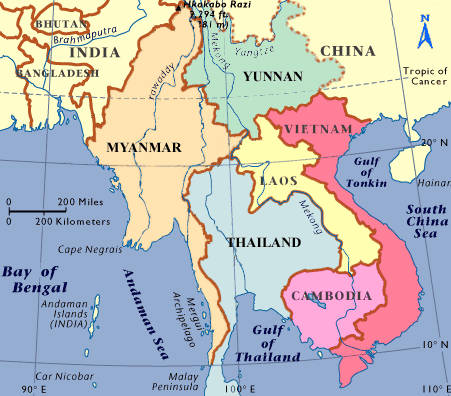
IFAD potential involvement in the Working Group on Environment in the Greater Mekong Region: scope and added value

On May 24-25, we attended the 17th Annual Meeting of the Great Mekong Sub-region (GMS) Working Group on Environment (WGE) in Siem Reap, Cambodia, during which the Core Environment Program 2012-2016 for the Sub-region was discussed. While IFAD has been participating to the Working Group on Agriculture for several years, this was the first time that our organization has been invited to attend the Environment Working Group.
This was notable for at least two reasons. First, the recognition by the WGE of the strategic importance of the agricultural sector in achieving the objectives of the Core Environment Program, and - consequently - of the need to involve partners that do not ‘strictly’ belong to the ‘environmental constituency’ in the Group. Second, the implicit recognition of the increasing role that IFAD is playing in promoting sustainable agriculture and climate-resilient investments.
At the end of the two-day meeting, the following are the key points that define the scope for and the added value of IFAD’s possible involvement in the partnership:
(1)  IFAD ongoing portfolio in the sub-region includes a significant number of operations that already support, directly or indirectly, the strategic objectives of the Core Environment Program (e.g. the Sustainable Natural Resource Management and Productivity Enhancement project in Laos, or the Pro-Poor Partnership for Agroforestry Development in Vietnam), thus providing a potential for co-financing or parallel financing;
(2)  When IFAD existing or planned portfolio in the sub-region does not directly support the objectives of the Core Environment Program, it often provides a baseline upon which additional financing/co-financing can easily generate environmental benefits;
(3)  In a context in which most of the existing resources focus on supporting ‘soft’ activities, IFAD’s added value stands in the fact that its resources could be used to finance ‘hardware’ and on-the-ground activities.

Sunday, November 15, 2009

IFAD and the Islamic Development Bank reach a landmark cofiancing agreement

On the eve of the World Summit on Food Security, the International Fund for Agricultural Development (IFAD), and the Islamic Development Bank Group (IsDB) have reached a groundbreaking US$1.5 billion framework cofinancing agreement that will strengthen their 30-year collaboration in supporting the world’s poorest people in common member countries. The agreement – the result of talks held in Rome today between Ahmad Mohamed Ali, President of IsDB, and Kanayo F. Nwanze, President of IFAD – comes at a critical moment, when the international community has recognized that agricultural development is fundamental to feeding the world’s population. Today, sustained investment in agriculture – especially smallholder agriculture – is acknowledged as the key to food security.

Using their own resources, IFAD and IsDB will jointly finance priority projects in most of the 52 common member countries under their respective three-year lending programmes for 2010-2012. The two institutions hope that this cofinancing arrangement will attract additional funding from other development partners for joint interventions. With their shared objectives in the field of agriculture and rural development, the two institutions will focus their efforts on increasing productivity, yields, processing capacities and access to markets. Microfinance, combined with capacity-building and technology transfer, will enable hundreds of thousands of project beneficiaries to undertake a multitude of microenterprises and income-generating activities. IFAD and IsDB are committed to working together to improve rural infrastructure, promote local economic development and enhance food security.

Popular Posts