Showing posts with label rural development. Show all posts

Monday, January 30, 2012

The Private Sector Development Strategy back story

From Mylene Kherallah of IFAD's Policy and Technical Advisory Division:

“Oh no, not again” was my first reaction when asked to lead the preparation and write-up of IFAD’s new Private Sector Development Strategy. I had already been through that experience in 2005 for the old strategy, and it was not exactly a pleasant memory.
A programme in Sri Lanka links smallholder farmers with
private-sector partners. © IFAD/G.M.B. Akash
The purpose of the strategy was clear enough: to help create new markets and opportunities for poor rural people by deepening IFAD’s engagement with the private sector. And it was not the writing that I minded. It was trying to obtain the consensus across the house through the various committees and getting the approval from the Executive Board that was the most daunting task.

Having to go through endless revisions, and incorporating comments that often contradicted each other, was an agonizing process – especially since the word “private sector” was interpreted differently by various people involved.

But how can you say “no” when a senior manager asks you to do something? So, building on my previous experience, I decided that the best way to handle this was to (a) take it one step at a time; (b) seek help and lots of it; and (c) use this occasion to improve my ability to listen, tolerate different views and develop my sense of humour under duress. Not sure I succeeded in applying point (c) at all times, but at least I tried.

Despite my apprehensions, I have to say that it was not as painful as I thought it would be. Despite a contentious informal seminar, a pre-feasibility study that was conducted in an extremely rushed timeframe, and a failed, long-winded attempt to circumvent official procurement procedures for the study (shame on me), the strategy was approved at its first submission to the EB in December 2011. My worst fear was that they would ask us to revise and come back again at another EB meeting, which is what happened for the previous strategy. But not this time!

In retrospect, I think several things made it work:
  • enough lead time – we started work early in January 2011 and therefore had enough time to “take it one step at a time” between organizing a Policy Reference Group, writing various drafts and PowerPoints, getting feedback, seeking consensus in-house and obtaining the various approvals;
  • a Policy Reference Group made up of a diverse mix of committed IFAD staff, which really made it happen – aside from the technical and strategic guidance, it was a fantastic moral support group;
  • communication and consultations with other staff and external stakeholders, which improved our knowledge in this area; and
  • the Senior Manager’s (Kevin Cleaver’s, in this case) constant guidance and support, quick responsiveness and his great sense of humour, which helped keep everything in perspective.

Tuesday, November 29, 2011

Smallholders critical to reigniting rural development in Asia #globaldev


By Thomas Rath, Country Programme Manager, Asia and the Pacific Division 

Rural poverty has declined throughout Asia and the overall economic performance has increased. Agricultural development has played a major role in these improvements with smallholder farmers in the lead. Around the world they already feed almost a third of the world’s population and produce 80 per ent of the food consumed in the developing world. But we need to take smallholder agriculture to the next level to make sure rural communities can play an important role in producing enough food for a growing population.

A good opportunity for Asian smallholders to boost their productivity and increase their incomes coincides with an important change in the Asian food retailing market. Supermarkets with global links have emerged, particularly in South East Asia, responding to changes in life styles, the liberalization of retail trade and the entry of foreign direct investment in Asia-Pacific countries. By 2015, supermarkets in China are expected to reach 62 per cent market share, while Malaysia is expected to reach 61 per cent, Thailand 48 per cent, and the Philippines 36 per cent.

Supermarket chains can offer farmers better deals – higher prices and greater certainty of selling the product than traditional supply chains. But in return farmers are obliged to meet stringent quality requirements and adhere to food safety standards. Also supermarkets usually prefer dealing with few large farmers rather than many small farmers.

Producers’ associations or cooperatives can help small producers gain a footing in international food retailing. Belonging to an organized group allows them to bulk produce, reduce costs through economies of scale and, perhaps most importantly, to strengthen their bargaining power with private-sector actors. Membership can also bring access to financial, processing and business service. All of which are key to empowering farmers to deal with the private sector on a more level playing field.

One of the most well-known producer organizations in Asia is the Indian dairy cooperative. It comprises 12 million members, including landless labourers and women, and produces 22 per cent of India’s milk supply. In China, a group of small scale growers, aided by the local government, formed the Ruoheng watermelon cooperative, which then sold directly to wholesalers, retailers and supermarkets. Due to its timely delivery, quality, and marketing success, the cooperative’s membership increased from 29 to 152, and its farmed area increased from 0.2 hectare in 1992 to thousands of hectares in 2005.

The ability of smallholder farmers to increase their production in a sustainable way is enormously important. Not only to further reducing rural poverty in Asia, but also to feeding the world’s growing population and resolving pressing environmental and climate challenges. Enabling smallholder farmers to benefit from the proliferation of supermarkets and export opportunities in the region can set the stage for new progress in overcoming rural poverty and hunger in Asia. Our focus should be on helping them develop the knowledge and the other tools they will need to do precisely that.

Originally posted on Business fights poverty blog

Friday, July 8, 2011

Pakistan: Successful stories from the IFAD funded AJK Community Development Program (AJK CDP)


This video provides an overview of the achievements of the IFAD funded Community Development Program in Azad Jammu & Kashmir (AJK), Pakistan.
Through a series of interviews to the beneficiaries, the video shows concrete examples of how rural poor, particularly women, have benefited from the Program and successfully managed to improve their quality of life.
More on the Program in a few days, in another post.

Thursday, June 30, 2011

Once a fisher always a fisher? Maybe not....

WOW, I had one of the most productive days in a long time. It was a day with no meetings, no emails, no phone calls, no deadlines and no process work. Wondering why it was so productive?

Well, I had the privilege of spending an entire day meeting and listening to the stories of smallholder producers who benefitted from the IFAD-funded Participatory Artisanal Fisheries Development Support Programme, better known as PADPPA.

Ndaya Beltchika, was appointed as the country programme manager for Benin in 2010. In closing PADPPA she took the bold step of documenting the success and challenges of this programme so that others could avoid making the same mistakes and reinventing the wheel.

Kudos to Beltchika, as she is a true knowledge worker and one of the few people I’ve worked with who fully appreciates the power and potential of learning both from successes and failures.

I think it is fair to say that PADPPA has both impressive achievements and faced massive challenges.

It was approved in 2003 and has a 50-50 cofinancing arrangement with African Development Fund (AfDF).

It took over two years before it started its operations in 2005. For the first four years it only disbursed 10.13%, which classifies it as a poor-performing project.

“One of the major challenges of PADPPA was the 50-50 cofinancing arrangements between AfDF and IFAD”, says Gerard Gnakadja, the National Coordinator. “If I had to redo the project, I would strongly recommend against such an arrangement and would have each donor fully finance a component thus making implementation more efficient and effective.”

The turning point was in 2009, when IFAD started supervising its own projects and providing direct implementation support. As a result, literally overnight there was a boast in the project activities and in just a little more than two years the disbursement rate increased from 20.47% to 50.53%.

The programme is coming to and end. Over the last eight years, it has focused on strengthening the fisheries sector in Benin by:


  • rehabilitating wetlands and lakes to increase fishing opportunities
  • strengthening fisher’s community and building their capacity to better manage the fisheries resources and other natural resources
  • encouraging fishers to take up alternative income generating activities


My productive day started with meeting three extraordinary smallholder producers who had given up fishing for other types of income generating activities.

Agriculture is cool: Meet Paul Allognon, the fisher who became a farmer

Paul Allognon, once a fisher, today thanks to the programme is a successful smallholder farmer. He is one of the 200 fishers who received training on agriculture-related activities offered by the Vice-President of the Agricultural Chamber, Adjehoda Amoussou, and his colleagues.

“Usually these training sessions last between 15 to 30 days and afterwords, the project provides extension services and monitors the farmers to make sure they apply what they learnt”, explains Amoussou. “However, the PADPPA trainees benefitted from an abridged version of the training and from what I understand not all of them received the post training backstopping”.

Although Allognon did not benefit from the full training programme, however, he learnt the basic agricultural practices such as rotating crops, when to plant what, when and how to use fertilizer, when to harvest and how and where to market and sell his produce. Understanding the importance of a good irrigation system, he installed a water pump and has a CFA350,0001 irrigation system on his land.

As a result, Allognon is now cultivating onions, tomatoes, pepper, parsley and cucumber.

“The village ladies visited me a couple of weeks ago and asked for onions. This is why we’re planting them now”, explains Allognon. “I plant based on needs, this way, I hardly ever have any surplus.”

On this farm, Allognon has a number of coconut palm trees which are another source of income. “I sell the coconut oil for CFA500 per litre. Every three months on average I manage to produced 120 litres of oil”, mentions Allognon.

“I dry the shell which is then used as firewood. The shell is also on high demand by the ladies who are in fish smoking business and also as animal feed”, says Allognon with a smile.

By embracing agriculture, Allognon has managed to triple his income. He is now able to offer employment to six other people and can afford paying them CFA15,000 per month.

“I would never go back to fishing. Believe me, fishing is not worthwhile. You go out to the sea at crack of dawn, stay out 3-5 days or if you make day trips, you come back at dusk and with what? What a basket full of small fish”, remarks Allognon.

Thanks to a steady income, Allognon is able to send all his 9 and 4 year old children to school. He has managed to buy an 2000 m2land, and is in the process of building a house for his family.

Reflecting on PADPPA’s achievements, Olivier Vigan, Secretary-General of the Ministry of Agriculture, Livestock and Fisheries observed: “Only if we could have changed the mindset of many more fishers, that would have made this programme a success”. “In retrospect, we should have had many more awareness building programmes and prepared the fishers psychologically to convert from fishing to other acitivities”.

I wish, the programme would have used people like Paul Allognon as mentors to show the benefits of embracing agriculture and engaging in agriculture-related projects. And yes, more awareness building and proactive actions to change the fisher’s mindset would have definitely resulted in many more fishers converting to agriculture, rabbit farming or other income generating activities.


Rabbit farming: a viable alternative to fishing

On this very special day, after meeting Paul Allognon, I met Rose Mensah and Kuassi Oke, two former fishers who are now fully emerged and engaged with rabbit farming.

Mensah lives by Aeheme lake where she used to be a fish wholesaler. However, the lake’s fish stock has depleted significantly, thus making fishing a risky business. Mensah was lucky to benefit from PADPPA’s rabbit farming activities. In 2007, PADPPA gave her three female and 1 male rabbit.

In a month’s time she had 18 rabbits and ever since then, it has been a growing business. Today she has over 200 rabbits and can count on a steady flow of 30 rabbits per month.

Thanks to her new activity, she has 20 fixed clients - among which some hotels in Cotonou. On average she makes CFA100,000 a month.

“I sell the rabbits for CFA3000. Thanks to the money I make from my rabbit farm, not only I am able to feed the family, send the children to school, but I am also able to put aside at least CFA10,000 a month”, explains Mensah.

Mensah’s vision is to be able to build another big rabbit pen. “But to do that I need one million CFA and I need to able to get a loan. And that is not an easy thing to do.”

Kuassi Oke, a 55 year old rabbit farmer, has an equally thriving farm as Mensah’s. He too in 2007 received 3 females and 1 male and ever since then, he’s gone from success to success.

Oke is a real businessman. To ensure that he has a steady stock, he has put in a place a bullet proof reproduction scheme. “I have 25 females. Each month I have half of them reproduce. This way, the females get a rest every other month and on average I have 115 new rabbits.”

He manages to sell 50 rabbits a month to clients in major cities, hotel owners and in to people in his village. As a true businessman, he has fixed price - CFA3000 per rabbit - and does not provide any preferential treatment to his fellow villagers!

Thanks to his new activity, he is able to provide a good life to his 19 children, three wives and has a monthly saving of CFA40,000. Realizing that not everyone has been lucky as him, to help others, he has created a village saving scheme where on a monthly basis he deposits some of his savings which is used to assist villagers in moments of dire need.

Initially the villagers were a bit intrigued and suspicious of his activity. But, today, thanks to his flourishing business, he has earned a social status. He is now providing rabbit farming training to interested villagers and is the adviser to the village chief.

He has put in place a succession plan by training two of his sons which will take over from him, when and if he decides to retire!

Oke has expanded his business to poultry and is looking forward to be able to buy himself a motorcycle.

New frontiers for rabbit farming: Processing and packaging

One would hope that sooner rather than later Mensah and Oke will learn how to add value to their rabbit farming business by embracing some processing activities. Hopefully, they will be able to access credit, challenging as it may be, so that they can acquire the necessary skills and set up the infrastructure needed for processing, packing and selling rabbit meat.

It would have been nice if PADPPA had seized this opportunity and offered these sterling entrepreneurs the opportunity to add value to their rabbit farm by exposing them to the processing and packaging world.

Keeping close to “Centre de miracle”


As we were driving back, I thought to myself, WOW, what a great day. Would it be possible to replicate this miracle every day? I guess if I keep close to this “Centre de miracle”, I will have a good chance of experiencing it over and over again.

I wonder what will my boss think, if I call or send an email telling her that I have found a new vocation and do not want to leave?

I’ll be covering the story of fishers on the next series of PADPPA blogposts. So, keep on eye on this space. More to come. For now, goodbye and good night.

$1=44CFA

Wednesday, June 8, 2011

The silent crisis

by Cheryl Morden

Hunger is sometimes called the silent crisis. Silent crises are the ones that are overlooked, crowded off the front pages by late-breaking news. Years of experience tell us that when hungry people are silent, they go unnoticed by the rest of the world. Apparently, to become a real and present crisis, those of us with full bellies need to be shaken awake.

In 2007-08, the world was roused to the plight of hungry people by street riots protesting skyrocketing food prices in some forty countries. And there is reason to believe that rising food prices have also been a factor in the uprisings that have spread across the Middle East. The food riots of 2007-08 prompted the world to focus attention on agriculture in a way that it had not done for twenty-five years or more. So, when hungry people and their supporters stop being silent, things happen.

As the U.S. budget stalemate persists, concerned U.S. leaders and advocates are breaking the silence of hungry people by themselves going hungry. They are trying to ensure that cutting programs that support poor and hungry people around the world is not the easy and uncontested way to balance the budget.

Who are these poor and hungry people? The cruel irony is that small-scale farmers account for half the world’s undernourished people and the majority of those living in absolute poverty and in marginal ecosystems. And at the same time, in a world that needs to increase food production by 70 percent by 2050 while dramatically reducing greenhouse gas emissions, these small-scale farmers represent a vast, undertapped potential.

When the President of the International Fund for Agricultural Development (IFAD), Kanayo Nwanze, took office in 2009, the first message he sounded to the world was a plain and unvarnished one: “Poverty and hunger are inhuman and cannot be tolerated.” While holding to that truth, he has since added another: “Every farm, no matter how small, is a business.” This focus on the business dimensions of agriculture and food production recognizes the critical importance of dynamic agricultural markets for sustainably overcoming rural poverty and hunger.

IFAD’s business is investing in projects that enable small-scale farmers to ensure adequate food for their families and increase their income. Targeted investments in gravity-piped water facilities and wells in dryland communities in Ghana, for example, mean that women like Elizabeth Wanjiru, who lives in the Kiambu District, can now fetch in two minutes the clean water that used to take six hours each day to fetch. With more time and training in improved farming practices, Elizabeth has moved from subsistence production to a profitable and more environmentally sustainable enterprise.

This kind of investment in self-reliance resonates deeply with American culture and ethics. Since its founding more than thirty years ago, IFAD has reached some 300 million poor producers like Elizabeth Wanjiru. And, with the encouragement of member states and contributors like the US, IFAD has been achieving steadily greater impact with each dollar it invests.

It’s time we better understood how intimately our future is linked with that of poor rural people the world over. Investments today in enterprising, small-scale farmers will pay dividends for generations.

Originally posted on HungerFast.org

Thursday, February 17, 2011

IFAD strengthens its partnership with indigenous peoples #ip2011

Indigenous peoples have repeatedly asked for a more systematic dialogue with United Nations agencies. In response to this request, IFAD has taken a series of initiatives in the past seven years and accumulated valuable experience in establishing constructive dialogue with indigenous peoples.

In 2009 IFAD developed its Policy on Engagement with Indigenous Peoples. The policy proposed to establish an Indigenous Peoples’ Forum as a concrete attempt to institutionalize a process of consultation and dialogue with indigenous peoples’ representatives at the national, regional and international levels.

From IFAD’s perspective, the objectives of such forum is to:
  • share and discuss the assessment of IFAD’s engagement with indigenous peoples among IFAD staff, Member States and indigenous peoples’ representatives;
  • consult on rural development and poverty reduction; and
  • promote the participation of indigenous peoples’ organizations in IFAD’s activities at the country, regional and international levels.

On Thursday 17 February, approximately 100 people participated in the workshop establishing indigenous people's forum. The indigenous delegated kicked off the meeting with a traditional ritual of blessing and calling on the spirits of different regions for guidance.


In his welcoming address, IFAD's President, Dr Kanayo Nwanze, reiterated that indigenous peoples have a "vast well of untapped potential, with unique forms of knowledge, practices and understanding of ecosystem management."

"Indigenous peoples’ ancestral memory is a storehouse full of thousands of different species capable of responding to new challenges and climatic conditions – just as they have done for centuries before", said Nwanze

"And we must place special emphasis on creating opportunities for the young people of indigenous communities. Theirs is a special challenge: to build a bridge between their rich cultural heritage and the demands and opportunities of today’s world. As was described in the Kari-Oca Declaration of 1992, they must be able to walk to the future in the footprint of their ancestors."

Dr Nwanze concluded that "We must listen to each other, learn from each other, and work together – today, tomorrow, and many days into the future."

Kevin Cleaver talked about IFAD's engagement with indigenous peoples, underscoring the importance of access to ancestral land and other natural resources such as water, forest. IFAD colleagues  gave an overview of situation and status of indigenous peoples in Africa, Asia and Latin America. Victoria Tauli-Corpuz, executive director Tebtebba Foundation and former Chair of the UNPFII gave a history of IFAD's engagement with indigenous peoples.

Mirna Cunningham, director of the Center for indigenous peoples’ autonomy and development and Member of the UNPFII, talked about how the important role indigenous peoples in producing food to ensure food security.  She complimented IFAD for giving indigenous peoples a voice.

Later during the day, in an interview, Mirna outlined the challenges and opportunities facing indigenous peoples. We immediately posted the interview on Facebook and tweeted about it. Some of our fans have asked us to add Spanish subtitles. We'll definitely do so!


The participants spent the rest of the day discussing issues and options for the forum's modalities, organization, participation and governance. They will be sharing the outcomes of these discussion on Friday afternoon.

The IFAD social reporting team will be reporting live from the final session of the workshop. Make sure you tune in. Follow us on Facebook and on Twitter. Follow #ip2011.

One last comment before filing this report: We often talk about bridging the digital divide and in doing so, we talk about providing the appropriate technology and locally relevant content to the people we work with. 

We also know that both modern and old information communication technologies (ICTs), be it computers, mobile phones, radio allow poor rural people and indigenous groups to take part in socio-economic activities of their respective communities. ICTs can be used to help indigenous peoples to preserve and promote their ancestral traditions and allows them to share knowledge.

So you can imagine how pleasantly surprised I was when I saw our Ethiopian indigenous delegate with an iPad! He is using it to connect to the world and also to share what he is learning with the rest of his community. Wonder which indicator we need to use to assess the impact of Steve Jobs!


See photo gallery

Monday, December 20, 2010

Celebrating and rewarding motivated and inspiring colleagues

Those of you familiar with Italian culture know that the superstitious are wary of Friday the 17th, because they believe it brings bad luck. Well, hate to break the news – but we at IFAD survived Friday 17th with flying marks. Here is a brief run-down of our Friday the 17th experience.

Presenting the Rural Poverty Report 2011 in Rome
As part of the Rural Poverty Report 2011 roll out, on Friday 17 December, we organized a high-level panel discussion at Tempio di Adriano to discuss the report’s themes and findings.

Our very own Mylene Kherallah, a graceful and eloquent mistress of ceremony, welcomed the over 150 participants to the event. Kherallah reminded the audience that the Rural Poverty Report 2011 provides a coherent and comprehensive look at rural poverty, its global consequences and the prospects for eradicating it.

IFAD President, Dr Kanayo Nwanze, taking the floor presented an overview of the report’s themes, findings and recommendations. In his statement, the President highlighted the two significant threats facing the poor rural people: food price volatility and climate change. Nwanze also talked about the profound changes that are happening in rural areas – changes that are bringing new opportunities for progress in the effort to eradicate rural poverty and ensure global food security for decades to come.

Following Dr Nwanze’s statement, a panel of eminent experts in rural poverty and food security moderated by Marta Dassu, Director-General for International Activities at the Aspen Institute Italia, featuring Hafez Ghanem, Assistant Director-General of the Food and Agriculture Organization of the United Nations; Uma Lele, an agricultural economist and former senior advisory to the World Bank; John Sender, Emeritus Professor of Economics, School of Oriental and African Studies at the University of London and Kevin Cleaver, Associate Vice-President for Programmes at IFAD, shared their views on the themes raised in the Rural Poverty Report and engaged in a compelling conversation with the audience.

Mylene concluding the event highlighted that for IFAD, the high level of interest in the Rural Poverty Report 2011 is a validation of our work, and it inspires us to re-double our efforts to eradicate rural poverty.

When we left Tempio di Adriano around 12:45, we were welcomed by an unusual phenomena for Rome. Talk about climate change – it was snowing. We get a lot of rain in Rome, but snow in Rome, is like having snow in the desert – a rare event and one that never fails to put a smile on everyone’s face.

IFAD staff awards
Later that same afternoon the IFAD staff awards ceremony concluded the week on a celebratory note. This programme recognizes the achievements and accomplishments of colleagues who as individual or as teams ― have made outstanding contributions as:
  • leader
  • designer or implementer of an innovative or outstanding project within IFAD or in a member country
  • effective agent and facilitator of change

What is special and what makes this awards programme different from others is the fact that the nominations come from STAFF. Colleagues nominate colleagues and reward their actions and behaviours because they have done something special.

The IFAD awards programme was informed by Daniel Pink’s paradigm. Pink argues that “the secret to high performance and satisfaction is the deeply human need to direct our own lives, to learn and create new things, and to do better by ourselves and our world”. Inspired by Pink’s thinking, the IFAD award committee composed of Shyam Khadka, Mylene Kherallah, Marie-Paulette Duhart, Maria-Elena Mangiafico, Henock Kifle and Carla Ferreira, in reviewing the nominations, focused on rewarding motivation and more specifically the three elements of true motivation - autonomy, mastery, and purpose.

Pink defines these three elements as follows:
  • autonomy, the desire to direct our own lives
  • mastery, the desire to continually improve at something that matters
  • purpose, the desire to do things in service of something larger than ourselves.
I believe that at IFAD we have space to be creative and inventive. It is up to us as individuals to take advantage of this opportunity and do something special. Yes - we have bureaucracy, yes - every once in a while we may experience a setback, but at the end of it all, if we want, we can bring about change; if we want, we can think out of the box; if we want, we can build something special; if we want, we can put our creativity to good use and if we want, we can continuously improve and do bigger and better things.

It was heart-warming to hear Henock Kifle, Chief Development Strategist and the chairperson of the awards committee reporting that the committee had received  60 nominations. It was even more heart-warming to hear that 14 colleagues were nominated under leadership category, 20 for designing and implementing outstanding projects and 26 for agent and facilitators of change.

And when Henock started reading the awardees under leadership category and read out the first name – Roberto Haudry – the entire plenary hall broke in a warm applause.
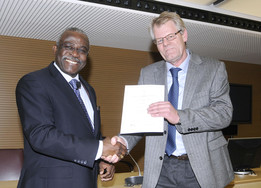
Roberto was recognized for pioneering and leading highly successful innovations during his long career at IFAD such as his trailblazing role as the first Country Programme Manager (CPM) to be outposted. Similarly, the “Learning Routes” initiative pioneered by Roberto have helped thousands of farmers, rural community leaders and government officials to exchange knowledge, information and experiences through visits to each other’s projects where they see first-hand what can be achieved.

Roberto is a great innovator, a hard worker and someone who never gives up. Thanks to all these qualities, he has led the design and supervision of projects that have produced outstanding results ― achieving the highest average score in management's self evaluations.

The second awardee in the leadership category was Henning Pederson. Henning stands out for his leadership capabilities in developing a country programmes and projects which are on the cutting edge of development practice, particularly in rural finance and value chain development. Henning was also singled out for his inspiring and empowering management style and as an outstanding mentor.
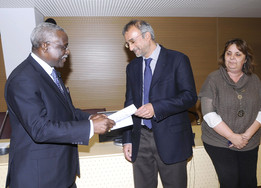
And to prove this very point, it was not too much of a surprise, that one of his mentees – Omer Zafar and the Yemen country team –received an award outstanding project category.

The Yemen country team led by Omer and composed of Dr. Fathia Bahran, Country Programme Officer,  Nicole Hervieu and Jessica Lattughi were recognized for having completely transformed the Yemen portfolio from one that was based on a hand-out approach, to one based on creating sustainable economic opportunities that empower poor rural men and women.
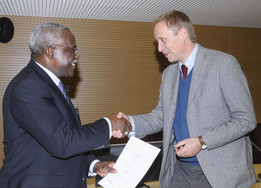
The new project designs for Yemen have been so highly regarded by other donors, including the Islamic Development Bank (IsDB) and the European Union, that they have together invested almost double the amount that IFAD has put it. The World Bank has also expressed interest in investing and the IsDB has recently announced that it stands ready to contribute over US$ 100 million to the forthcoming Yemen project, which focuses on rural employment generation.

The next awardee in the outstanding project category was Edward Heinemann, the Rural Poverty Report 2011 team leader. Ed was recognized for his outstanding efforts to finalize IFAD’s flagship publication.
Work on the report started in late 2007 and, while much preparation was done, it became clear in 2009 that the project was losing momentum. In July 2009 senior management asked Ed to take over responsibility for the report.

Ed, assisted by Bettina Prato rolled up his sleeves and started to draft and re-drafted the report several times with support and contributions from IFAD colleagues and external reviewers, producing the excellent report that we have today.

Although only released ten days ago, those of you who follow this blog know that the Report has already received wide praise and is being recognized as one of the most comprehensive studies on the dynamics of rural poverty. A distinctive feature of the report is that it gives a human face to rural poverty through the personal narratives of ordinary poor rural people around the globe. It also advocates a number of important policy measures to tackle rural poverty. These will undoubtedly give impetus and drive the efforts of governments in developing countries and the international community to enhance national and global food security.

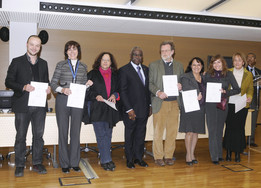
The first award in the agent and facilitator of change category went to the Farmer’s Forum Team coordinated by Jean-Philippe Audinet. The team included:
  • Philippe Remy
  • Roberto Longo
  • Carla De Donato
  • Sandra Di Rienzo
  • Gisella Barbieri
  • Natalia Espinel
  • Sylvia Isaia
  • Vincent Sineau
The team was recognized for its outstanding work in developing the Farmers’ Forum and creating a strong relationship between IFAD and farmers’ organizations across the developing world.

Their efforts has led to the organizing the Farmers’ Forum every two years to coincide with the meetings of the Governing Council. In 2010 the Forum featured a special session to promote women’s leadership in farmers’ and rural producers’ organizations. Thanks to the work of the Farmers’ Forum team, IFAD has also continued to support global and regional farmers’ organizations in developing countries. And through their work, IFAD has managed to amplify the voices of the rural poor in various global fora.

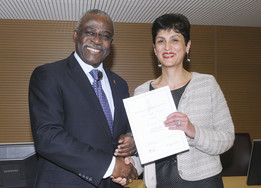
The second awardee in the agent and facilitator of change was yours truly – Roxanna Samii. Those who follow this blog will remember that in February 2010 we used a number of social media and web2.0 tools to report live from the Farmers’ Forum. In a way I partially owe my award to the openness and willingness of the Farmers’ Forum team who embraced the idea of putting these tools into practice.

I was extremely flattered listening to Henock reading out the following motivation for my award:

“The award pays tribute to the key role Roxanna played in leading the change in the way we communicate. It recognizes Roxy’s tireless dedication and energy to introduce IFAD staff to social media, promote the benefits and advantages of social media at the corporate level, and share her knowledge by conducting awareness-building and training sessions on web 2.0 tools and guiding IFAD staff on how to use social media effectively and professionally.”

“Roxy’s passion, enthusiasm and tireless dedication have anchored social media in IFAD’s communications work and she is commended for empowering her colleagues to become effective users of social media tools. “

I cannot but end this blogpost by referring back to Daniel Pink’s DRIVE paradigm. Pink’s paradigm is pushing us to embrace motivation 3.0 – where people are “motivated by the desire for autonomy over a task, for the mastery of a craft and for a sense of purpose”.

The IFAD awards programme paid tribute to these people. For sure, the 2011 edition will pay tribute to many more motivated and inspiring colleagues.

The six awardees will be receiving the official plaque at the forthcoming Governing Council. So please make sure you stay tuned, as we’ll be using social media and web2.0 tools to bring you live not only the award ceremony but the entire Governing Council event!

For now, Happy Holidays and on behalf of the IFAD social reporting team we wish you a prosperous 2011.

Wednesday, December 15, 2010

The journey from arms to agriculture

The turbulent history of the Republic of Congo with its troubled transition from centralized planning under a Marxist government to a market economy, together with economic mismanagement, military coups and brutal civil conflict during the 1990s has definitely marked the people of this country.

The Republic of Congo, once one of sub-Saharan Africa’s main oil producers, today has more than 40% of its 3.7 million people living under the poverty line most of whom live in rural areas earn their livelihoods as smallholder farmers and fishers.

The country’s economy relies on subsistence agriculture and livestock. Cassava, rice, vegetables are among the main agricultural products and the population is also engaged in rearing small ruminants.

The civil wars of 1993-1994 and 1997-1999 have had a devastating socio-economic impact on the country. During the civil war all fundamental and foundational infrastructure was destroyed. More than 800,000 people were displaced, the population suffered from severe food insecurity and many young children became soldiers.

Once the civil war came to an end, the United Nations family began its post-conflict effort. In 2000, the United Nations Development Program (UNDP), in an effort to reintegrate the displaced people and encourage child soldiers to surrender their arms, launched the seven year «Action Communautaire pour le Rétablissement Post-Conflit» project. This project provided basic social services and helped the population to engage in economic activities.

In 2009, building on the UNDP project, IFAD funded the Rural Development Project in the Likouala, Pool and Sangha Departments (PRODER3).

“The objective of this project is to increase the production, productivity and income of poor rural people in a sustainable manner and encourage the young people to put down their arms”, explains Dominique Kenga, Coordinator of the IFAD-funded Rural Development Project.

The project reaches out to 160 villages and covers 15,750 households. The 62,800 poor rural people benefitting from this project are engaged in in the local cassava-based farming system, fisheries and livestock related activities.

The project is enabling farmers to produce, multiply and disseminate improved, disease-free cassava planting materials and seeds. It is providing training and agricultural extension services to give smallholder farmers full access to inputs and know-how. And it is also financing the rehabilitation of rural roads to better connect the over 600 villages.

“One of our other priorities is to encourage the 3000 young people, living in the Pool department, to put down their arms and start engaging in agricultural related activities”, says Kenga.

“During the civil war, Pool department was very badly hit. Things got really bad back in 1993. During this period, many died and as result families were shattered and many young people ended up on the street”.

“For these young people the only way to survive in the fury of the war was to take up arms”, explains a visibly moved Kenga. “What was devastating was the fact that almost 100% of the 3000 young people living the Pool department had become child soldiers. So after the unrest, we had a huge challenge at hand.”

Using rural radio, Kenga and his colleagues launched a campaign to encourage the youngsters to surrender their arms and to embrace agriculture.

“Convincing a young person who has experienced nothing but violence in his or her life is a Herculean undertaking. And we are dealing with 3000 devastated and shattered souls and bodies”, clarifies Kenga.

“The physical and psychological impact of the violence experienced by the youth is beyond words. Our challenge is not only to convince them to put down their arms and go back to the farms, but more importantly to do so in a peaceful and harmonious manner. The last thing we want is for them to act as aggressor and be disrespectful to their parents and other villagers. We want peace!”

To overcome this immense challenge, Kenga and other PRODER3 colleagues provide every young person who surrenders their arms and takes up agriculture between 25,000 to 50,000 CFA and 1.5 acre of land, along with inputs such as seeds, fertilizer. Mostly, the disarmed and demobilized child soldiers cultivate the land belonging to their family. If they are landless, PRODER3 facilitates a renting arrangement where they pay an annual rent of $50 to work on the land.

“We are going further than agriculture and are encouraging them to also engage in fisheries, raise poultry and rear small-ruminants”, clarifies Kenga.

“Farming in Pool department is very much a manual activity and at best the smallholder farmers can produce approximately 2 tonnes of cassava a year, of which 60% is used for local consumption mainly in the form of foufou – processed cassava.”

The goal of Kenga and PRODER3 staff is to ensure food security and transform farming into a viable business. This is why the farmers are now using part of their income to invest in better inputs.

“Our vision is to have an economy based on modern agriculture, an economy whereby we are not dependent on imports but can ensure food security for all”, says Kenga.

“So far we’ve managed to disarm 20% of the young soldiers. Our goal is to disarm the remaining 2400, build a peaceful society based on respect and trust. A society where everyone can lead a decent life, can put enough food on the table and is engaged in a profitable and dignified economic activity".

“Building a better future starts at home. Now that the leader of these youngsters has disarmed and is part of the government, we hope that we can build a peaceful and better future”, says Kenga with smile.

Only time will tell, but definitely, Kenga and his colleagues are on the right track to build a peaceful and prosperous future for the people of Likouala, Pool and Sangha Departments.

Monday, December 6, 2010

Today, IFAD President released The Rural Poverty Report 2011 at Chatham House in London, #rpr2011


Here is our big day. We are launching the Rural Poverty Report 2011. The report is the result of two years of extensive work.

To make sure that nothing would go wrong, I went down early to the plenary hall of Chatham House to get myself organized to find out to the my biggest chagrin that there was no internet access in the plenary hall. PANIC, total PANIC. I pulled out my Blackberry, more PANIC, no signal!!

Deep breath, think and think fast. Rushed upstairs to do as much as I could do  before the meeting started. After putting in place the contingency plan and coming to terms with my constraint, I headed back downstairs.

At 9:33, David Nabarro welcomed the participants and opened the “Food Security 2010 – Making Food Security work: Matching supply to demand.

In introducing Dr Nwanze, IFAD President, to take the floor to deliver the keynote address, he mentioned that “IFAD is now a leader and advocate for food security". Nabarro compliment IFAD taking "actions to ensure that food security will be experienced by everyone and not just a few”.

With that introduction, the President, holding the report in his hand  and later in the session, Edward Heinemann, the Rural Poverty Report, team leader,  proceeded to unveil the findings of the Rural Poverty Report 2011.

"The report is a comprehensive review of rural poverty, which accounts for 70 per cent of the world’s extremely poor people – about 1 billion children, women and men", said Dr Nwanze.

"The report provides an in-depth evaluation of the state of rural poverty and its consequences for people all over the world. It also makes important recommendations on policies and investments that will help rural women and men move out of poverty and, in the process, become part of the solution for the global food security challenges of the next
several decades".

"One of unique characteristics of the Rural Poverty Report 2011 is that it goes beyond cold facts and figures and includes the stories, hopes, challenges and aspirations of poor rural women and men from around the world who are struggling to overcome poverty. Their thoughts and perspectives were influential in the preparation of the report", said Nwanze.


During the meeting both Dr Nwanze and Heinemann reminded the audience that as we embark in the new decade of the 21st century, global poverty still remains a massive and predominantly rural phenomenon - and this is absolutely unacceptable.

The Rural Poverty Report outlines four steps to eliminate hunger and poverty
  • Help rural people better manage the risks they face
  • Sustainably increase agricultural production
  • Facilitate equitable access to new and changing marketplaces by viewing smallholder farmers first and foremost as businesses
  • Encourage the growth of non-farm rural jobs
Managing risk
"Smallholder farmers have always been vulnerable to risk, and now these risks are growing. Today, they face less secure access to land, increasing pressure on common property resources, climate change and food price volatility. We need to find ways of reducing risk and giving poor rural people access to the tools they need to deal with it", explained Nwanze.

The Report argues that for some, this will mean improving their skills, while for others, it will mean access to micro insurance, and for others still it will mean social protection. What is crucial is to create the right environment to make it easier for more rural people to be more entrepreneurial, creating the conditions for a vibrant rural sector which generates locally produced goods and spurs sustainable non-farm employment in services, in agro-processing and in small-scale manufacturing.

Sustainably increase agricultural production
The report makes the case that we need to ensure that the world’s 500 million smallholder farms are able to realise their potential as small-scale businesses and at the same time increase food production but in a sustainable way.

In Africa, for example, only 6 per cent of the land is irrigated. Only one tenth of the average amount of fertilizer is used on farm land. But we also know that 60 per cent of the world’s uncultivated arable land is in Africa. Imagine the potential that this land holds for the approximately 300 million poor people who live in rural Africa. Imagine the potential of the 2 billion people who live or work on small farms the world over.

This means we need to get higher yields from existing land, and we need to do so in an environmentally sustainable way that does not pollute, diminish the land over time or contribute to greenhouse gas emissions - in other words, we must have sustainable intensification.

The report highlights that sustainable farming practices have improved yields by an average of nearly 80 per cent over four years. It argues that what we need is a systemic approach that uses a variety of innovations – derived from the latest scientific discoveries and from local practices and knowledge – to bring agriculture into the forefront of efforts to protect and preserve land, air and water for generations to come.

The report concludes that this means complementing conventional approaches to increasing productivity with a much stronger focus on soil and water management, integrated approaches to soil fertility management and overall farm production systems.

At the same time, the report recognizes that there is no blueprint for sustainable agricultural  intensification. The best practices will be determined by the local context. The challenge is to develop policies and institutions that can make it happen on a massive scale.

Facilitate equitable access to new and changing marketplaces by viewing smallholder farmers first and foremost as businesses
"One of the other challenges highlighted in the report is the lack of access to markets which is one of the determinants of poverty", explains Heinemann".

Smallholder farmers and poor rural people must have opportunities to be entrepreneurs, rather than bystanders. To realize their business potential there should be a concerted effort to reduce risk and transaction costs along value chains, supporting rural producers’ organizations, expanding financial services into rural areas and ensuring that small farmers have access to the infrastructure, the utilities and information. Investing in good governance is another key ingredient".

Encourage the growth of non-farm rural jobs
"There is no question that agriculture is and will continue to be the key economic driver in rural areas. Agricultural success is a route out of poverty for millions", said Nwanze.

"Today, around 80 per cent of rural people are involved in farming to some degree. We must continue to support those who see agricultural production as their main livelihood in every way we can. But we must also recognize that rural economies are becoming more diverse. If we succeed in creating more profitable farms, we will also succeed in creating associated non-farm enterprises. Some people will leave the farm for new jobs with large enterprises in rural areas, while others will choose to become entrepreneurs in non-farming pursuits".

The Rural Poverty Report suggests that in order to meet the growing needs of a hungry world, agriculture must be a viable and rewarding activity for the large number of people who choose it. But increasingly, it will be one of many choices, not the only choice. This is not a threat to agriculture, but rather a chance to develop a more modern, diversified economy.

Call for action
"Our report is not one that should sit on a shelf to collect dust. I hope that we all join hands to implement the four steps outlined above to eliminate poverty and hunger", exclaimed Nwanze.

"The challenge now is for governments to follow through on their promises and for players in all areas of rural development to take action. Developing countries must be the drivers of rural development. Where countries have shown the commitment, development agencies and others should support their efforts".

IFAD is meeting the challenge by working closely with partners to scale up our support to rural development on the ground. We are also championing a new and more dynamic vision of rural development.

Dr Nwanze concluded: "And as we look at today’s rural poverty report, we must also look to the future, and that means focusing on the young people who live and work in rural areas. Give them the skills and confidence they need to run profitable farms or start businesses, and they hold the potential to become the community leaders of tomorrow. Ignore them, and they will have little option but to leave their homes and families to search for work in the cities".

Sir Gordon Conway who took the floor after the President's keynote address complimented and congratulated IFAD for a great multidisciplinary report which is totally grounded in reality and comprehensively reflects the stories, challenges and aspirations of poor rural people!

Others commended IFAD for putting out a strong practical report showing how to unlock the potential smallholder agriculture, for seeing farmers as business people and for depicting "their business" being embedded in social, economic and political relationships and showing how when these relationships do not work that is when food security fails.

Sitting in the room and hearing rural development leaders citing and referring to the report just minutes after it was launched was indeed a gratifying moment. Undoubtedly we'll be hearing more and more people citing and quoting the report. Well done to all those who were involved in this two year effort. Well done to Ed and Bettina.

The panelists echoing the President's  message of hope and call for action urged the participants to read the Rural Poverty Report. Make sure you download the report.


Also, please mark your calendars: on 9 and10 December from 9:00-10:00 and from 14:00-15:00 December, Edward Heinemann and his team will answer your questions and comments on Facebook and Twitter.

Please send us your questions and comments by 16:00GMT 8 December.

Follow @ifadnews on Twitter and become join us on our Facebook (http://www.facebook.com/pages/ifad/107399332627995).

See you on-line.

Listen to Edward Heinemann who shares some of the findings of the Rural Poverty Report 2011

Sunday, December 5, 2010

Rural Poverty Report 2011: Mixed progress but also new hope in reducing rural poverty #rpr2011

by Kanayo F. Nwanze

On 6 December 2010, at 11:00GMT at the opening of a major international conference on food security convened by Chatham House IFAD will launch the Rural Poverty Report 2011.

Just think, what would your life be like if you were one of the 1.4 billion women, men and children who live in extreme poverty? Chances are you would live in a rural area, as 70 per cent of the world’s extremely poor people do.

Like Pascaline Bampoky from Senegal, you wouldn’t have had much of an opportunity to study, you would be farming rice, raising pigs, selling ice cream and cleaning houses – all in a day’s work to feed your family.

Like Shazia Bibi from Pakistan, you might wonder if your garlic will compete at the market with lower priced imports and whether your profits will cover the costs of your children’s education and treatment for your heart condition.

And if you are a young man like Williams Novoa Lizardo in Peru, you might lose hope of making a living where you were born and consider migrating to a city to find work.

The good news, according to the Rural Poverty Report 2011 issued by IFAD, is that over the last ten years more than 350 million rural people have pulled themselves out of extreme poverty. During this time, the percentage of the world’s rural inhabitants living on less than US$1.25 a day has dropped from nearly half to about one-third.

Accounting for much of the progress has been East Asia, and particularly China, where the number of extremely poor people in rural areas fell by two-thirds – from 365 million to 117 million – as did the rate of extreme poverty, which went from 44 to 15 per cent.

There was also good progress in both Latin America and the countries of the Middle East and North Africa, where extreme poverty rates in rural areas fell by about half over the past decade.

But, this progress notwithstanding, the problem remains a pervasive one, especially in Sub-Saharan Africa, where the rate of rural poverty has fallen slightly in the last decade but is still above 60 per cent, and in South Asia, which is home to half of the world’s one billion extremely poor rural people.


Just as these statistics tell a story of uneven progress in reducing rural poverty, changes that are underway in rural areas are giving rise to both challenges and new hope for rural people in their struggle for a better life.

The challenges include increasingly volatile food prices, which complicate life for rural people both as producers and buyers of food. And there are other emerging threats such as the deterioration of the natural resource base, growing competition for land and water, and the potential harm that climate change can cause to the rural landscape.

But good things are happening, as well. As cities expand and the world becomes more urbanized, there is a growing demand for high value food, and accordingly agricultural markets are expanding and becoming better organized. Supermarkets, for example, have grown rapidly across much of the developing world, and in some parts of Latin America they typically account for 60 per cent or more of retail food sales. To be sure, modern markets and value chains bring with them their own challenges for some smallholder farmers in terms of higher entry costs, but the potential opportunities they also bring cannot be overlooked.

And while agriculture continues to be a key driver of rural growth – four-fifths of rural households worldwide are engaged in farming at some level – technological advancements and changes in the global economy are also creating non-farm jobs and development in rural areas. The potential for growth is further enhanced by the search for renewable energy sources that is ramping up around the world.

All of this means opportunity for greater numbers of poor rural women and men to lift themselves out of poverty and create a better life and a future for themselves and their children. But making the most of it requires an overall policy and investment approach that is, at the same time, both market-oriented and environmentally sustainable.

For starters, national governments and the international community need to reverse the longstanding neglect of rural development. We need to improve governance in rural areas and create a better economic environment for smallholder farmers to succeed and grow not only food but their businesses as well.

We need to invest in rural infrastructure and in the education and skills of rural people so that they themselves can make the most of new opportunities to engage in agricultural markets or work in non-farm industries. We need to strengthen their collective capabilities so that they can support each other in managing the risks they face, learn new techniques for improving their productivity, and market their products.

Above all, we need to stop treating the rural poor as charity cases and truly recognize that they are people whose innovation, dynamism and hard work will ultimately lead the way out of poverty’s darkness and into the bright sunshine of growth, development and prosperity.

Nothing less than global food security hangs in the balance. The experts say that agricultural production will have to increase 70 per cent by 2050 – and output in developing countries will have to double – in order to feed the world’s growing global population, expected to reach nine billion by then.

I have no doubt that Pascaline, Shazia and Williams are up to the challenge. Are the rest of us?


On 6 December at 11:00GMT you may download the English version of the Rural Poverty Report 2011 at http://www.ifad.org/rpr2011/report

Meet the women and men from rural areas whose thoughts and perspectives were influential in the preparation of theRural Poverty Report 2011 Read testimonies and watch the video testimonials

Tuesday, November 30, 2010

On 6 December, IFAD will release the Rural Poverty Report 2011: Meet the lead author, Edward Heinemann

On Monday 6, December during an international conference on food security at Chatham House in London, IFAD will launch the Rural Poverty Report 2011: New realities, new challenges: new opportunities for tomorrow’s generation.
The Rural Poverty Report 2011 is a comprehensive resource for policymakers and practitioners, especially those in developing countries.  The report provides latest estimates on poverty rates in rural areas of developing countries, as well as poverty trends in different regions. It has new information on how many people move in and out of poverty over time, as well as first-hand accounts from poor rural people on the challenges they face in their everyday lives.

RPR 2011 photo essay
The report looks at who poor rural people are, what they do and how their livelihoods are changing.  It explores the challenges that make it so difficult for rural people to overcome poverty, and identifies the opportunities and pathways that could lead towards greater prosperity for them and their communities.  And it highlights key global challenges such as the need to double agriculture output and increase food production by 70 per cent to feed 9 billion people in 2050.

It also highlights the policies and actions that governments and development practitioners can take to support the efforts of rural people themselves, both today and in the years to come.

Writing the report: the back story
Many colleagues were involved at different stages of the report’s preparation. You can find out more about these great people in the report’s acknowledgements, and there are many more who worked behind the scenes. At the end of the day, it ended up being an “all-hands-on-deck” exercise.

Having said that, the report would not have seen the light of the day if were not for Edward Heinemann and Bettina Prato.

Some 10 months ago, Ed, was asked to lead this process and finalize the report. For months, he worked around the clock and hardly left his office. I remember sometime in the summer, not having seen Ed around for weeks, I went up to his office to check on him. I knocked on his door and put in my head and I found an unshaven Ed typing furiously. I said: “Hi Ed, have not seen you around for some time, just came up to see how you were doing”.

Ed smiled and said he was fine. Closing the door, I thought to myself, “I guess he is so busy that he did not have time to shave” and I almost asked him, “Ed, why have not you shaved?”, but thought it was better not to do so.

There are many things Ed has learnt thanks to the Rural Poverty Report process and undoubtedly many experiences and conversations that will stay with him for ever. There is one other thing that, for the time being, seems to have stayed with him – and that is his unshaven look, which has now transformed to a well-groomed beard.

With six days to go to the big day, yesterday I asked Ed to share his state of mind about the launch. Here is what he had to say.

Edward Heinemann – the Rural Poverty Report lead author’s state of mind
“Back in July, when I gave in what I thought was the final draft of the Rural Poverty Report, my idea was that I would be able to wash my hands of it, do something else for a few months, and then re-engage once we had the launch presentations lined up. I got that completely wrong. From September on I spent days, weeks, months looking over galley proofs – a term I didn’t even know three months ago – til the words ran into each other; I rewrote briefs, prepared Q&As, drafted summaries of summaries and reviewed key messages. I looked over the text 273 times, and each time I did I found things that could have been said better, that should have been said differently, or that simply shouldn’t have been said at all. There were corrections and there were corrections to corrections. It was miserable. 
In my worst nightmares, someone somewhere dreams up a question that leaves me gasping for air like a suffocating goldfish.
Now, with a week to go to the launch, I’m looking forward to it, of course. I tell myself it will be fun. I do know that it will be worthwhile, because I am confident that the report will help us and our partners make a real difference in the lives of the poor rural people.”  


Visit the Rural Poverty Report 2011 website. Make sure you meet the women and men from rural areas whose thoughts and perspectives were influential in the preparation of the Rural Poverty Report 2011.Read testimonies |  Watch the video testimonials

Find out more about the report and join the virtual chats: Follow #rpr2011

  • On 6 December from 9:30 to 11:30 GMT, IFAD’s social reporting team will report live from the Chatham House launch event. Follow us on Twitter, Facebook and on this blog. Follow #rpr2011
  • On 9 and 10 December from 9:00 to 10:00 GMT and 14:00 to 15:00 GMT, Ed and Bettina will host a virtual chat on Facebook and Twitter. Please send your questions and comments.  Follow rpr2011
  • On 17 December from 9:00 to 11:00 GMT, IFAD’s social reporting team will report live from the Rome launch event. Follow us on Twitter, Facebook and on this blog.  Follow #rpr2011
Looking forward to seeing you on line.


Tuesday, November 23, 2010

Historical Global Gathering of Women Pastoralists in Gujarat – from dream to reality!

By IFAD Reporters: Mattia, Antonella, Silvia, Judith, Soma and Luisa


On 21 November in a small village 100km from Ahmedabad, over 200 pastoral women, men and children danced, clapped and banged tambourines to the accompaniment of their jingling jewels and lowing animals. This colourful pageant - a joyous celebration of the inseparable relationship between pastoralists, their animals and land - was a fittingly emotional opening ceremony for a truly historic gathering.

Over 130 pastoral women from 27 countries are gathered together in the gujerati village of Mera to discuss the challenges they face - and how they can become forces for change. MARAG leaders had the vision to organize the gathering in a genuine Indian pastoral setting, where pastoralists have lived for several generations. After the event the mobile and permanent huts and buildings built specially for the Gathering will be used as a research and cultural centre for the maldhari (pastoral) communities themselves, where MARAG and their wide network of volunteers can preserve and encourage the continuation of pastoralism as a unique and valuable way of life.

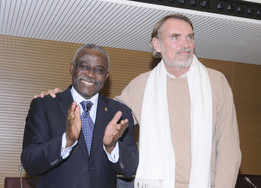
The commitment and mobilization of the communities here is palpable – opening speeches overflow with emotion and their efforts make this a unique event. Mattia Prayer Galletti highlighted the importance of pastoralist women’s knowledge, which is needed by the world, while Carlo Petrini from Slow Food/Terra Madre, who was determined from the start to be present at the event, said that he was overwhelmed by the energy and the sense of community of this event, which would remain in his heart for a long time. Many are volunteers, from the exhausted international interpreters, furiously connecting participants in heated discussions in 12 languages, to the freelance photographer, the artist and facilitators - but most especially the pastoral men and women themselves, who spontaneously contributed more than 300 beds and blankets, and the elder women, who decorated the traditional huts to welcome their fellow pastoralists.

As key agents of their communities’ livelihoods, pastoralist women have seized this opportunity to network with alacrity. It is a breathtaking sight to see so many of them from all over the world, sharing their experiences, and swapping stories about their daily life. A Jordanian woman stood, eagerly explaining to an Indian lady the secret to making the bread typical of her region, whilst a group of colourfully clad Gujerati women demonstrated to an audience of women from Africa how to use their hand looms. Over in another corner, a delegate from the Cameroon listened with interest to the story of how a woman pastoralist from Kenya became a Member of Parliament and worked to raise the voice of other women in her situation…the power of sharing knowledge! But behind the ebullience lies a serious desire to go home with something concrete, and the break-out sessions of the first day are lively with debate.

There is tremendous diversity in the situations facing the women here, with women from highly marginalized and patriarchal communities sharing experiences with relatively well-organized womens’ groups - but they also have much in common, from problems with land rights to marginalization as pastoralist and as women, to keeping their children fed and healthy. The Gathering is a small but concrete step towards enabling women to share experience and knowledge and plan ahead strategies to strengthen their roles in pastoral societies and within the wider community.

The world gathering of women pastoralists, sponsored by IFAD, will last till 26 November. We will keep you informed on the issues emerging from the reach discussions and thematic working groups.

Popular Posts