Showing posts with label water. Show all posts

Wednesday, March 21, 2012

The weight of water – and the significance of leisure

World Water Day 2012
The weight of water – and the significance of leisure

While I was chewing my pencil over how to start on this blog, I googled “how much does water weigh?” And I was pretty surprised at some of the answers, including that the question was incorrect and that water’s weight depends on its temperature.

Senegal: Pascaline Bampoky carries home a bucket of water

What I was really trying to estimate was how heavy the bucket of water Pascaline Bampoky is carrying in the photo would be. If she’s carrying about 20 litres of water – then the answer is about 20 kilogrammes. The only time I lift that sort of weight is when I heave my suitcase onto the airport scales.

For millions of women – especially young women – across the developing world, water means heavy loads and hours of drudgery. Every day one of their jobs is to walk long distances, often across unsafe areas, lugging home buckets, jars or plastic containers of water for household needs.

Obviously they are not the strongest members of the family – but they are mostly the ones with the lowest status. And so the task falls to them.

Here are some sourced stats, if you need them to be convinced. In rural Guinea women spend 3 and half times longer than men fetching water every day.[1] In rural Benin, girls spend an hour a day collecting water, while boys spend 25 minutes. [2]

When the load is lightened
There are also studies looking at how women use their time when water supplies are improved and brought closer to home. The results are thought-provoking.

School enrolment and attainment does improve for girls – much more so than for boys. And in some places, women spend more time in market-related activities when they don’t have to fetch and carry water.[3]

But several studies also show that women use some of the time they save for something potentially life-changing but difficult to measure – and that something is leisure.

That got me thinking about how many different ways women might use their free time – and still call it leisure.

Some might sit in the shade and talk to their friends – and who knows where that might lead ;) Others might study, visit a relative or even play with their children. Or they might choose to use their time for a task in the home that they want to do.

What makes it leisure is that they have the choice.

Women’s freedom to choose how they spend at least some of their time is a key strand in their empowerment – that slippery objective that is difficult to define and difficult to achieve, but still right at the top of our agenda.


[1] World Bank: World Development Report 2012: Gender Equality and Development, page 299.
[2] WDR 2012, page 111.
[3] WDR 2012, page 299.

Monday, July 11, 2011

The Eco Boiler Range from Angel Springs

The Eco Boiler range by Angel Springs, provides not only huge cost savings, but is also a convenient product which can save in time and efficiency too, particularly in the workplace. And it can help your firm be greener, too.

Angel Springs are the UK’s longest established water cooler company. They also offer a range of water boilers which are both cost saving and useful for frequent use of hot

Friday, October 15, 2010

Blog action day 2010: More MDGs per drop

Pim is my nephew. He has many friends and a wide, tender loving family. Love blinds and we forgot to take him to regular health checks. Pim has been stumbling and is seriously ill. But he can be cured and made into a serious marathon runner again.

In the mid-80s Ben Bagadion of the Philippines  National Irrigation Administration was the champion of Participatory Irrigation Management (PIM) and Irrigation Management Transfer (IMT) in community based smallholder systems. PIM and IMT were seen as panacea, also for large canal systems. IFAD (and many others) adopted the philosophy and strengthening water user associations (WUA) became the buzz word of the '90s and beyond. We reflected this belief in our corporate approaches, learning products,  RIMS and Office of Evaluation work.

Today, some 25 years later, the international water community was shaken wide awake when informed at the Asian Development Bank (ADB) conference on Water Crisis and Choices that PIM was ill, seriously ill. After assessing PIM in Asia, IWMI found a success rate of 40%. That is a politically correct way of not saying that 60% of PIM failed. They even downplay the success rate stating that it is mostly the 'good' cases to get documented.

This is serious food for thought. Luckily there are plenty of caveats, if's and but's. Non-paddy (I.e. mixed farming), smaller systems in more isolated or peripheral community based settings seem to fare better. That would be us. No time for complacency. Better safe than sorry. The work of Office of Evaluation dates from 2000. So IWMI and Policy and Technical Advisory Division will be concluding an assessment on PIM and WUA performance in our portfolio worldwide to draw lessons for the future.

A future in which improved water productivity in terms of 'More MDGs per drop' will be key, especially under the poverty exacerbating climate change conditions and adverse terms of negotiating and decision-making power affecting our target groups over the sustainable use of the, correction: their, natural resource base.

For IFAD, live from Manila, Rudolph Cleveringa

Saturday, June 5, 2010

5 June: World Environment Day - IFAD green group launches "Back to the TAP (Traditional Acqua, Please) campaign"


To commemorate World Environment Day, IFAD's Green Group launched " Back to the TAP (Traditional Acqua, Please) campaign".

Moses, Hazel, Dunia and other colleagues set up a stand outside of the cafeteria to raise awareness about the devastating environmental impact of our bottled water consumption. Did you know that:

  • on a daily basis the bar sells 300 small bottles
  • each day, cleaners collect on average 4 bags of plastic bottles. Only 10 of us recycle plastic bottle properly!!! REMEMBER the BLUE bag is for PLASTIC!
Leaving IFAD behind, on a global scale, did you know that:
  • Italians drink the most bottled water per person, at nearly 184 liters in 2004—more than two glasses a day and more than two times the consumption of Portugal. Mexico is second in world per person consumption of 168 litres and first in the American continent. Perhaps, Italy is still leading in the per person consumption of bottled water yet it has the world largest number of public fountains dating back to the Roman Empire.
  • In contrast to tap water, which is distributed through an energy-efficient infrastructure, transporting bottled water long distances involves burning massive quantities of fossil fuels. In 2004, for example, Nord Water of Finland bottled and shipped 1.4 million bottles of Finnish tap water 4,300 kilometers (2,700 miles) from its bottling plant in Helsinki to Saudi Arabia, implying a huge carbon footprint.
  • Fossil fuels are also used in the packaging of water. The most commonly used plastic for making water bottles is polyethylene terephthalate (PET), which is derived from crude oil. For example, making bottles to meet Americans’ demand for bottled water requires more than 17 million barrels of oil annually, enough to fuel more than 1 million U.S. cars for a year.
  • Worldwide, some 2.4 million metric tons of plastic are used to bottle water each year.
  • But bottled water is not guaranteed to be any healthier than tap water. In fact, roughly 40 percent of bottled water begins as tap water; and the French Senate even advises people who drink bottled mineral water to change brands frequently because the added minerals are helpful in small amounts but may be dangerous in higher doses
  • The United Nations Millennium Development Goal for environmental sustainability calls for halving the proportion of people lacking sustainable access to safe drinking water by 2015. Meeting this goal would require doubling the $15 billion a year that the world currently spends on water supply and sanitation. While this amount may seem large, it pales in comparison to the estimated $100 billion spent each year on bottled water while more than 1 billion people around the globe still lacking access to a safe and reliable source of water.
So, after hearing these shocking facts, we are all looking forward to seeing water fountains installed in strategic corners of the building.... I think it is safe to say that we all subscribe to NO PLASTIC campaign. And let's not forget that water coolers or water fountains are great knowledge sharing venues, just like the shuttle bus has proven to be a fantastic knowledge sharing vehicle!!!

Read more:

Wednesday, March 24, 2010

World Water Day 2010 at IFAD

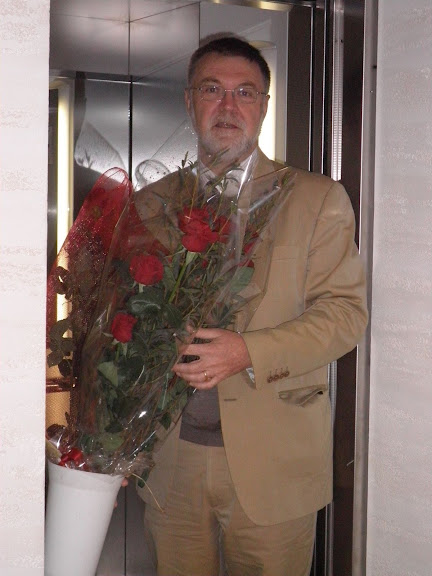
What is the water footprint of 3 dozens of roses? In my case it was a wet boot of my car, a small price to pay thanking our colleagues who made IFAD's World Water Day a success.


Placemats are a fine way to convey a message. Gosh, I myself didn't know that for every kcal I consume -and I eat a lot- I consume almost a liter of water. And at my age I have to get rid of that as well. Small wonder the Dutch had to put dikes around them. Not so much to keep the salt water out as much as keep the neighbours from peeping in.

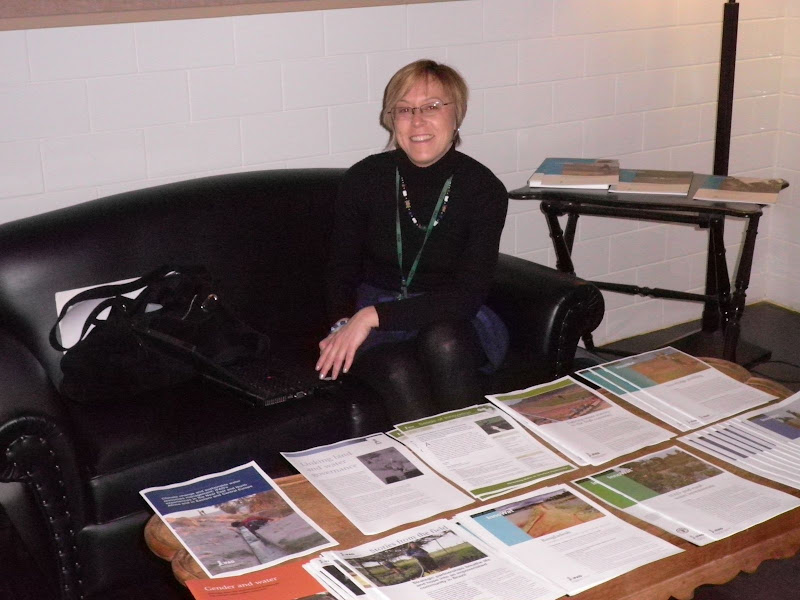
As at my early arrival I was hijacked for 'important corporate matters', it was Audrey who had the honor of facing our IFAD colleagues during the morning hours on all matters water from her conveniently located spot at the entrance of the restaurant. She must have pointed plenty many colleagues to the exhibit in the Qatar Information Centre because when I finally made it to do my turn of the Q+A (not QA) many water-related brochures and documents had already found new owners. We shall introduce the polluter-pays-principle to reduce possible wastage of precious knowledge!

My turn on the couch -not to be confounded with the work of our IFAD shrink- drew some notable visitors who had to pull a number to be seated. They were all offered a glass of water - from the tap. Frank wanted to know whether his proposed text on water would find my approval (which it did).

'Is this worth your while' inquired Rodney and 'Aren't you on your way to this Agricultural Water in Africa bash in Tunis' (yes to both). And then Abla draped herself next to me for a detailed briefing on her latest watery conquests in Eritrea. After a most vivid discussion on what is going well and what is doing not so fine, respectively 'when you come to support the new IFAD programme in September we can have a big lobster' and 'we really need to beef up the Zoba performance'.


I briefly thought of referring to the Ethics Commission and Mrs. Merkel (but it turned out that Zoba wasn't Greek) but then dropped the idea as I am fond of the crustacean (thermidor or a la plancha). All in all a wonderful experience which next time round we may want to share with our neighbours from the quartiere."

By Rudolph Cleveringa

Friday, December 11, 2009

Impact of climate change on Eritrean agriculture sector

As world leaders gather in Copenhagen to seal the deal on climate change, while collecting testimonials for a series of human stories, I saw, first hand, the devastating consequences of climate change on Eritrea’s agriculture and livestock sector.

Crop cultivation and animal husbandry account for 60 per cent of rural incomes in Eritrea. Recent models and estimates show that the effects of climate change will have an adverse impact on the country’s agriculture and livestock sector. Decreases in rainfall and a rise in temperature has resulted in increased dry spells and decreased soil moisture.

Water scarcity is one of the many challenges that farmers and pastoralist s face in Eritrea. The country has two perennial river systems, the Setit River, which forms the country’s border with Ethiopia and drains into the Nile basin, and the Gash Barka system, which collects the run-off water from the highlands. All other rivers in the country are seasonal and carry water only after rainfall, which means that they are dry most of the year. The country has limited sources of fresh surface water, and although groundwater can be tapped, quantity and quality may be poor.

Official estimates show average annual rainfall at 400-500mm. However, for the last two years, rainfall has been erratic and less than above average.

Investing in blue gold improves livelihoods of smallholder farmers

To counter the devastating impact of climate change and to ensure food security for its people, the government of Eritrea is investing in the agriculture sector by:
  • creating small-scale irrigation schemes
  • building ponds, reservoirs and dams
  • installing solar panels for water pumps
  • installing drip, pump and sprinkler irrigation systems

For example in Zoba Debub the livelihoods of 82% of the 750,000 people living in this zoba depend on agriculture and related activities. Farmers in Debub and in Ma’ekel and other areas of Eritrea plant cereals such as wheat, barley, sorghum, taf, millet, maize and also vegetables – tomato, onion, carrot, potato, cabbage, lettuce and pepper.

In drought-prone Eritrea, livestock are a farmer’s most valuable asset. Animal husbandry is not only one of the main sources of livelihood for farmers, but it is also a form of insurance that enables poor rural people to cope with drought and other disasters.

One of the many challenges facing Eritrean farmers and pastoralists is to find grazing land and water for their livestock. The reservoirs and the surroundings provide an invaluable source of water and grazing land for livestock.

If you’ve ever visited Eritrea, you will be familiar with its arid landscape. You can imagine my surprise when driving through Zoba Ma’ekel and - Zoba Debub, against an arid and dry landscape, literally out of the blue I saw a beautiful body of water surrounded by hectares of emerald green and lush vegetation. These mini-oas e s which are the result of Eritrean government’s investment in agriculture are THE source of livelihoods and food security for poor rural Eritreans.

The reservoirs can hold anywhere between 50,000 to 350,000 m3 of water and serve 200 to 350 poor rural households who are now able to irrigate a total of 35 hectares of agricultural land. Furthermore, the reservoirs and dams provide a secure source of grazing and water for livestock and also source of water for domestic/washing purposes.

These secure source of blue gold allow farmers to complement their rain-fed crops - cereals, sorghum and barely - with vegetables such as tomatoes, lettuce, cabbage, carrots, onions and pepper.

Eritrean farmers use a variety of irrigation methods ranging from drip to pipe and sprinkler and religiously adhere to the agreed irrigation schedule. Thanks to a favourable government policy, they have the luxury of not paying for water for the time being. However, they pay an average of 10,000-15,000 nakfa for a pump and those who have a fuel-run pump benefit from subsidized fuel.

The farmers are cognizant that their livelihoods depends not only on water, high yielding seeds and high-value crops but also on making sure that their pumps are well maintained. To this end they’ve established a revolving fund which is used exclusively for this purpose.

“Thanks to the reservoir now I have a secure source of water and can irrigate my 0.25 hectare”, says Woldo a farmer living in the Shmangus-laalay village. “Now I have three crops instead of one.” Woldo uses a combination of sprinkler and water pump. “When my crop was germinating, I used water pump, because sprinklers can damage the crop”, says Woldo. Woldo’s water pump is run by electricity for which he pays 24 nakfa per hour.

The 350 households living in the vicinity of this reservoir use this body of water not only to irrigate their plots, but also for their livestock and for domestic purposes such as for washing.

Before the reservoir was built, Elsa a mother of three, used to wake up at crack of dawn to go fetch water for washing purposes. Today, in tow with her donkey and her youngest son, she goes to the lake to collect water. While the water collecting technique may be rudimentary, it has saved Elsa hours of walking, allowing her to spend more time at home and to get involved in agricultural activities.

In the nearby village of Tesazege village, Athaneta and her brother are cultivating 0.5 hectare of land using the nearby reservoir. “I practice crop rotation and for this crop cycle I’ve replaced barley with tomatoes, because I have a secure source of water”, says Athaneta with a smile. “I’ve already harvested 100kg and expect to harvest another 200kg which I sell for 2 nakfa per kilo”.

“Thanks to this secure source of water, my brother and I can be sure to have one cereal crop and two vegetable crops”, says Athaneta.

Habtemariam is a model farmer who has fully taken advantage of the nearby reservoir and exploited the potential of his 0.75 hectare land, managing to secure himself and his family a total 5,000 nakfa by planting cabbage, lettuce and carrot.

Eritrea has the potential of having many more lush, green-emerald mini-oasis allowing more farmers to systematically cultivate agricultural land, ensure their food security and earn a secure income.

The government of Eritrea and IFAD are currently designing a national agricultural water management framework to allow for sustainable and reliable accesss to water especially in times of drought which unfortunately due to climate change will be affecting the country more frequently in the future. This framework will ensure that many Eritrean farmers will have a better crop to harvest,thus ensuring their food security.

Hopefully the world leaders gathered in Copenhagen will seal the climate change deal, so that Eritrean women, children, men, farmers and pastoralists can have a bright future and never again suffer from famine.

Popular Posts