Explore contemporary issues facing women in Latin America and the Caribbean today with this interactive map.
Entérese más acerca de temas de mujeres con este mapa interactivo.
View Mapeando el Género en América Latina y el Caribe in a larger map
Learn More
IFAD gender portal
Blogs on Gender
Entérese más
El Poder de Ser Mujer
Blogs sobre temas de género
Participe en el debate en nuestro foro en español
Showing posts with label Key words: Rural Women. Show all posts
Showing posts with label Key words: Rural Women. Show all posts
Thursday, February 3, 2011
'Study Tours' yield dividends for participants
 In a recent series of “study tours” focused on gender and rural empowerment, people from across Latin America (and across the world) came together in El Salvador and Guatemala to share their insights on gender equality and contemporary issues affecting people living in rural poverty across the region. The study tours were made possible through the IFAD-FAO Gender Capacity Building and Knowledge Management Grant.
And while plenty of reports and emails will come out documenting the study tours (a video is even in the works), the insightful letters of thanks from the study tour participants, themselves, provide a surprising glimpse into many of the pressing issues facing the region.
“The tour in El Salvador was really beneficial for me to understand and experience gender mainstreaming in the rural development process. Truly, many concepts as were presented are not commonly utilized in Grenada, however, they represent valuable approaches for rural individuals, family and community development. During the tour I reflected on some of the challenges that may be encountered in implementing some aspects, however, I also recognize that as Human and Social Capital Building Specialist, there are several feasible approaches that can be taken to enable people to address socio-economic issues in the rural settings in Grenada. Emphasis on the value chain, "inclusive family development" and the use of "demonstrator families" within communities were of special interest. The inclusive community development approach was also notable…” – Lindonne Glasgow, Human and Social Capital Specialist, MAREP, Grenada.
“Primero que todo tengo que agradecerle la oportunidad que me ha brindado, en tan bonita experiencia de conocer las diferentes punto de vista de género y empoderamiento rural, de nuestros hermanos latinoamericanos. La experiencia fue y es enriquecedora, que ha ampliado mis horizontes profesionales, y que todo éstos conocimientos, de seguro se van aplicar en pro de un proyecto PARTICIPA mejor, siempre visualizando la equidad y oportunidad de participación de hombres, mujeres, jóvenes y niños…” – Ing. Miguel Rivera. H. Coordinador. Proyecto de Desarrollo Participativo y Modernización Rural. PARTICIPA
Monday, October 18, 2010
El Poder de Ser Mujer
“El Poder de Ser Mujer” es una publicación del FIDA que examina la situación de las mujeres rurales en América Latina.
“Las mujeres campesinas de América Latina y el Caribe realizan buena parte de las labores agrícolas y pecuarias, y dedican mucho tiempo a las labores domésticas, con lo que su jornada de trabajo es mucho más larga”, afirmó la Directora de la División de América Latina y el Caribe del FIDA, Josefina Stubbs, en 'El Poder de Ser Mujer'.
“Ellas tienen más dificultades que los hombres para obtener los medios que les permitan mejorar sus condiciones de vida, menos posibilidades de procurarse una educación y es frecuente que no estén legitimadas ni para poseer ni para heredar tierras”.
Leer el 'Poder de Ser Mujer'
Fotos: Greg Benchwick/IFAD
Musica: 4th of July
Artista: The Brightwings
Licensed under Animoto for a Cause
Tuesday, July 13, 2010
Armando el rompecabezas en Colombia

Conversatorio Internacional “La Mujer Rural: Derechos, desafíos y perspectivas”
By Maija Peltola
“Sueños, derechos, territorios, cultura, identidad, violencia, resistencia, políticas públicas, desplazamientos forzados, organización, capacitación, emprendimientos, indígenas, afrodescendientes, mestizas, futuro…” Éstas fueron algunas palabras que las y los participantes del Conversatorio Internacional “La Mujer Rural: Derechos, desafíos y perspectivas” saborearon y sazonaron durante tres días (7 al 9 de julio), en Bogotá, Colombia. El frío y la lluvia de la ciudad no apaciguaron el calor humano de nuestros anfitriones colombianos, y tampoco entibiaron los debates en los cuales participaron y opinaron más de sesenta mujeres y hombres, provenientes de todos los rincones de Latinoamérica.
El conversatorio fue coorganizado por el FIDA, la Coalición Internacional por el Acceso a la Tierra (Internacional Land Coalition) y la fundación colombiana CINEP (Centro de Investigación y Educación Popular – Programa por la Paz), con los objetivos de:
- Enriquecer el conocimiento sobre los procesos de emancipación desde la pobreza y la marginación de las mujeres que viven en las áreas rurales de Latinoamérica y el Caribe.
- Elaborar un inventario de instrumentos políticos y técnicos, y de experiencias para apoyar a las mujeres a erradicar las discriminaciones y ejercer sus derechos civiles, económicos, sociales y culturales.
Para el FIDA, el conversatorio ofreció, además, una oportunidad de recoger recomendaciones concretas, formuladas por las mismas mujeres productoras, sobre cómo fortalecer el rol de las mujeres en nuestros proyectos y, en particular, cómo trabajar hacia el acceso equitativo de mujeres y hombres a la tierra.
La participación de mujeres y hombres de Centroamérica, la región andina, el Caribe y el Conosur garantizó que las experiencias compartidas fueran distintas – más quizá no tan distantes – entre sí. Aprendimos cómo, en Argentina, Patricia Rojas van der Bruyn de GAJAT (Grupo de Apoyo Jurídico por el Acceso a la Tierra), capacita y presta apoyo legal a organizaciones indígenas que luchan por hacer valer sus derechos a las tierras ancestrales.

En el otro extremo del continente sudamericano, Dorina Hernández, de la comunidad de San Basilio de Palenque, disfruta de la seguridad y oportunidad de sobresalir que le proporciona su “cuadro”, el grupo que se nutre de la cultura e identidad afrocolombianas. Estos cuadros se forman espontáneamente, pero cobran cuotas y se reúnen de manera periódica. Al momento de una emergencia como enfermedad o muerte, los cuadros ofrecen apoyo a sus miembros, cubriendo gastos de medicina y servicios fúnebres, entre otros.
En el Perú, Olga Zapana Alania participa en las actividades del proyecto Sierra Sur (cofinanciado por el FIDA) y se ha convertido en promotora de grupos de mujeres ahorristas. “Al principio nuestros esposos no querían que ahorráramos, ‘les van a robar’ nos decían, pero ahora ya no”, nos contaba. Ahora las mujeres indígenas de los altos cuentan con seguros de vida y exportan sus productos textiles hasta Canadá y Japón.
Y en Nicaragua, Lea Montes de la organización NITLAPAN promueve un fondo de tierras que ha permitido a mujeres rurales pobres – presionadas, por un lado por los flujos emigratorios y, por el otro, el acaparamiento de terrenos por grandes empresarios – adquirir terrenos fértiles para cultivar.
Y, entre toda esta maraña de experiencias, operamos las organizaciones, redes e instituciones de financiamiento como el FIDA, buscando cambiar el curso de la historia y el rumbo del mundo rural. Como si fueran piezas de rompecabezas vamos, comprometidos con los derechos de las mujeres rurales en el mundo, juntando las palabras, los desafíos – y los sueños.
Cuando pequeños, solíamos juntarnos con nuestros hermanos, primos, amiguitos y vecinos, para armar un rompecabezas que a veces nos abrumaba por su complejidad y cantidad de piezas. A veces teníamos como apoyo una imagen que nos ayudaba a visualizar cómo tenía que ser. Otras veces nos dejábamos guiar por la intuición. Aún me acuerdo lo feliz que nos sentíamos cuando por fin lográbamos descifrar el caos y encontrar un lugar perfecto para cada pieza. Pero más allá de la satisfacción al terminar una tarea difícil, lo que más atesoraba era el compartir: charlar, pelearnos y reírnos juntos.

Al igual que hace muchos años, en este conversatorio volví a sentir lo mismo: el privilegio de compartir un fin común, y la oportunidad de estar trabajando juntos hacia esa meta. Y así vamos todos armando el gran rompecabezas de los sueños, pieza por pieza, equivocándonos sobre la marcha, debatiendo ideas, cambiando estrategias, buscando soluciones... Para que algún día todas las mujeres y hombres rurales en el mundo puedan revertir la rueda de la pobreza.
Monday, February 15, 2010
Summary of women farmer leaders workshop
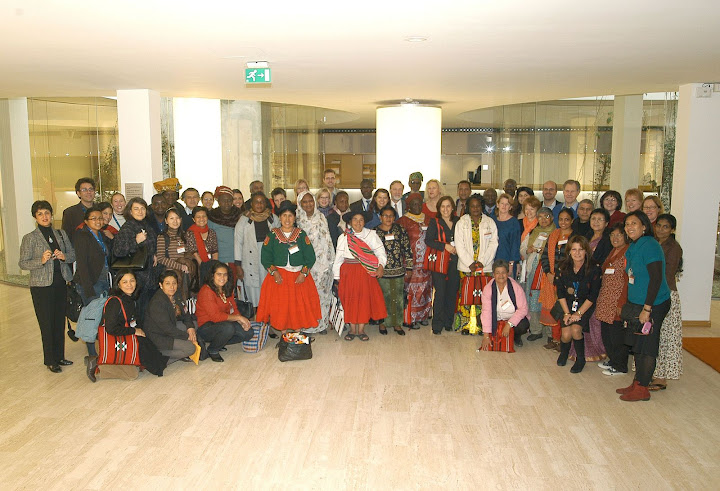 We delegates to the Global Farmers’ Forum 2010 – 61 participants from 27 countries and four continents – IFAD staff and observers, gathered during the Preparatory Workshop to the Farmers’ Forum on Promoting Women’s Leadership in Farmer’ Organizations held on February 12-13, declare the following:
We, women farmers, fishers and pastoralists, call attention once again to the glaring disproportion between women’s roles in all aspects of agriculture across the developing world and the limited recognition, rights, resources and services provided to us. We also raise an alarm over the effect that climate change and the financial crisis are having on us women as they result in increased poverty and food scarcity. Because of poverty and lack of services in rural areas, our sons and daughters do not wish to be farmers and continue to migrate to urban areas. This raises a critical question: How can the profitability and sustainability of farming be secured so as to ensure a future for the next generation of women and men farmers?
Effective and representative producer organizations can provide a powerful instrument to make rural women’s voices heard, so that we can have a greater influence over decisions that affect our lives and livelihoods. But as of yet, our voices have been heard too rarely in our organizations.
The economic empowerment of women and their increased knowledge and skills are essential preconditions to improve our status and livelihoods, and for us to be able to assume effective roles in producer organizations. We therefore urge IFAD and other donors to bring new and significant resources to support the economic empowerment of women farmers. We need these resources to strengthen our knowledge, skills and leadership in order to produce and process food more effectively and sustainably, for our families and also for the markets. We urge IFAD and other donors to direct resources to women’s structures in farmers’ organizations and to require quotas that are respected.
We also specifically call upon IFAD to:
- continue and increase efforts to enable women to increase their access to and control over productive assets including land and water
- support the development and provision of financial services suitable to agriculture, and to enable women’s incomes to grow;
- in addition to mainstreaming gender equality concerns throughout projects and programmes, wherever feasible earmark funds for women in IFAD-funded programmes as an affirmative action measure – for example under community development funds, and in training;
- use grant funding for women’s capacity building – including child care facilities where needed – when it is not possible to finance such activities through a loan;
- where IFAD-funded programmes support access to land and other kinds of property, seek to negotiate for joint titling, supported with legal advisory services to enable women to defend their rights;
- in the context of a much-needed focus on rural youth give attention to the specific situation and needs of young women.
In the context of IFAD’s engagement with farmers’ organizations we recommend that IFAD:
- open spaces for women farmer leaders to participate in country and global policy processes, and also in IFAD country strategy consultations;
- in the design of the projects and programmes that work with farmers’ organizations, establish quotas for women (where possible, not less than 30 per cent, with a view to reaching 50 per cent over time), provide incentives for producer organizations to achieve the targets, and monitor their implementation;
- invest more grant resources in increasing capacity of farmers’ organizations to address gender issues and empower women, and to strengthen women’s leadership – where possible channelling funds directly to women’s structures within organizations;
- involve women leaders of farmers’ organizations in the supervision and monitoring of development programmes.
Finally, we note with satisfaction that the 30 per cent quota of women participants recommended at the last meeting of the Farmers’ Forum has been exceeded this year. We urge that the current proportion of 40 per cent be maintained in subsequent meetings, with a view to further increasing over time.
Subscribe to:
Posts (Atom)
Popular Posts
-
 ADL Board Member's Grandson Transformed as "al Qaeda" Agent Threatens "Islamofascist" Attack on U.S.CAIRO, Egypt -- An American member of al-Qaida warned President Bush on Tuesday to end U.S. involvement in all Muslim lands or face an attac...
 -
According to the account given below, Monsignor Pacelli (later Pius XII) facilitated a meeting between the British Zionist, Mark Sykes, and ...
-
Paul Shamplina, founder of Landlord Action, a company specialising in tenant eviction, comments on the latest Government proposal to make su...
-
 Newsweek has published an except from Benedict XVI's new book, Jesus of Nazareth which he has earlier stated is written as a dialog wit...
 -
The research and writing presented on this blog is not intended as entertainment for a small group of readers. This is an informative blog a...