By Musarat Begum
I am a BA student working on agriculture (kitchen gardening) as a part-time job. I have acquired good experience in producing vegetables using indigenous techniques, seeds from my own plot, and compost from my own compost pits, minimizing the use of chemical fertilizers and pesticides. In this way, the vegetables produced are better tasting and healthy. People in my village prefer buying these vegetable due to good taste and better quality as compared to vegetables that are available in the market. I sell my produce at market rates and this is a factor both attracting my costumers and increasing them day by day.
I belong to a poor family living in a rural area, where the available sources of income are very limited. My father works as a carpenter in the village on a daily wage basis and his income is very low. He has to feed a large family and cover our education expenses too. For this reason, I wished to help my father and do something to generate some income. Therefore, I joined as a volunteer the “Bindra Khanam” female CO & Community Development Foundation a cluster organization working on the agriculture sector. I attended a three-day workshop on kitchen gardening through the IFAD-supported Azad Jammu Kashmir Community Development Programme (AJKCDP). This training enabled me to learn useful techniques to grow vegetables and help my father with kitchen gardening. As a result of this, we were able to produce vegetables for household consumption and to save Rs. 48,000 annually, excluding production costs. I am very happy to have contributed to ensure that my family was able to cover the expenses associated to the education of my brothers and sister. Furthermore, my experience generated a positive impact on successful involvement of young people in agriculture.
In the second year of vegetable production, I managed to increase the vegetable cultivation area and produce even more surplus. Through sales, during the whole year, I earned Rs. 52,000 and saved Rs. 48000. I also dried some vegetables to be consumed during the winter season. All my family members supported me during plugging, sowing, and marketing the vegetables. This was a mutually-learning process, with me being helped by my father and my father learning from my experience.
I believe that commitment, training and skills development in agriculture, better use of local and knowledge resources, and full support from my family were the major factors of success. Nevertheless, I also faced a number of constraints such as water shortage; unavailability of quality seeds, solar drying, storage and packing facilities, and tunnels for off seasons vegetable production; limited access to market; and land erosion.
The following measures could be adopted for agriculture development in rural areas: build water pounds near spring channels to collect and store excess water and use it for dry season; build protecting walls to stop land; grow forest nurseries as well as fruit plant nurseries through community organizations (COs) to promote social forestry and income generation of people; promote small scale dairy farming as well as poultry farming to develop natural resources for organic agriculture development; enhance skills of COs about agriculture, social forestry, poultry and livestock development; and promote organic agriculture through the use of local resources.
Showing posts with label fafo. Show all posts
Showing posts with label fafo. Show all posts
Saturday, February 18, 2012
Monday, December 20, 2010
Celebrating and rewarding motivated and inspiring colleagues
 Those of you familiar with Italian culture know that the superstitious are wary of Friday the 17th, because they believe it brings bad luck. Well, hate to break the news – but we at IFAD survived Friday 17th with flying marks. Here is a brief run-down of our Friday the 17th experience.
Presenting the Rural Poverty Report 2011 in Rome
 As part of the Rural Poverty Report 2011 roll out, on Friday 17 December, we organized a high-level panel discussion at Tempio di Adriano to discuss the report’s themes and findings.
Our very own Mylene Kherallah, a graceful and eloquent mistress of ceremony, welcomed the over 150 participants to the event. Kherallah reminded the audience that the Rural Poverty Report 2011 provides a coherent and comprehensive look at rural poverty, its global consequences and the prospects for eradicating it.
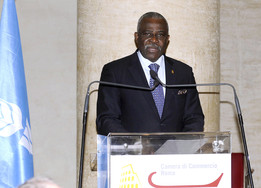 IFAD President, Dr Kanayo Nwanze, taking the floor presented an overview of the report’s themes, findings and recommendations. In his statement, the President highlighted the two significant threats facing the poor rural people: food price volatility and climate change. Nwanze also talked about the profound changes that are happening in rural areas – changes that are bringing new opportunities for progress in the effort to eradicate rural poverty and ensure global food security for decades to come.

When we left Tempio di Adriano around 12:45, we were welcomed by an unusual phenomena for Rome. Talk about climate change – it was snowing. We get a lot of rain in Rome, but snow in Rome, is like having snow in the desert – a rare event and one that never fails to put a smile on everyone’s face.
IFAD staff awards
Later that same afternoon the IFAD staff awards ceremony concluded the week on a celebratory note. This programme recognizes the achievements and accomplishments of colleagues who as individual or as teams ― have made outstanding contributions as:
- leader
- designer or implementer of an innovative or outstanding project within IFAD or in a member country
- effective agent and facilitator of change
What is special and what makes this awards programme different from others is the fact that the nominations come from STAFF. Colleagues nominate colleagues and reward their actions and behaviours because they have done something special.
The IFAD awards programme was informed by Daniel Pink’s paradigm. Pink argues that “the secret to high performance and satisfaction is the deeply human need to direct our own lives, to learn and create new things, and to do better by ourselves and our world”. Inspired by Pink’s thinking, the IFAD award committee composed of Shyam Khadka, Mylene Kherallah, Marie-Paulette Duhart, Maria-Elena Mangiafico, Henock Kifle and Carla Ferreira, in reviewing the nominations, focused on rewarding motivation and more specifically the three elements of true motivation - autonomy, mastery, and purpose.
Pink defines these three elements as follows:
- autonomy, the desire to direct our own lives
- mastery, the desire to continually improve at something that matters
- purpose, the desire to do things in service of something larger than ourselves.
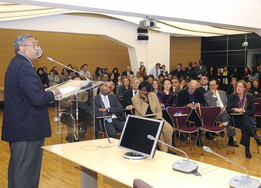 I believe that at IFAD we have space to be creative and inventive. It is up to us as individuals to take advantage of this opportunity and do something special. Yes - we have bureaucracy, yes - every once in a while we may experience a setback, but at the end of it all, if we want, we can bring about change; if we want, we can think out of the box; if we want, we can build something special; if we want, we can put our creativity to good use and if we want, we can continuously improve and do bigger and better things.
It was heart-warming to hear Henock Kifle, Chief Development Strategist and the chairperson of the awards committee reporting that the committee had received 60 nominations. It was even more heart-warming to hear that 14 colleagues were nominated under leadership category, 20 for designing and implementing outstanding projects and 26 for agent and facilitators of change.
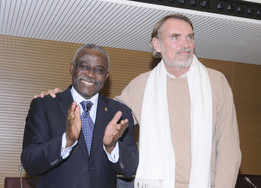 And when Henock started reading the awardees under leadership category and read out the first name – Roberto Haudry – the entire plenary hall broke in a warm applause.
 Roberto was recognized for pioneering and leading highly successful innovations during his long career at IFAD such as his trailblazing role as the first Country Programme Manager (CPM) to be outposted. Similarly, the “Learning Routes” initiative pioneered by Roberto have helped thousands of farmers, rural community leaders and government officials to exchange knowledge, information and experiences through visits to each other’s projects where they see first-hand what can be achieved.
Roberto is a great innovator, a hard worker and someone who never gives up. Thanks to all these qualities, he has led the design and supervision of projects that have produced outstanding results ― achieving the highest average score in management's self evaluations.
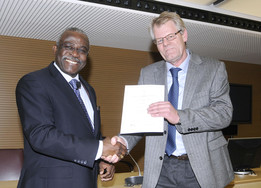 The second awardee in the leadership category was Henning Pederson. Henning stands out for his leadership capabilities in developing a country programmes and projects which are on the cutting edge of development practice, particularly in rural finance and value chain development. Henning was also singled out for his inspiring and empowering management style and as an outstanding mentor.
 And to prove this very point, it was not too much of a surprise, that one of his mentees – Omer Zafar and the Yemen country team –received an award outstanding project category.
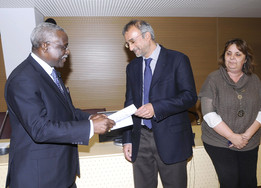 The Yemen country team led by Omer and composed of Dr. Fathia Bahran, Country Programme Officer, Nicole Hervieu and Jessica Lattughi were recognized for having completely transformed the Yemen portfolio from one that was based on a hand-out approach, to one based on creating sustainable economic opportunities that empower poor rural men and women.
 The new project designs for Yemen have been so highly regarded by other donors, including the Islamic Development Bank (IsDB) and the European Union, that they have together invested almost double the amount that IFAD has put it. The World Bank has also expressed interest in investing and the IsDB has recently announced that it stands ready to contribute over US$ 100 million to the forthcoming Yemen project, which focuses on rural employment generation.
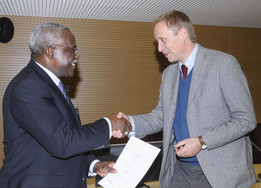 The next awardee in the outstanding project category was Edward Heinemann, the Rural Poverty Report 2011 team leader. Ed was recognized for his outstanding efforts to finalize IFAD’s flagship publication.
 Work on the report started in late 2007 and, while much preparation was done, it became clear in 2009 that the project was losing momentum. In July 2009 senior management asked Ed to take over responsibility for the report.
Ed, assisted by Bettina Prato rolled up his sleeves and started to draft and re-drafted the report several times with support and contributions from IFAD colleagues and external reviewers, producing the excellent report that we have today.
Although only released ten days ago, those of you who follow this blog know that the Report has already received wide praise and is being recognized as one of the most comprehensive studies on the dynamics of rural poverty. A distinctive feature of the report is that it gives a human face to rural poverty through the personal narratives of ordinary poor rural people around the globe. It also advocates a number of important policy measures to tackle rural poverty. These will undoubtedly give impetus and drive the efforts of governments in developing countries and the international community to enhance national and global food security.
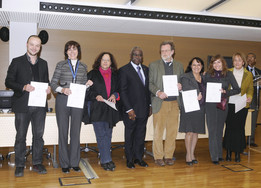 The first award in the agent and facilitator of change category went to the Farmer’s Forum Team coordinated by Jean-Philippe Audinet. The team included:
- Philippe Remy
- Roberto Longo
- Carla De Donato
- Sandra Di Rienzo
- Gisella Barbieri
- Natalia Espinel
- Sylvia Isaia
- Vincent Sineau
Their efforts has led to the organizing the Farmers’ Forum every two years to coincide with the meetings of the Governing Council. In 2010 the Forum featured a special session to promote women’s leadership in farmers’ and rural producers’ organizations. Thanks to the work of the Farmers’ Forum team, IFAD has also continued to support global and regional farmers’ organizations in developing countries. And through their work, IFAD has managed to amplify the voices of the rural poor in various global fora.
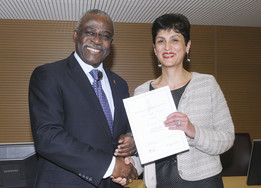 The second awardee in the agent and facilitator of change was yours truly – Roxanna Samii. Those who follow this blog will remember that in February 2010 we used a number of social media and web2.0 tools to report live from the Farmers’ Forum. In a way I partially owe my award to the openness and willingness of the Farmers’ Forum team who embraced the idea of putting these tools into practice.
 I was extremely flattered listening to Henock reading out the following motivation for my award:
“The award pays tribute to the key role Roxanna played in leading the change in the way we communicate. It recognizes Roxy’s tireless dedication and energy to introduce IFAD staff to social media, promote the benefits and advantages of social media at the corporate level, and share her knowledge by conducting awareness-building and training sessions on web 2.0 tools and guiding IFAD staff on how to use social media effectively and professionally.”
“Roxy’s passion, enthusiasm and tireless dedication have anchored social media in IFAD’s communications work and she is commended for empowering her colleagues to become effective users of social media tools. “
I cannot but end this blogpost by referring back to Daniel Pink’s DRIVE paradigm. Pink’s paradigm is pushing us to embrace motivation 3.0 – where people are “motivated by the desire for autonomy over a task, for the mastery of a craft and for a sense of purpose”.
The IFAD awards programme paid tribute to these people. For sure, the 2011 edition will pay tribute to many more motivated and inspiring colleagues.
The six awardees will be receiving the official plaque at the forthcoming Governing Council. So please make sure you stay tuned, as we’ll be using social media and web2.0 tools to bring you live not only the award ceremony but the entire Governing Council event!
For now, Happy Holidays and on behalf of the IFAD social reporting team we wish you a prosperous 2011.
Thursday, August 12, 2010
Investing in young farmers

Youth are often one of the most vulnerable segments of IFAD’s target group, both in terms of access to assets and services and in terms of opportunities and capacities to engage in decision-making processes that determine their livelihood prospects.
Farmer organizations are a key channel for young rural people to develop activities, get access to services and natural resources, and make their needs and concerns heard in decision-making processes.
The Farmers’ Forum was created in 2005 by IFAD, the International Federation of Agricultural Producers (IFAP), La Via Campesina and the Network of Peasant and Agricultural Producers’ Organizations of West Africa (ROPPA). It was designed as process of consultation and dialogue between farmers’ and rural producers’ Organizations (FOs), IFAD and governments focused on rural development and poverty reduction. A global meeting of the Farmers’ Forum was held in February 2010 at IFAD Headquarters where the participants stressed the urgent need to address young farmers in the following way: “Our family agriculture needs to be remunerative and give dignity. Young women and men farmers’ access to production assets – land, credit, and training – has to be ensured”.
In this regard, the participants recommended that IFAD mmainstreams youth in all IFAD policies and programmes, with a gender balance and an emphasis on developing capacity-building and enhancement programmes for rural youth to engage in sustainable food production and agriculture and rural employment.
They particularly recommended that IFAD:
- Map young farmer and rural youth organizations and their networks (national and regional).
- Hold a Farmers’ Forum event similar to the one held for women this year, and ensure more representation of young people in subsequent Farmers’ Forums.
- Designate within IFAD a focal point for youth.
- Hold a global workshop on youth involvement in Sustainable Agriculture and Rural Development during this year (UN Year of Youth).
- Mainstream youth in all IFAD policies and programmes, with a gender balance and an emphasis on developing capacity-building and enhancement programmes for rural youth to engage in sustainable food production and agriculture and rural employment.
- Launch pilot projects supporting rural youth.
- Organize youth exchanges for experience-sharing on best practices and learning”.
To start responding to that request, a specific programme to map key actors, specific issues and success stories in the different regions of IFAD operations is under preparation by MIJARC (International Movement of Catholic Agricultural and Rural Youth), in close collaboration with the Farmers’ Forum Steering committee members, and FAO and CTA.
The programme will develop collaborations with the various on going initiatives within IFAD to address youth issues (for example, the collaboration with the ILO to review strategies and programmes for promoting decent and productive employment of young people in rural areas and projects and grants in regional divisions supporting young people’s activities).
Regional workshops will be organised to define ways of promoting active participation of the young in FOs and in the definition of FOs’ agendas that respond to young peoples’ needs; to improve capacity of FOs to advocate for young rural women and men in gaining access to farming activities; identify tools and methods to support young men and women farmers’ interests in agricultural development programmes through their organizations.
The programme will lead to recommendations in terms of policies and projects to help FOs support young people, women and men, enter and invest sustainably in farming activities. They will be discussed during the next global meeting of the Farmers’ Forum in February 2012.
By Philippe Remy
Tuesday, February 16, 2010
The third global meeting of Farmers' Forum thanks IFAD for establishing the Forum
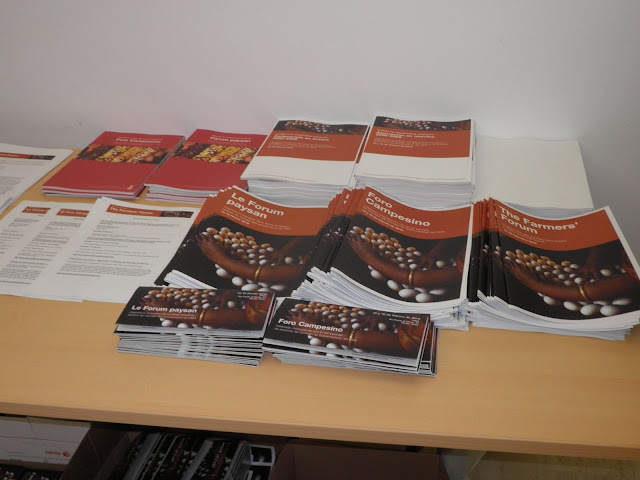
On Tuesday afternoon, 70 farmers' leaders from around the world, representing millions of smallholders and rural producers from all over the world concluded their work at the third global meeting of the Farmers' Forum.
In their synthesis of deliberations they reiteriated the fact that since the last Farmers’ Forum, the world has experienced multiple crises, exacerbated by the global recession and climate change and as a result more people are poor and hungry.
They acknowledged the significance of family agriculture in the world and pledged to campaign for a UN Declaration for International Year of Family Farming.
The farmers indicated that they want agriculture to be controlled by them, the VERY people who cultivate the land and are feeding the world.
In sharing the summary of their deliberations with IFAD's 33rd Governing Council, they indicated there is no effective response to the challenges of food security for all, eradication of extreme poverty and mitigation of climate change without more and better investment in farms and rural communities and more supportive policies for rural development.
They commended IFAD for forging a strong partnership with Farmers’ Organizations and embedding them in Country Programmes. They told IFAD's membership that they highly appreciated the real progress in the consultation and partnership between IFAD, governments and farmer organizations.
They made the following recommendations to IFAD:
- Extend the partnership to all countries where IFAD is operating, taking into account the diversity of the organizations of poor rural people.
- Systematically include at least one national apex organization in the IFAD Country Programme Management Team in order to contribute to the steering of the IFAD country programme (COSOP formulation, project and programme design and implementation, policy dialogue and other initiatives).
- Create a flexible, demand-led facility within IFAD’s budget for facilitating the participation of farmers’ organizations in the COSOP and the project cycle.
- Develop operational guidelines to support the systematic engagement of farmers’ organizations at country level; in particular in the monitoring and implementation of IFAD programmes.
- Ensure that the already strong practice of consultation with farmers’ organizations is systematized; in this regard, IFAD and regional/international farmers’ organizations could maintain a roster of organizations that should be systematically invited when IFAD is about to embark on project design.
- Take stock of important lessons from programmes with farmers’ organizations, with a view to replication and upscaling, and to promote south-south exchanges and knowledge among the farmers. (In this regard, we recommend exploring the possibility replicating the programme ‘Learning Routes’, which was successfully implemented in Latin America.)
Last but not least, both farmer leaders and IFAD President stressed the importance of investing in young farmers. Farmer leaders recommended that IFAD:
- Map young farmer and rural youth organizations and their networks (national and regional).
- Hold a Farmers’ Forum event similar to the one held for women this year, and ensure more representation of young people in subsequent Farmers’ Forums.
- Designate within IFAD a focal point for youth.
- Hold a global workshop on youth involvement in Sustainable Agriculture and Rural Development during this year (UN Year of Youth ).
- Mainstream youth in all IFAD policies and programmes, with a gender balance and an emphasis on developing capacity-building and enhancement programmes for rural youth to engage in sustainable food production and agriculture and rural employment.
- Launch pilot projects supporting rural youth.
- Organize youth exchanges for experience-sharing on best practices and learning.
Monday, February 15, 2010
Summary of women farmer leaders workshop
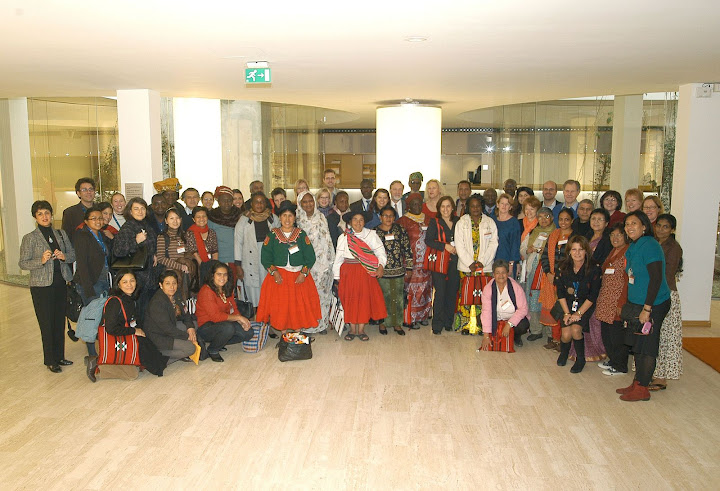 We delegates to the Global Farmers’ Forum 2010 – 61 participants from 27 countries and four continents – IFAD staff and observers, gathered during the Preparatory Workshop to the Farmers’ Forum on Promoting Women’s Leadership in Farmer’ Organizations held on February 12-13, declare the following:
We, women farmers, fishers and pastoralists, call attention once again to the glaring disproportion between women’s roles in all aspects of agriculture across the developing world and the limited recognition, rights, resources and services provided to us. We also raise an alarm over the effect that climate change and the financial crisis are having on us women as they result in increased poverty and food scarcity. Because of poverty and lack of services in rural areas, our sons and daughters do not wish to be farmers and continue to migrate to urban areas. This raises a critical question: How can the profitability and sustainability of farming be secured so as to ensure a future for the next generation of women and men farmers?
Effective and representative producer organizations can provide a powerful instrument to make rural women’s voices heard, so that we can have a greater influence over decisions that affect our lives and livelihoods. But as of yet, our voices have been heard too rarely in our organizations.
The economic empowerment of women and their increased knowledge and skills are essential preconditions to improve our status and livelihoods, and for us to be able to assume effective roles in producer organizations. We therefore urge IFAD and other donors to bring new and significant resources to support the economic empowerment of women farmers. We need these resources to strengthen our knowledge, skills and leadership in order to produce and process food more effectively and sustainably, for our families and also for the markets. We urge IFAD and other donors to direct resources to women’s structures in farmers’ organizations and to require quotas that are respected.
We also specifically call upon IFAD to:
- continue and increase efforts to enable women to increase their access to and control over productive assets including land and water
- support the development and provision of financial services suitable to agriculture, and to enable women’s incomes to grow;
- in addition to mainstreaming gender equality concerns throughout projects and programmes, wherever feasible earmark funds for women in IFAD-funded programmes as an affirmative action measure – for example under community development funds, and in training;
- use grant funding for women’s capacity building – including child care facilities where needed – when it is not possible to finance such activities through a loan;
- where IFAD-funded programmes support access to land and other kinds of property, seek to negotiate for joint titling, supported with legal advisory services to enable women to defend their rights;
- in the context of a much-needed focus on rural youth give attention to the specific situation and needs of young women.
In the context of IFAD’s engagement with farmers’ organizations we recommend that IFAD:
- open spaces for women farmer leaders to participate in country and global policy processes, and also in IFAD country strategy consultations;
- in the design of the projects and programmes that work with farmers’ organizations, establish quotas for women (where possible, not less than 30 per cent, with a view to reaching 50 per cent over time), provide incentives for producer organizations to achieve the targets, and monitor their implementation;
- invest more grant resources in increasing capacity of farmers’ organizations to address gender issues and empower women, and to strengthen women’s leadership – where possible channelling funds directly to women’s structures within organizations;
- involve women leaders of farmers’ organizations in the supervision and monitoring of development programmes.
Finally, we note with satisfaction that the 30 per cent quota of women participants recommended at the last meeting of the Farmers’ Forum has been exceeded this year. We urge that the current proportion of 40 per cent be maintained in subsequent meetings, with a view to further increasing over time.
Farming is a business: A unanimous call from farmers from all over the world attending the third global meeting of Farmers' Forum
The third global meeting of the Farmers' Forum is now underway. This morning IFAD President welcomed 70 farmers' leaders from around the world, representing millions of smallholders and rural producers from all over the world.
In his statement the President made a strong case for investing more in agriculture and smallholder farmers. The President said: "if we know that 85% of all farmland worldwide is less than 2 ha in size (in the developing world it is as low as ¼ ha); if we know that 500,000 million smallholders produce 80% of the food we consume in the developing world; that they live in rural areas and make up the majority of the rural poor; and if we know that over 60% of the rural population is made of youths with over 50% being young women and girls. If we know all this, I ask you, ladies and gentlemen, who will feed the world in 2020, in 2030 or in 2050 by which time we would have added another 3 billion people, 50%, to our population?" He continued to say: "We must invest in the rural youth of today, the farmers of tomorrow".
The President talking about Africa said: "I am also absolutely convinced that Africa can feed itself, just as Viet Nam and China have done. Africa has the human and natural resources it needs to achieve agricultural growth and food self-sufficiency. What is needed is committed local leadership.... And this is what I have been calling to African leaders. "
"And I will repeat my call: No nation, no people achieved economic development unless it comes from within and agriculture is the foundation for it; after all, development is an intrinsic and endogenous process."
The President concluded by mentioning that "there are still a number of countries were IFAD’s cooperation with farmers organizations is limited. He indicated that we need to reach out further and deeper and develop these connections."
"We must work together to strengthen the linkages of your organizations with the grassroots levels and invest in the village-level advocacy to have an impact at the ground level and to improve the inclusive basis of our partnerships", said Nwanze.
"We need to develop the advocacy role of the farmers’ organizations in the national policy debate". The President concluded his statement by stating that "we need to engage rural youth in agricultuture; help them organise themselves into young farmers associations, provide opportunities for capacity building and training; institutional linkages and market informations. They are the food producers of tomorrow. "
Following the President's statement, the members of the steering committe (IFAP, LVC, WFFP, WFF, AFA, COPROFAM, ROPPA) made short statements echoing:
In his statement the President made a strong case for investing more in agriculture and smallholder farmers. The President said: "if we know that 85% of all farmland worldwide is less than 2 ha in size (in the developing world it is as low as ¼ ha); if we know that 500,000 million smallholders produce 80% of the food we consume in the developing world; that they live in rural areas and make up the majority of the rural poor; and if we know that over 60% of the rural population is made of youths with over 50% being young women and girls. If we know all this, I ask you, ladies and gentlemen, who will feed the world in 2020, in 2030 or in 2050 by which time we would have added another 3 billion people, 50%, to our population?" He continued to say: "We must invest in the rural youth of today, the farmers of tomorrow".
The President talking about Africa said: "I am also absolutely convinced that Africa can feed itself, just as Viet Nam and China have done. Africa has the human and natural resources it needs to achieve agricultural growth and food self-sufficiency. What is needed is committed local leadership.... And this is what I have been calling to African leaders. "
"And I will repeat my call: No nation, no people achieved economic development unless it comes from within and agriculture is the foundation for it; after all, development is an intrinsic and endogenous process."
The President concluded by mentioning that "there are still a number of countries were IFAD’s cooperation with farmers organizations is limited. He indicated that we need to reach out further and deeper and develop these connections."
"We must work together to strengthen the linkages of your organizations with the grassroots levels and invest in the village-level advocacy to have an impact at the ground level and to improve the inclusive basis of our partnerships", said Nwanze.
"We need to develop the advocacy role of the farmers’ organizations in the national policy debate". The President concluded his statement by stating that "we need to engage rural youth in agricultuture; help them organise themselves into young farmers associations, provide opportunities for capacity building and training; institutional linkages and market informations. They are the food producers of tomorrow. "
Following the President's statement, the members of the steering committe (IFAP, LVC, WFFP, WFF, AFA, COPROFAM, ROPPA) made short statements echoing:
- the need to focus on women and youth in developing agricultural policies
- the need to focus on issues such as land entitlement and ownership
- the fact that commercialization of smallscale agriculture is the way forward
During the course of the day, the participants interacted with IFAD staff and selected partners and attended regional working group sessions to share the progress achieved to date and discuss future goals for partnerships with farmer organizations at national and regional levels.
Stay tuned on this channel! The social reporting team will be bringing live soundbites and stories from this workshop and from the Third Global Farmers' Forum. Follow us on Twitter (@ifadnews) and on this social reporting blog (http://ifad-un.blogspot.com/).
Saturday, February 13, 2010
Women farmer leaders meet in Rome to discuss their challenges and opportunities
The workshop on promoting womens' leadership in farmers' organizations kicked off the Third Global Farmers' Forum. This workshop is very unique, so unique that even the weather decided to do something unique. On Friday, it snowed in Rome!!!
The workshop brings together some 40 women and men farmer leaders. In most developing countries, women perform a large part of the agricultural work and produce the bulk of the world’s food crops. The productivity of women farmers is constrained by the same factors that affect small agricultural producers in general, which are in turn compounded by gender-specific factors. These include:
- lack of time and limited mobility due to multiple domestic and productive responsibilities;
- women’s more limited access to assets and services (including extension);
- illiteracy;
- low participation and limited decision-making in producers’ organizations; and
- socio-cultural factors affecting their mobility and participation in public decision-making.
On the other hand, women have a unique base of experience and knowledge that can be used to increase the productivity of smallholder agriculture in the broadest sense. Without a significant investment in improving the livelihoods, assets and decision-making power of rural women, the Millennium Development Goals of reduced poverty and food insecurity are unlikely to be achieved.
The workshop will discuss the importance of maintaining the focus on mixed farmers’ organizations, while recognizingthat women must have their own space within these confines. During the workshop, the participants will discuss challenges and opportunities for women farmer leaders such as:
- constraints of lack of self-esteem and low levels of education
- capacity-building as an important means to promote gender equality for rural women;
- the need to concentrate on increasing women’s negotiation skills, self-esteem and leadership capacities, and put in place supportive measures such as child care facilities during training sessions
- involving men in gender-related activities and enlisting men as champions of women’s
increased leadership roles are important approaches to gain their support - gender-sensitization training, aimed at challenging gender stereotypes and norms and the
perpetuation of traditional gender roles should be provided to women and men - sharing knowledge, exchanging experiences and networking among women are critical for
women’s empowerment
Estrella Penunia, gave a passionate keynote address, in which she said: "Women farmers will not remain victims, we're key solution providers, nothing about us without us". She made a plea to move away from gender stereotypes and reminded the participants and audience that women should be at the forefront of the agriculture. She said: "If we earn more, we can spend more on food, education, health." Estrella then continued to say "Women perform magic to put food on the table".
In her keynote address, Estrella shared with the gathering that "in many developing countries women cannot owe land, yet we are the one who cultivate the land and take care of land."
She continuted to say that "50-90% of work in farms is done by women and women ensure food security when crops fail."
Estrella Penunia and other women leaders such as Elisabeth Atangana, Kati Partanen and all the women farmer leaders showed passion in their interventions. Elisabeth remarked: "If women don't have economic power, they can't do very much. Women need access to financial resources, and access to land".
As Estrella said: "Women work with personal touch, we need to help more women farmer leaders to further unleash their potential".
Makanjuola Olaseinde Arigbede took the floor and made a passionate case for empowering women. He said: "there is gender discrimination: If women choose farming, their possibility of marriage diminishes". "Men should recognize women as an effective farmer and a partner", he said.
Stay tuned on this channel! The social reporting team will be bringing live soundbites and stories from this workshop and from the Third Global Farmers' Forum. Follow us on Twitter (@ifadnews) and on this social reporting blog (http://ifad-un.blogspot.com).
Thursday, February 11, 2010
IFAD's Governing Council, an occasion for many debuts
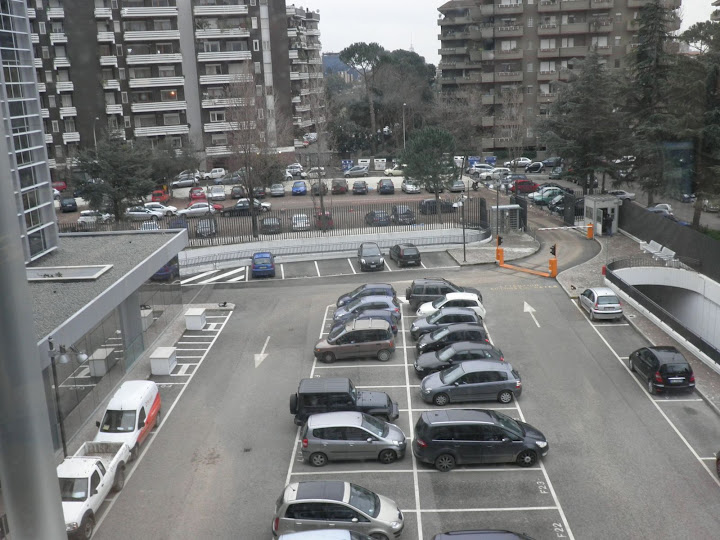 For the first time in IFAD's history we are holding our annual Governing Council at our headquarters. Like any debut, the making of the GC is an exciting and unique experience. For the first time, all of us, and not only those closely involved in the preparations are experiencing the making of the Governing Council. Many colleagues have commented that "now that we are seeing it all happening under our nose, we feel part of it".
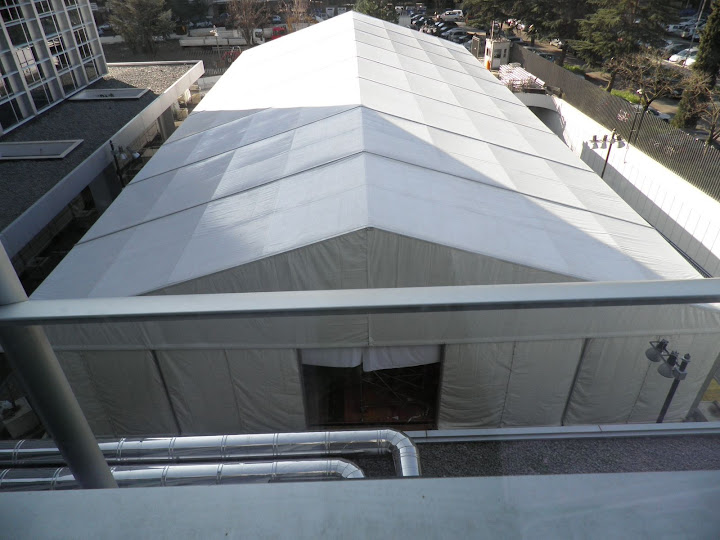 On Monday morning, when we came to the office we saw a tent erected in our outside parking space. This was the first visible sign of the GC preparations. Everyone was amazed how in just less than 48 hours the workers had managed to put up the tent. The tent will be the heart of the event serving as the plenary hall.
For safety reasons, administrative services declared the whole area off-limits. But your social reporting team was granted special access to visit the construction site on regular intervals to share with you the making of the GC.
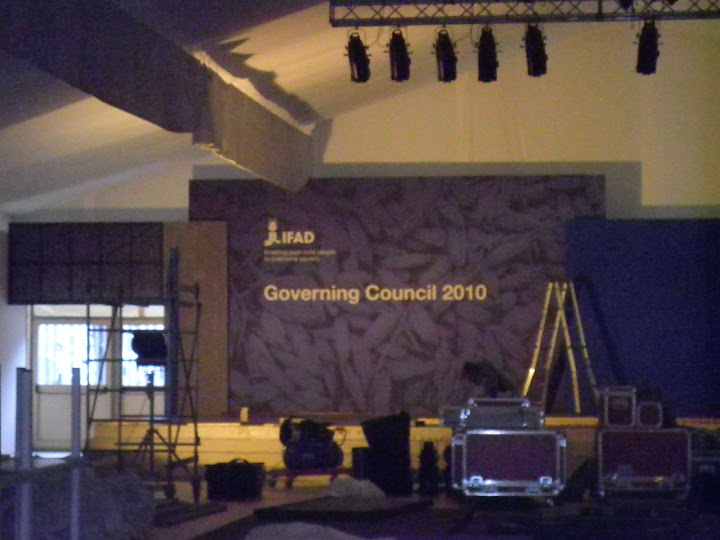 Over the last couple of days, we've seen the tent come life and I must admit both the outside and inside the tent looks absolutely fabulous. My colleague who provided the creative inspiration and my administrative services colleagues were telling me that they been receiving so many compliments.
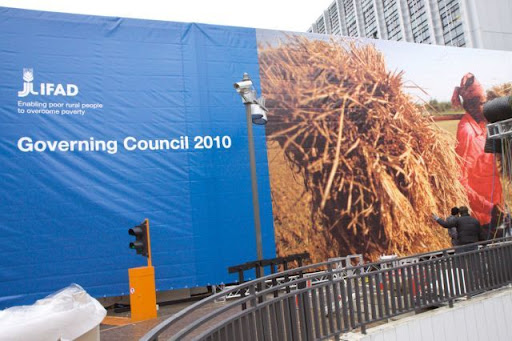 This whole undertaking is another testimony of the commitment, inventiveness and passion of IFAD staff. Everyone is doing their bit to make this debut a smashing success.
In another debut, this year the IFAD social reporting team will use social media to report live from the Third Global Meeting of Farmers' Forum and the Thirty-third session of the Governing Council.
 We'll be using Twitter and this social reporting blog to share the highlights of the Farmers' Forum and the Governing Council. Make sure you follow us on Twitter @ifadnews and you can use the blog and Twitter to pose your questions and comments.
Looking forward to "hearing from you".
Watch the making of the GC tent
Subscribe to:
Posts (Atom)
Popular Posts
-
 ADL Board Member's Grandson Transformed as "al Qaeda" Agent Threatens "Islamofascist" Attack on U.S.CAIRO, Egypt -- An American member of al-Qaida warned President Bush on Tuesday to end U.S. involvement in all Muslim lands or face an attac...
 -
According to the account given below, Monsignor Pacelli (later Pius XII) facilitated a meeting between the British Zionist, Mark Sykes, and ...
-
Paul Shamplina, founder of Landlord Action, a company specialising in tenant eviction, comments on the latest Government proposal to make su...
-
 Newsweek has published an except from Benedict XVI's new book, Jesus of Nazareth which he has earlier stated is written as a dialog wit...
 -
The research and writing presented on this blog is not intended as entertainment for a small group of readers. This is an informative blog a...