Showing posts with label rpr2011. Show all posts

Sunday, May 1, 2011

Small farmers can energize rural economies in Africa, they hold the future of food security in their hands

by Tina Joemat-Pettersson and Kanayo F. Nwanze


As news headlines scream fresh concerns about global food security – and as many African countries continue to struggle with poverty and hunger – too little attention is being directed at what could be a major part of the solution to all this: smallholder farming.

Africa’s smallholder farmers not only have the potential to produce enough food for export – and thereby contribute to food security worldwide – but also to lead the way to robust growth and development across the continent.

It is an accepted fact that price volatility for agricultural commodities is no longer the exception, but the norm. And we believe that, with the right kind of investment, access to information services and markets, African farmers can lead an economic renaissance on the continent.

But to get there we have to accelerate the investments and policy prescriptions that will invigorate African agriculture and empower smallholder farmers to increase their productivity and their success.

The first steps in this direction are already showing great promise. Thanks to new policies and innovative investments by national governments, donor countries and multilateral organizations – as well as many civil society organizations and private sector enterprises – rural women and men in a number of African countries are reaping the benefits of access to markets where they can purchase seeds and fertilizers, and where they can sell the crops they grow. They are responding by increasing their yields, increasing their production and increasing their marketed surplus. And their surrounding communities are benefiting from this.

But much more needs to be done for people living and working in sub-Saharan Africa’s rural areas to enable them to raise their productivity and increase their incomes.

According to the recently released Rural Poverty Report 2011 by the International Fund for Agricultural Development (IFAD), sub-Saharan Africa has the highest incidence of rural poverty anywhere in the world, and is the only region in the world where the numbers of rural people living in extreme poverty is still on the rise. More than 300 million rural people on the continent – some 60 per cent of the rural population – live in extreme poverty.

The importance of farming as an income source on the continent cannot be underestimated. Agricultural markets are changing. No longer do we need to think exclusively in terms of export crops; new market opportunities are emerging on Africa’s own doorstep. As cities expand and incomes increase, people in the urban areas are changing their eating habits and are becoming consumers who want more meat, dairy products and vegetables, and they expect higher quality standards – we are seeing this across the continent. And agricultural value chains are expanding and becoming better organized to respond to this new demand. These modern markets bring with them their own challenges for some smallholder farmers in terms of higher entry costs, but the potential opportunities they bring cannot be overlooked.

So what needs to happen to make the most of these opportunities, and for smallholder agriculture in Africa to lead the way to economic growth and food security?

For starters, national governments and the international community need to reverse the longstanding neglect of rural development. We need to improve governance in rural areas and create a better economic environment for smallholder farmers to succeed and grow not only food but their businesses as well.

We need to invest in rural infrastructure. Nearly a third of the rural population in Africa lives more than five hours away from a market town, and fewer than 20 per cent live within an hour of a market town. Only one in five Africans has access to a national electricity grid. Targeted investments in road-building and utility construction can go a long way toward improving farmers’ capabilities and access to markets.

Similarly, we need to make investments in the education and skills of rural people so that they themselves can make the most of new opportunities to engage in agricultural markets or work in non-farm industries. This should include strengthening their collective capabilities – and particularly farmers’ organizations – so that they can support each other in managing the risks they face, learn new techniques for improving their productivity, and market their products.

Importantly, our investments need to recognize and address the major challenges and risks that rural people in Africa face – such as the deterioration of the natural resource base, growing competition for land and water, and the effects of climate change on the rural landscape. We need to help small farmers not only to become more productive, but to farm in a way that is more sustainable in their use of natural resources, and more resilient to the shocks of climate change.

The rural poor are not charity cases. They are people whose innovation, dynamism and hard work will ultimately lead the way into a new era of growth, development and prosperity across Africa.

If we can succeed in creating the conditions for poor rural people in Africa to move permanently out of subsistence and into the marketplace – in country after country – then we will have our best chance to transform Africa into a continent that not only feeds itself, but also exports surpluses to increase global availability of food. What a momentous and welcome accomplishment that would be.


Tina Joemat-Pettersson is South Africa’s Minister of Agriculture, Forestry and Fisheries. Kanayo F. Nwanze is President of the International Fund for Agricultural Development (IFAD), an international financial institution and a specialized UN agency. They will be participating in a 3 May event in Cape Town, New challenges, new opportunities: African agriculture in the 21st Century convened to discuss IFAD’s Rural Poverty Report 2011.

Monday, April 4, 2011

Positive news for world's poor

By Kanayo F Nwanze
IFAD President

What would your life be like if you were one of the 1.4 billion women, men and children who live in extreme poverty?

Chances are you would live in a rural area, as do 70 per cent of the world's extremely poor people.

Like Li Guimin from China, you would worry about the exodus of young people from your community as they seek opportunities but likely face worse poverty in distant cities.

Like Shazia Bibi from Pakistan, you might wonder if your garlic can compete at the market with lower priced imports and whether you will earn enough to pay your children's school fees and buy your heart medicine.

And like Ribita Iobete, a farmer in Kiribati, you would be concerned about the shrinking size of your coconuts due to intrusions of seawater - an ominous repercussion of climate change in a country where ''high ground'' is just two metres above sea level.

But there is good news, and it is being discussed at meetings in Canberra this week. A new report issued by the International Fund for Agricultural Development reveals that more than 350 million rural people have pulled themselves out of extreme poverty over the last 10 years. The percentage of the world's rural inhabitants living on less than $1.20 a day has dropped from nearly half to about one third.

East Asia has accounted for much of the progress. Standouts are China and other emerging economies such as Vietnam, where the number of extremely poor people in rural areas fell by two thirds from 365 million to 117 million. So did the rate of extreme poverty, which declined from 44 to 15 per cent.

But poverty remains pervasive, especially in sub-Saharan Africa. Though its rate of rural poverty has fallen slightly in the last decade, it is still above 60 per cent. And not far from Australia's own shores, South Asia is home to half of the world's one billion extremely poor rural people.

Yet change is under way in rural areas, giving rise to hope while also exposing challenges.

These include increasingly volatile food prices, which complicate life for rural people as both producers and buyers of food. Other emerging threats include deterioration of natural resources, growing competition for land and water, and as Australians know only too well increasingly severe weather events worsened by climate change.

But good things are happening too. As cities expand and the world becomes more urbanised, the demand for high-value food is growing, expanding markets for farmers.

And while agriculture continues to drive rural growth engaging four-fifths of rural households worldwide at some level technological advancements and changes in the global economy are also creating jobs off the farm. The accelerating search for renewable energy sources around the world only increases the potential for growth.

All of this creates opportunities for poor rural women and men to lift themselves out of poverty and create a future for their children. But making the most of it requires policies and investments that are both market oriented and environmentally sustainable.

For starters, governments and the international community need to reverse the long-standing neglect of rural development. We need to improve governance in rural areas and create an economic environment that will allow small holder farmers to grow both food and their businesses.

We need to invest in rural infrastructure and in building the skills of rural people so they can exploit new opportunities in agricultural markets or find jobs in non-farm industries. If we help them strengthen their collective capabilities, they will be able to support each other in managing risks, learning new techniques to improve productivity and marketing their products.

And we need to invest in youth. In developing countries, young people aged 15 to 24 make up 20 per cent of the population. In rural areas, many of them are growing up on small holder farms. We must invest in those young, creative minds so they can develop the skills to run their farms like small businesses.

Anyone who has spent any time with farmers in developing countries knows that they are dynamic, innovative people whose hard work will ultimately lead the way to development and prosperity.

At stake is the security of the global food supply. Agricultural production must increase 70 per cent by 2050, and output in developing countries will have to double, if we are to keep food on the table for the nine billion people expected on earth by then.

I have no doubt that Li, Shazia and Ribita are up to the challenge. Are the rest of us?


Originally published in The Canberra Times

Wednesday, January 26, 2011

Smallholders Play Fundamental Role as Business Partners in Feeding the World

By Kanayo F. Nwanze (this blogpost was originally posted on the World Economic Forum blog)

What do the heads of multibillion-dollar companies and those working in development have in common with millions of small farmers? They all know that agriculture can transform economies and lives, allowing people to move out of poverty.

Nearly one billion people go hungry every day. Most live in the rural areas of developing countries. With food prices once again soaring, clearly more needs to be done so that all people have enough to eat. But if we focus only on feeding people today, we will be doing nothing to prevent hunger in the future. 

We must create the conditions for poor rural people to move permanently out of subsistence and into the marketplace.  GDP growth generated by agriculture is at least twice as effective in reducing poverty as growth in other sectors. And experience repeatedly shows – in China, Ghana, Viet Nam and elsewhere – that smallholders can lead agricultural growth.   

The New Vision for Agriculture, to be unveiled this week in Davos, recognizes the fundamental role of smallholders as business partners in feeding the world, protecting our planet and creating prosperity.
 
Ensuring global food security will require the collective will to create an enabling environment for smallholders,  while addressing the weaknesses in global food and agricultural markets. Only then will we be able to create a business-oriented agriculture sector in developing countries and, in so doing, sow the seeds for a more nutritionally secure world. I am looking forward to the discussions in Davos and hope that this year’s meeting will spur leaders not just to listen and debate, but to take action.

For the most up-to-date, comprehensive assessment of rural poverty, see IFAD’s Rural Poverty Report 2011.

Prospering despite climate change: A lot of ground covered. What stones have we left unturned?

The climate change breakout session of the Conference on New Directions for Smallholder Agriculture was based on (Director of IIED) Camilla Toulmin’s  paper “Prospering Despite Climate Change.”   I’ll use the sum-up by the session chair, IFAD’s Director of Environment and Climate, Elwyn Grainger-Jones, to run through the key points.

  • We are seeing impacts today, and urgency for action is growing: current science and emissions reductions commitments are taking us to a 4 degree Celsius average global temperature increase – with extremes of up to 10 degrees Celsius at the N. and S. Poles.  Also, science is increasingly telling us that the speed of change is increasing.  There will be limits to adaptation: some changes will be impossible to adapt to, some may be possible but too expensive to adapt to. Adaptation is not a cure: although from a livelihoods perspective some said it should be our first concern.
  • Climate change is increasing the scale and the unpredictability of risk. Camilla Toulmin stressed, the past is no longer a good guide to the future. New risks are also appearing. Climate finance commitments need to be invested in research and technologies; info and communications tools; resource rights; bridging local and modern science; social infrastructure and learning; infrastructure like roads and storage; increasing market engagement and better governance…. to build resilience. We also need to distinguish between risk – which we can plan for – and uncertainty – which we can’t. So, spread risk, build resilience.
  • Nahu Senaye Araya, the former CEO of Nyala Insurance S.C. (Ethiopia) explained how that company is offering weather risk insurance products (based on farmer demand, including livestock and crops) to smallholder clients through associations and unions. He stressed that the unpredictability of climate made weather index-based insurance premiums (20% of insured sum) much more expensive than mixed insurance packages – health, fire, death (5% of insured sum). Can the poorest afford 20% (or 5% for that matter)? He explained that it was difficult for Nyala to get reinsurance on international markets due to lack of experience with the product and also lack of country specific knowledge and data for use by international re-insurers (what happens to payouts in bad years?). He urged the development to stop the 1-year cycle of aid provision in favour of a 3 to 5 year cycle of support, including through subsidies to bring down premiums in the short run for smallholders. View Mr. Araya’s excellent PPT presentation.
  • Francesco Tubiello of GET-Carbon reminded us that agriculture’s window of opportunity in carbon markets in closing as the Kyoto Protocol is unlikely to be extended post-2012 – and we must reach out to the negotiators to keep agriculture on the radar. They need reminding that in addition to CO2, emissions include nitrous oxide, methane, etc. not covered under market mechanisms. Given the increasing sums committed for climate change support, but the shifting allocation modalities, he suggested we need to concentrate efforts where both adaptation and mitigation can be achieved (integrated, climate-smart approaches), especially where smallholders are concerned.
  • Following on the “multiple wins imperative” Elwyn noted that – luckily – many of the sustainable intensification or eco-agriculture or landscape approaches (choose your term), such as conservation agriculture and agro-forestry, actually increase resilience and also reduce emissions as they reduce poverty and increase productivity.
  • Knowledge was a recurring theme both in terms of missing knowledge causing unpredictability and how knowledge and skills can build individual and community resilience under changing scenarios. Bioversity International’s Deputy Director General, Kwesi Atta-Krah, pointed out “the genetic resources you have today may be useful not to you, but to another country in the future” and stressed support to preserving and exchanging genetic gene pools. ICIMOD’s Dhrupad Chowdhury told us that indigenous communities in marginal and remote areas often employ the most diversified livelihood strategies and genetically robust crops - ready made for adaptation learning, and perhaps even “saleable”. The lead author of IFAD’s Rural Poverty Report 2011 added from the floor that in addition to knowledge about planting and cropping techniques, pest management or new seed technologies, smallholders should also be provided with portable, intangible knowledge and skills to help them adapt and adopt new technologies as challenges and changes arise – including displacement / migration.
 So much more was shared by the fantastic paper presenters, discussants and participants – migration issues, youth education as an investment for family-level resilience, MRV… the 2 hours went by in a flash. Do you think something important is missing from the discussion?

By Jeff Brez

Tuesday, January 25, 2011

Breakfast with Sir Gordon Conway: learning about the genesis of participatory rural appraisal

IFAD's Conference on New Directions for Smallholder Agriculture brought together numerous leading development actors. One among them is Sir Gordon Conway.

Last night, I had the pleasure of listening to a presentation by Sir Gordon. What struck me was how he managed to convey complex concepts in such a natural way. And this was because he actually told us a story - another example of the power and potential of story telling. Maybe next time, anyone out there decides to do a powerpoint presentation, they can at least try and give it a nice plot and actually TELL the story, rather than reading the slides!

This morning, I decided to be bold and ask Sir Gordon whether he would agree to do a short interview. It was a privilege and an honour to have this short conversation with him.

In less than 4 minutes he:
  • shared an important piece of rural development history: the genesis of participatory rural appraisal 
  • complimented IFAD for doing analytical work which is grounded in farmer's realities and challenged us to boil down the messages of comprehensive approach to smallholder development emerging from the  Rural Poverty Report 2011 to simple messages so that the people can understand and act upon them
  • challenged IFAD to do more on climate change and to take the lead on climate change and agriculture
  • shared his optimism on future of agriculture by saying that smallholder farmers in developing countries can feed the world and ensure food security. What we need to do is to use the available the technology and link farmers with markets and the outside world

Wednesday, January 12, 2011

We need to help smallholder farmers become a bigger part of the solution to food security

Robert Zoellick ("Free markets can still feed the world") rightly acknowledges smallholder farms as part of the solution to food security. The Rural Poverty Report 2011, issued by the International Fund for Agricultural Development (IFAD), makes it clear how important they are.

In many developing countries a majority of smallholder farmers are net food buyers, and rural households make up a substantial majority of the world’s 900 million-plus hungry. Helping smallholders to increase their productivity and marketed supply is thus perhaps the most important thing that can be done to reduce the number of hungry people in the world. Yet we also know that many smallholder farmers are facing growing difficulties – soil erosion, declining soil fertility, salination of arable lands, growing scarcity of water, and increasingly volatile and uncertain weather patterns – and these are undermining agricultural production in large parts of the developing world.

So yes, we need to help smallholder farmers become a bigger part of the solution to food security, but that needs to go hand-in-hand with also helping them to farm in a way that is more sustainable in its use of the natural resource base, and more resilient to the ever-growing impacts of climate change. It's a challenge that is given added urgency by the need to feed a global population that will likely exceed 9 billion by the year 2050. The alternative is continued hunger, mass migration and a threat to the social stability of many developing countries.

Download the Rural Poverty Report 2011. 

Monday, December 20, 2010

Celebrating and rewarding motivated and inspiring colleagues

Those of you familiar with Italian culture know that the superstitious are wary of Friday the 17th, because they believe it brings bad luck. Well, hate to break the news – but we at IFAD survived Friday 17th with flying marks. Here is a brief run-down of our Friday the 17th experience.

Presenting the Rural Poverty Report 2011 in Rome
As part of the Rural Poverty Report 2011 roll out, on Friday 17 December, we organized a high-level panel discussion at Tempio di Adriano to discuss the report’s themes and findings.

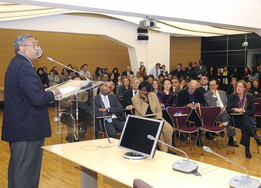
Our very own Mylene Kherallah, a graceful and eloquent mistress of ceremony, welcomed the over 150 participants to the event. Kherallah reminded the audience that the Rural Poverty Report 2011 provides a coherent and comprehensive look at rural poverty, its global consequences and the prospects for eradicating it.

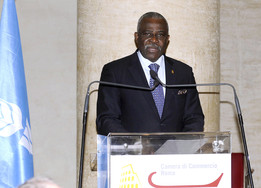
IFAD President, Dr Kanayo Nwanze, taking the floor presented an overview of the report’s themes, findings and recommendations. In his statement, the President highlighted the two significant threats facing the poor rural people: food price volatility and climate change. Nwanze also talked about the profound changes that are happening in rural areas – changes that are bringing new opportunities for progress in the effort to eradicate rural poverty and ensure global food security for decades to come.

Following Dr Nwanze’s statement, a panel of eminent experts in rural poverty and food security moderated by Marta Dassu, Director-General for International Activities at the Aspen Institute Italia, featuring Hafez Ghanem, Assistant Director-General of the Food and Agriculture Organization of the United Nations; Uma Lele, an agricultural economist and former senior advisory to the World Bank; John Sender, Emeritus Professor of Economics, School of Oriental and African Studies at the University of London and Kevin Cleaver, Associate Vice-President for Programmes at IFAD, shared their views on the themes raised in the Rural Poverty Report and engaged in a compelling conversation with the audience.

Mylene concluding the event highlighted that for IFAD, the high level of interest in the Rural Poverty Report 2011 is a validation of our work, and it inspires us to re-double our efforts to eradicate rural poverty.

When we left Tempio di Adriano around 12:45, we were welcomed by an unusual phenomena for Rome. Talk about climate change – it was snowing. We get a lot of rain in Rome, but snow in Rome, is like having snow in the desert – a rare event and one that never fails to put a smile on everyone’s face.

IFAD staff awards
Later that same afternoon the IFAD staff awards ceremony concluded the week on a celebratory note. This programme recognizes the achievements and accomplishments of colleagues who as individual or as teams ― have made outstanding contributions as:
  • leader
  • designer or implementer of an innovative or outstanding project within IFAD or in a member country
  • effective agent and facilitator of change

What is special and what makes this awards programme different from others is the fact that the nominations come from STAFF. Colleagues nominate colleagues and reward their actions and behaviours because they have done something special.

The IFAD awards programme was informed by Daniel Pink’s paradigm. Pink argues that “the secret to high performance and satisfaction is the deeply human need to direct our own lives, to learn and create new things, and to do better by ourselves and our world”. Inspired by Pink’s thinking, the IFAD award committee composed of Shyam Khadka, Mylene Kherallah, Marie-Paulette Duhart, Maria-Elena Mangiafico, Henock Kifle and Carla Ferreira, in reviewing the nominations, focused on rewarding motivation and more specifically the three elements of true motivation - autonomy, mastery, and purpose.

Pink defines these three elements as follows:
  • autonomy, the desire to direct our own lives
  • mastery, the desire to continually improve at something that matters
  • purpose, the desire to do things in service of something larger than ourselves.
I believe that at IFAD we have space to be creative and inventive. It is up to us as individuals to take advantage of this opportunity and do something special. Yes - we have bureaucracy, yes - every once in a while we may experience a setback, but at the end of it all, if we want, we can bring about change; if we want, we can think out of the box; if we want, we can build something special; if we want, we can put our creativity to good use and if we want, we can continuously improve and do bigger and better things.

It was heart-warming to hear Henock Kifle, Chief Development Strategist and the chairperson of the awards committee reporting that the committee had received  60 nominations. It was even more heart-warming to hear that 14 colleagues were nominated under leadership category, 20 for designing and implementing outstanding projects and 26 for agent and facilitators of change.

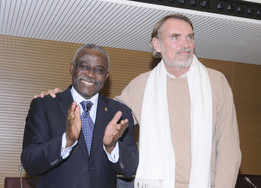
And when Henock started reading the awardees under leadership category and read out the first name – Roberto Haudry – the entire plenary hall broke in a warm applause.
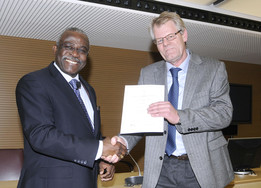
Roberto was recognized for pioneering and leading highly successful innovations during his long career at IFAD such as his trailblazing role as the first Country Programme Manager (CPM) to be outposted. Similarly, the “Learning Routes” initiative pioneered by Roberto have helped thousands of farmers, rural community leaders and government officials to exchange knowledge, information and experiences through visits to each other’s projects where they see first-hand what can be achieved.

Roberto is a great innovator, a hard worker and someone who never gives up. Thanks to all these qualities, he has led the design and supervision of projects that have produced outstanding results ― achieving the highest average score in management's self evaluations.

The second awardee in the leadership category was Henning Pederson. Henning stands out for his leadership capabilities in developing a country programmes and projects which are on the cutting edge of development practice, particularly in rural finance and value chain development. Henning was also singled out for his inspiring and empowering management style and as an outstanding mentor.
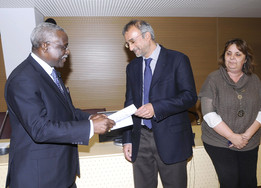
And to prove this very point, it was not too much of a surprise, that one of his mentees – Omer Zafar and the Yemen country team –received an award outstanding project category.

The Yemen country team led by Omer and composed of Dr. Fathia Bahran, Country Programme Officer,  Nicole Hervieu and Jessica Lattughi were recognized for having completely transformed the Yemen portfolio from one that was based on a hand-out approach, to one based on creating sustainable economic opportunities that empower poor rural men and women.
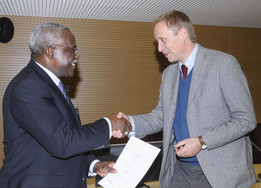
The new project designs for Yemen have been so highly regarded by other donors, including the Islamic Development Bank (IsDB) and the European Union, that they have together invested almost double the amount that IFAD has put it. The World Bank has also expressed interest in investing and the IsDB has recently announced that it stands ready to contribute over US$ 100 million to the forthcoming Yemen project, which focuses on rural employment generation.

The next awardee in the outstanding project category was Edward Heinemann, the Rural Poverty Report 2011 team leader. Ed was recognized for his outstanding efforts to finalize IFAD’s flagship publication.
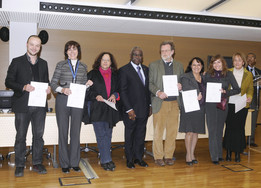
Work on the report started in late 2007 and, while much preparation was done, it became clear in 2009 that the project was losing momentum. In July 2009 senior management asked Ed to take over responsibility for the report.

Ed, assisted by Bettina Prato rolled up his sleeves and started to draft and re-drafted the report several times with support and contributions from IFAD colleagues and external reviewers, producing the excellent report that we have today.

Although only released ten days ago, those of you who follow this blog know that the Report has already received wide praise and is being recognized as one of the most comprehensive studies on the dynamics of rural poverty. A distinctive feature of the report is that it gives a human face to rural poverty through the personal narratives of ordinary poor rural people around the globe. It also advocates a number of important policy measures to tackle rural poverty. These will undoubtedly give impetus and drive the efforts of governments in developing countries and the international community to enhance national and global food security.

The first award in the agent and facilitator of change category went to the Farmer’s Forum Team coordinated by Jean-Philippe Audinet. The team included:
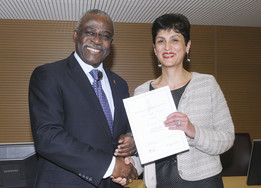
  • Philippe Remy
  • Roberto Longo
  • Carla De Donato
  • Sandra Di Rienzo
  • Gisella Barbieri
  • Natalia Espinel
  • Sylvia Isaia
  • Vincent Sineau
The team was recognized for its outstanding work in developing the Farmers’ Forum and creating a strong relationship between IFAD and farmers’ organizations across the developing world.

Their efforts has led to the organizing the Farmers’ Forum every two years to coincide with the meetings of the Governing Council. In 2010 the Forum featured a special session to promote women’s leadership in farmers’ and rural producers’ organizations. Thanks to the work of the Farmers’ Forum team, IFAD has also continued to support global and regional farmers’ organizations in developing countries. And through their work, IFAD has managed to amplify the voices of the rural poor in various global fora.

The second awardee in the agent and facilitator of change was yours truly – Roxanna Samii. Those who follow this blog will remember that in February 2010 we used a number of social media and web2.0 tools to report live from the Farmers’ Forum. In a way I partially owe my award to the openness and willingness of the Farmers’ Forum team who embraced the idea of putting these tools into practice.

I was extremely flattered listening to Henock reading out the following motivation for my award:

“The award pays tribute to the key role Roxanna played in leading the change in the way we communicate. It recognizes Roxy’s tireless dedication and energy to introduce IFAD staff to social media, promote the benefits and advantages of social media at the corporate level, and share her knowledge by conducting awareness-building and training sessions on web 2.0 tools and guiding IFAD staff on how to use social media effectively and professionally.”

“Roxy’s passion, enthusiasm and tireless dedication have anchored social media in IFAD’s communications work and she is commended for empowering her colleagues to become effective users of social media tools. “

I cannot but end this blogpost by referring back to Daniel Pink’s DRIVE paradigm. Pink’s paradigm is pushing us to embrace motivation 3.0 – where people are “motivated by the desire for autonomy over a task, for the mastery of a craft and for a sense of purpose”.

The IFAD awards programme paid tribute to these people. For sure, the 2011 edition will pay tribute to many more motivated and inspiring colleagues.

The six awardees will be receiving the official plaque at the forthcoming Governing Council. So please make sure you stay tuned, as we’ll be using social media and web2.0 tools to bring you live not only the award ceremony but the entire Governing Council event!

For now, Happy Holidays and on behalf of the IFAD social reporting team we wish you a prosperous 2011.

Monday, December 6, 2010

Today, IFAD President released The Rural Poverty Report 2011 at Chatham House in London, #rpr2011


Here is our big day. We are launching the Rural Poverty Report 2011. The report is the result of two years of extensive work.

To make sure that nothing would go wrong, I went down early to the plenary hall of Chatham House to get myself organized to find out to the my biggest chagrin that there was no internet access in the plenary hall. PANIC, total PANIC. I pulled out my Blackberry, more PANIC, no signal!!

Deep breath, think and think fast. Rushed upstairs to do as much as I could do  before the meeting started. After putting in place the contingency plan and coming to terms with my constraint, I headed back downstairs.

At 9:33, David Nabarro welcomed the participants and opened the “Food Security 2010 – Making Food Security work: Matching supply to demand.

In introducing Dr Nwanze, IFAD President, to take the floor to deliver the keynote address, he mentioned that “IFAD is now a leader and advocate for food security". Nabarro compliment IFAD taking "actions to ensure that food security will be experienced by everyone and not just a few”.

With that introduction, the President, holding the report in his hand  and later in the session, Edward Heinemann, the Rural Poverty Report, team leader,  proceeded to unveil the findings of the Rural Poverty Report 2011.

"The report is a comprehensive review of rural poverty, which accounts for 70 per cent of the world’s extremely poor people – about 1 billion children, women and men", said Dr Nwanze.

"The report provides an in-depth evaluation of the state of rural poverty and its consequences for people all over the world. It also makes important recommendations on policies and investments that will help rural women and men move out of poverty and, in the process, become part of the solution for the global food security challenges of the next
several decades".

"One of unique characteristics of the Rural Poverty Report 2011 is that it goes beyond cold facts and figures and includes the stories, hopes, challenges and aspirations of poor rural women and men from around the world who are struggling to overcome poverty. Their thoughts and perspectives were influential in the preparation of the report", said Nwanze.


During the meeting both Dr Nwanze and Heinemann reminded the audience that as we embark in the new decade of the 21st century, global poverty still remains a massive and predominantly rural phenomenon - and this is absolutely unacceptable.

The Rural Poverty Report outlines four steps to eliminate hunger and poverty
  • Help rural people better manage the risks they face
  • Sustainably increase agricultural production
  • Facilitate equitable access to new and changing marketplaces by viewing smallholder farmers first and foremost as businesses
  • Encourage the growth of non-farm rural jobs
Managing risk
"Smallholder farmers have always been vulnerable to risk, and now these risks are growing. Today, they face less secure access to land, increasing pressure on common property resources, climate change and food price volatility. We need to find ways of reducing risk and giving poor rural people access to the tools they need to deal with it", explained Nwanze.

The Report argues that for some, this will mean improving their skills, while for others, it will mean access to micro insurance, and for others still it will mean social protection. What is crucial is to create the right environment to make it easier for more rural people to be more entrepreneurial, creating the conditions for a vibrant rural sector which generates locally produced goods and spurs sustainable non-farm employment in services, in agro-processing and in small-scale manufacturing.

Sustainably increase agricultural production
The report makes the case that we need to ensure that the world’s 500 million smallholder farms are able to realise their potential as small-scale businesses and at the same time increase food production but in a sustainable way.

In Africa, for example, only 6 per cent of the land is irrigated. Only one tenth of the average amount of fertilizer is used on farm land. But we also know that 60 per cent of the world’s uncultivated arable land is in Africa. Imagine the potential that this land holds for the approximately 300 million poor people who live in rural Africa. Imagine the potential of the 2 billion people who live or work on small farms the world over.

This means we need to get higher yields from existing land, and we need to do so in an environmentally sustainable way that does not pollute, diminish the land over time or contribute to greenhouse gas emissions - in other words, we must have sustainable intensification.

The report highlights that sustainable farming practices have improved yields by an average of nearly 80 per cent over four years. It argues that what we need is a systemic approach that uses a variety of innovations – derived from the latest scientific discoveries and from local practices and knowledge – to bring agriculture into the forefront of efforts to protect and preserve land, air and water for generations to come.

The report concludes that this means complementing conventional approaches to increasing productivity with a much stronger focus on soil and water management, integrated approaches to soil fertility management and overall farm production systems.

At the same time, the report recognizes that there is no blueprint for sustainable agricultural  intensification. The best practices will be determined by the local context. The challenge is to develop policies and institutions that can make it happen on a massive scale.

Facilitate equitable access to new and changing marketplaces by viewing smallholder farmers first and foremost as businesses
"One of the other challenges highlighted in the report is the lack of access to markets which is one of the determinants of poverty", explains Heinemann".

Smallholder farmers and poor rural people must have opportunities to be entrepreneurs, rather than bystanders. To realize their business potential there should be a concerted effort to reduce risk and transaction costs along value chains, supporting rural producers’ organizations, expanding financial services into rural areas and ensuring that small farmers have access to the infrastructure, the utilities and information. Investing in good governance is another key ingredient".

Encourage the growth of non-farm rural jobs
"There is no question that agriculture is and will continue to be the key economic driver in rural areas. Agricultural success is a route out of poverty for millions", said Nwanze.

"Today, around 80 per cent of rural people are involved in farming to some degree. We must continue to support those who see agricultural production as their main livelihood in every way we can. But we must also recognize that rural economies are becoming more diverse. If we succeed in creating more profitable farms, we will also succeed in creating associated non-farm enterprises. Some people will leave the farm for new jobs with large enterprises in rural areas, while others will choose to become entrepreneurs in non-farming pursuits".

The Rural Poverty Report suggests that in order to meet the growing needs of a hungry world, agriculture must be a viable and rewarding activity for the large number of people who choose it. But increasingly, it will be one of many choices, not the only choice. This is not a threat to agriculture, but rather a chance to develop a more modern, diversified economy.

Call for action
"Our report is not one that should sit on a shelf to collect dust. I hope that we all join hands to implement the four steps outlined above to eliminate poverty and hunger", exclaimed Nwanze.

"The challenge now is for governments to follow through on their promises and for players in all areas of rural development to take action. Developing countries must be the drivers of rural development. Where countries have shown the commitment, development agencies and others should support their efforts".

IFAD is meeting the challenge by working closely with partners to scale up our support to rural development on the ground. We are also championing a new and more dynamic vision of rural development.

Dr Nwanze concluded: "And as we look at today’s rural poverty report, we must also look to the future, and that means focusing on the young people who live and work in rural areas. Give them the skills and confidence they need to run profitable farms or start businesses, and they hold the potential to become the community leaders of tomorrow. Ignore them, and they will have little option but to leave their homes and families to search for work in the cities".

Sir Gordon Conway who took the floor after the President's keynote address complimented and congratulated IFAD for a great multidisciplinary report which is totally grounded in reality and comprehensively reflects the stories, challenges and aspirations of poor rural people!

Others commended IFAD for putting out a strong practical report showing how to unlock the potential smallholder agriculture, for seeing farmers as business people and for depicting "their business" being embedded in social, economic and political relationships and showing how when these relationships do not work that is when food security fails.

Sitting in the room and hearing rural development leaders citing and referring to the report just minutes after it was launched was indeed a gratifying moment. Undoubtedly we'll be hearing more and more people citing and quoting the report. Well done to all those who were involved in this two year effort. Well done to Ed and Bettina.

The panelists echoing the President's  message of hope and call for action urged the participants to read the Rural Poverty Report. Make sure you download the report.


Also, please mark your calendars: on 9 and10 December from 9:00-10:00 and from 14:00-15:00 December, Edward Heinemann and his team will answer your questions and comments on Facebook and Twitter.

Please send us your questions and comments by 16:00GMT 8 December.

Follow @ifadnews on Twitter and become join us on our Facebook (http://www.facebook.com/pages/ifad/107399332627995).

See you on-line.

Listen to Edward Heinemann who shares some of the findings of the Rural Poverty Report 2011

Sunday, December 5, 2010

Rural Poverty Report 2011: Mixed progress but also new hope in reducing rural poverty #rpr2011

by Kanayo F. Nwanze

On 6 December 2010, at 11:00GMT at the opening of a major international conference on food security convened by Chatham House IFAD will launch the Rural Poverty Report 2011.

Just think, what would your life be like if you were one of the 1.4 billion women, men and children who live in extreme poverty? Chances are you would live in a rural area, as 70 per cent of the world’s extremely poor people do.

Like Pascaline Bampoky from Senegal, you wouldn’t have had much of an opportunity to study, you would be farming rice, raising pigs, selling ice cream and cleaning houses – all in a day’s work to feed your family.

Like Shazia Bibi from Pakistan, you might wonder if your garlic will compete at the market with lower priced imports and whether your profits will cover the costs of your children’s education and treatment for your heart condition.

And if you are a young man like Williams Novoa Lizardo in Peru, you might lose hope of making a living where you were born and consider migrating to a city to find work.

The good news, according to the Rural Poverty Report 2011 issued by IFAD, is that over the last ten years more than 350 million rural people have pulled themselves out of extreme poverty. During this time, the percentage of the world’s rural inhabitants living on less than US$1.25 a day has dropped from nearly half to about one-third.

Accounting for much of the progress has been East Asia, and particularly China, where the number of extremely poor people in rural areas fell by two-thirds – from 365 million to 117 million – as did the rate of extreme poverty, which went from 44 to 15 per cent.

There was also good progress in both Latin America and the countries of the Middle East and North Africa, where extreme poverty rates in rural areas fell by about half over the past decade.

But, this progress notwithstanding, the problem remains a pervasive one, especially in Sub-Saharan Africa, where the rate of rural poverty has fallen slightly in the last decade but is still above 60 per cent, and in South Asia, which is home to half of the world’s one billion extremely poor rural people.


Just as these statistics tell a story of uneven progress in reducing rural poverty, changes that are underway in rural areas are giving rise to both challenges and new hope for rural people in their struggle for a better life.

The challenges include increasingly volatile food prices, which complicate life for rural people both as producers and buyers of food. And there are other emerging threats such as the deterioration of the natural resource base, growing competition for land and water, and the potential harm that climate change can cause to the rural landscape.

But good things are happening, as well. As cities expand and the world becomes more urbanized, there is a growing demand for high value food, and accordingly agricultural markets are expanding and becoming better organized. Supermarkets, for example, have grown rapidly across much of the developing world, and in some parts of Latin America they typically account for 60 per cent or more of retail food sales. To be sure, modern markets and value chains bring with them their own challenges for some smallholder farmers in terms of higher entry costs, but the potential opportunities they also bring cannot be overlooked.

And while agriculture continues to be a key driver of rural growth – four-fifths of rural households worldwide are engaged in farming at some level – technological advancements and changes in the global economy are also creating non-farm jobs and development in rural areas. The potential for growth is further enhanced by the search for renewable energy sources that is ramping up around the world.

All of this means opportunity for greater numbers of poor rural women and men to lift themselves out of poverty and create a better life and a future for themselves and their children. But making the most of it requires an overall policy and investment approach that is, at the same time, both market-oriented and environmentally sustainable.

For starters, national governments and the international community need to reverse the longstanding neglect of rural development. We need to improve governance in rural areas and create a better economic environment for smallholder farmers to succeed and grow not only food but their businesses as well.

We need to invest in rural infrastructure and in the education and skills of rural people so that they themselves can make the most of new opportunities to engage in agricultural markets or work in non-farm industries. We need to strengthen their collective capabilities so that they can support each other in managing the risks they face, learn new techniques for improving their productivity, and market their products.

Above all, we need to stop treating the rural poor as charity cases and truly recognize that they are people whose innovation, dynamism and hard work will ultimately lead the way out of poverty’s darkness and into the bright sunshine of growth, development and prosperity.

Nothing less than global food security hangs in the balance. The experts say that agricultural production will have to increase 70 per cent by 2050 – and output in developing countries will have to double – in order to feed the world’s growing global population, expected to reach nine billion by then.

I have no doubt that Pascaline, Shazia and Williams are up to the challenge. Are the rest of us?


On 6 December at 11:00GMT you may download the English version of the Rural Poverty Report 2011 at http://www.ifad.org/rpr2011/report

Meet the women and men from rural areas whose thoughts and perspectives were influential in the preparation of theRural Poverty Report 2011 Read testimonies and watch the video testimonials

Tuesday, November 30, 2010

On 6 December, IFAD will release the Rural Poverty Report 2011: Meet the lead author, Edward Heinemann

On Monday 6, December during an international conference on food security at Chatham House in London, IFAD will launch the Rural Poverty Report 2011: New realities, new challenges: new opportunities for tomorrow’s generation.
The Rural Poverty Report 2011 is a comprehensive resource for policymakers and practitioners, especially those in developing countries.  The report provides latest estimates on poverty rates in rural areas of developing countries, as well as poverty trends in different regions. It has new information on how many people move in and out of poverty over time, as well as first-hand accounts from poor rural people on the challenges they face in their everyday lives.

RPR 2011 photo essay
The report looks at who poor rural people are, what they do and how their livelihoods are changing.  It explores the challenges that make it so difficult for rural people to overcome poverty, and identifies the opportunities and pathways that could lead towards greater prosperity for them and their communities.  And it highlights key global challenges such as the need to double agriculture output and increase food production by 70 per cent to feed 9 billion people in 2050.

It also highlights the policies and actions that governments and development practitioners can take to support the efforts of rural people themselves, both today and in the years to come.

Writing the report: the back story
Many colleagues were involved at different stages of the report’s preparation. You can find out more about these great people in the report’s acknowledgements, and there are many more who worked behind the scenes. At the end of the day, it ended up being an “all-hands-on-deck” exercise.

Having said that, the report would not have seen the light of the day if were not for Edward Heinemann and Bettina Prato.

Some 10 months ago, Ed, was asked to lead this process and finalize the report. For months, he worked around the clock and hardly left his office. I remember sometime in the summer, not having seen Ed around for weeks, I went up to his office to check on him. I knocked on his door and put in my head and I found an unshaven Ed typing furiously. I said: “Hi Ed, have not seen you around for some time, just came up to see how you were doing”.

Ed smiled and said he was fine. Closing the door, I thought to myself, “I guess he is so busy that he did not have time to shave” and I almost asked him, “Ed, why have not you shaved?”, but thought it was better not to do so.

There are many things Ed has learnt thanks to the Rural Poverty Report process and undoubtedly many experiences and conversations that will stay with him for ever. There is one other thing that, for the time being, seems to have stayed with him – and that is his unshaven look, which has now transformed to a well-groomed beard.

With six days to go to the big day, yesterday I asked Ed to share his state of mind about the launch. Here is what he had to say.

Edward Heinemann – the Rural Poverty Report lead author’s state of mind
“Back in July, when I gave in what I thought was the final draft of the Rural Poverty Report, my idea was that I would be able to wash my hands of it, do something else for a few months, and then re-engage once we had the launch presentations lined up. I got that completely wrong. From September on I spent days, weeks, months looking over galley proofs – a term I didn’t even know three months ago – til the words ran into each other; I rewrote briefs, prepared Q&As, drafted summaries of summaries and reviewed key messages. I looked over the text 273 times, and each time I did I found things that could have been said better, that should have been said differently, or that simply shouldn’t have been said at all. There were corrections and there were corrections to corrections. It was miserable. 
In my worst nightmares, someone somewhere dreams up a question that leaves me gasping for air like a suffocating goldfish.
Now, with a week to go to the launch, I’m looking forward to it, of course. I tell myself it will be fun. I do know that it will be worthwhile, because I am confident that the report will help us and our partners make a real difference in the lives of the poor rural people.”  


Visit the Rural Poverty Report 2011 website. Make sure you meet the women and men from rural areas whose thoughts and perspectives were influential in the preparation of the Rural Poverty Report 2011.Read testimonies |  Watch the video testimonials

Find out more about the report and join the virtual chats: Follow #rpr2011

  • On 6 December from 9:30 to 11:30 GMT, IFAD’s social reporting team will report live from the Chatham House launch event. Follow us on Twitter, Facebook and on this blog. Follow #rpr2011
  • On 9 and 10 December from 9:00 to 10:00 GMT and 14:00 to 15:00 GMT, Ed and Bettina will host a virtual chat on Facebook and Twitter. Please send your questions and comments.  Follow rpr2011
  • On 17 December from 9:00 to 11:00 GMT, IFAD’s social reporting team will report live from the Rome launch event. Follow us on Twitter, Facebook and on this blog.  Follow #rpr2011
Looking forward to seeing you on line.


Popular Posts