With under two weeks go before the closing date for nominations, the World Business and Development Awards have announced the ten-member international judging panel charged with determining award winners in 2012.
The organisers have issued a final call for businesses to submit successful initiatives in line with the Rio+20 UN Conference on Sustainable Development. All organisations,
Showing posts with label development. Show all posts
Showing posts with label development. Show all posts
Sunday, March 18, 2012
Monday, December 6, 2010
Today, IFAD President released The Rural Poverty Report 2011 at Chatham House in London, #rpr2011

Here is our big day. We are launching the Rural Poverty Report 2011. The report is the result of two years of extensive work.
To make sure that nothing would go wrong, I went down early to the plenary hall of Chatham House to get myself organized to find out to the my biggest chagrin that there was no internet access in the plenary hall. PANIC, total PANIC. I pulled out my Blackberry, more PANIC, no signal!!
Deep breath, think and think fast. Rushed upstairs to do as much as I could do before the meeting started. After putting in place the contingency plan and coming to terms with my constraint, I headed back downstairs.
At 9:33, David Nabarro welcomed the participants and opened the “Food Security 2010 – Making Food Security work: Matching supply to demand.
In introducing Dr Nwanze, IFAD President, to take the floor to deliver the keynote address, he mentioned that “IFAD is now a leader and advocate for food security". Nabarro compliment IFAD taking "actions to ensure that food security will be experienced by everyone and not just a few”.
 "The report is a comprehensive review of rural poverty, which accounts for 70 per cent of the world’s extremely poor people – about 1 billion children, women and men", said Dr Nwanze.
"The report provides an in-depth evaluation of the state of rural poverty and its consequences for people all over the world. It also makes important recommendations on policies and investments that will help rural women and men move out of poverty and, in the process, become part of the solution for the global food security challenges of the next
several decades".
"One of unique characteristics of the Rural Poverty Report 2011 is that it goes beyond cold facts and figures and includes the stories, hopes, challenges and aspirations of poor rural women and men from around the world who are struggling to overcome poverty. Their thoughts and perspectives were influential in the preparation of the report", said Nwanze.
During the meeting both Dr Nwanze and Heinemann reminded the audience that as we embark in the new decade of the 21st century, global poverty still remains a massive and predominantly rural phenomenon - and this is absolutely unacceptable.
The Rural Poverty Report outlines four steps to eliminate hunger and poverty
- Help rural people better manage the risks they face
- Sustainably increase agricultural production
- Facilitate equitable access to new and changing marketplaces by viewing smallholder farmers first and foremost as businesses
- Encourage the growth of non-farm rural jobs
"Smallholder farmers have always been vulnerable to risk, and now these risks are growing. Today, they face less secure access to land, increasing pressure on common property resources, climate change and food price volatility. We need to find ways of reducing risk and giving poor rural people access to the tools they need to deal with it", explained Nwanze.
The Report argues that for some, this will mean improving their skills, while for others, it will mean access to micro insurance, and for others still it will mean social protection. What is crucial is to create the right environment to make it easier for more rural people to be more entrepreneurial, creating the conditions for a vibrant rural sector which generates locally produced goods and spurs sustainable non-farm employment in services, in agro-processing and in small-scale manufacturing.
Sustainably increase agricultural production
The report makes the case that we need to ensure that the world’s 500 million smallholder farms are able to realise their potential as small-scale businesses and at the same time increase food production but in a sustainable way.
In Africa, for example, only 6 per cent of the land is irrigated. Only one tenth of the average amount of fertilizer is used on farm land. But we also know that 60 per cent of the world’s uncultivated arable land is in Africa. Imagine the potential that this land holds for the approximately 300 million poor people who live in rural Africa. Imagine the potential of the 2 billion people who live or work on small farms the world over.
This means we need to get higher yields from existing land, and we need to do so in an environmentally sustainable way that does not pollute, diminish the land over time or contribute to greenhouse gas emissions - in other words, we must have sustainable intensification.
The report highlights that sustainable farming practices have improved yields by an average of nearly 80 per cent over four years. It argues that what we need is a systemic approach that uses a variety of innovations – derived from the latest scientific discoveries and from local practices and knowledge – to bring agriculture into the forefront of efforts to protect and preserve land, air and water for generations to come.
The report concludes that this means complementing conventional approaches to increasing productivity with a much stronger focus on soil and water management, integrated approaches to soil fertility management and overall farm production systems.
At the same time, the report recognizes that there is no blueprint for sustainable agricultural intensification. The best practices will be determined by the local context. The challenge is to develop policies and institutions that can make it happen on a massive scale.
Facilitate equitable access to new and changing marketplaces by viewing smallholder farmers first and foremost as businesses
"One of the other challenges highlighted in the report is the lack of access to markets which is one of the determinants of poverty", explains Heinemann".
Smallholder farmers and poor rural people must have opportunities to be entrepreneurs, rather than bystanders. To realize their business potential there should be a concerted effort to reduce risk and transaction costs along value chains, supporting rural producers’ organizations, expanding financial services into rural areas and ensuring that small farmers have access to the infrastructure, the utilities and information. Investing in good governance is another key ingredient".
Encourage the growth of non-farm rural jobs
"There is no question that agriculture is and will continue to be the key economic driver in rural areas. Agricultural success is a route out of poverty for millions", said Nwanze.
 "Today, around 80 per cent of rural people are involved in farming to some degree. We must continue to support those who see agricultural production as their main livelihood in every way we can. But we must also recognize that rural economies are becoming more diverse. If we succeed in creating more profitable farms, we will also succeed in creating associated non-farm enterprises. Some people will leave the farm for new jobs with large enterprises in rural areas, while others will choose to become entrepreneurs in non-farming pursuits".
The Rural Poverty Report suggests that in order to meet the growing needs of a hungry world, agriculture must be a viable and rewarding activity for the large number of people who choose it. But increasingly, it will be one of many choices, not the only choice. This is not a threat to agriculture, but rather a chance to develop a more modern, diversified economy.
Call for action
"Our report is not one that should sit on a shelf to collect dust. I hope that we all join hands to implement the four steps outlined above to eliminate poverty and hunger", exclaimed Nwanze.
"The challenge now is for governments to follow through on their promises and for players in all areas of rural development to take action. Developing countries must be the drivers of rural development. Where countries have shown the commitment, development agencies and others should support their efforts".
IFAD is meeting the challenge by working closely with partners to scale up our support to rural development on the ground. We are also championing a new and more dynamic vision of rural development.
Dr Nwanze concluded: "And as we look at today’s rural poverty report, we must also look to the future, and that means focusing on the young people who live and work in rural areas. Give them the skills and confidence they need to run profitable farms or start businesses, and they hold the potential to become the community leaders of tomorrow. Ignore them, and they will have little option but to leave their homes and families to search for work in the cities".
Sir Gordon Conway who took the floor after the President's keynote address complimented and congratulated IFAD for a great multidisciplinary report which is totally grounded in reality and comprehensively reflects the stories, challenges and aspirations of poor rural people!
Others commended IFAD for putting out a strong practical report showing how to unlock the potential smallholder agriculture, for seeing farmers as business people and for depicting "their business" being embedded in social, economic and political relationships and showing how when these relationships do not work that is when food security fails.
Sitting in the room and hearing rural development leaders citing and referring to the report just minutes after it was launched was indeed a gratifying moment. Undoubtedly we'll be hearing more and more people citing and quoting the report. Well done to all those who were involved in this two year effort. Well done to Ed and Bettina.
The panelists echoing the President's message of hope and call for action urged the participants to read the Rural Poverty Report. Make sure you download the report.
Also, please mark your calendars: on 9 and10 December from 9:00-10:00 and from 14:00-15:00 December, Edward Heinemann and his team will answer your questions and comments on Facebook and Twitter.
Please send us your questions and comments by 16:00GMT 8 December.
Follow @ifadnews on Twitter and become join us on our Facebook (http://www.facebook.com/pages/ifad/107399332627995).
See you on-line.
Listen to Edward Heinemann who shares some of the findings of the Rural Poverty Report 2011
Sunday, December 5, 2010
Rural Poverty Report 2011: Mixed progress but also new hope in reducing rural poverty #rpr2011
by Kanayo F. Nwanze
 On 6 December 2010, at 11:00GMT at the opening of a major international conference on food security convened by Chatham House IFAD will launch the Rural Poverty Report 2011.
Just think, what would your life be like if you were one of the 1.4 billion women, men and children who live in extreme poverty? Chances are you would live in a rural area, as 70 per cent of the world’s extremely poor people do.
Like Pascaline Bampoky from Senegal, you wouldn’t have had much of an opportunity to study, you would be farming rice, raising pigs, selling ice cream and cleaning houses – all in a day’s work to feed your family.
Like Shazia Bibi from Pakistan, you might wonder if your garlic will compete at the market with lower priced imports and whether your profits will cover the costs of your children’s education and treatment for your heart condition.
And if you are a young man like Williams Novoa Lizardo in Peru, you might lose hope of making a living where you were born and consider migrating to a city to find work.
The good news, according to the Rural Poverty Report 2011 issued by IFAD, is that over the last ten years more than 350 million rural people have pulled themselves out of extreme poverty. During this time, the percentage of the world’s rural inhabitants living on less than US$1.25 a day has dropped from nearly half to about one-third.
Accounting for much of the progress has been East Asia, and particularly China, where the number of extremely poor people in rural areas fell by two-thirds – from 365 million to 117 million – as did the rate of extreme poverty, which went from 44 to 15 per cent.
There was also good progress in both Latin America and the countries of the Middle East and North Africa, where extreme poverty rates in rural areas fell by about half over the past decade.
But, this progress notwithstanding, the problem remains a pervasive one, especially in Sub-Saharan Africa, where the rate of rural poverty has fallen slightly in the last decade but is still above 60 per cent, and in South Asia, which is home to half of the world’s one billion extremely poor rural people.
Just as these statistics tell a story of uneven progress in reducing rural poverty, changes that are underway in rural areas are giving rise to both challenges and new hope for rural people in their struggle for a better life.
The challenges include increasingly volatile food prices, which complicate life for rural people both as producers and buyers of food. And there are other emerging threats such as the deterioration of the natural resource base, growing competition for land and water, and the potential harm that climate change can cause to the rural landscape.
But good things are happening, as well. As cities expand and the world becomes more urbanized, there is a growing demand for high value food, and accordingly agricultural markets are expanding and becoming better organized. Supermarkets, for example, have grown rapidly across much of the developing world, and in some parts of Latin America they typically account for 60 per cent or more of retail food sales. To be sure, modern markets and value chains bring with them their own challenges for some smallholder farmers in terms of higher entry costs, but the potential opportunities they also bring cannot be overlooked.
And while agriculture continues to be a key driver of rural growth – four-fifths of rural households worldwide are engaged in farming at some level – technological advancements and changes in the global economy are also creating non-farm jobs and development in rural areas. The potential for growth is further enhanced by the search for renewable energy sources that is ramping up around the world.
All of this means opportunity for greater numbers of poor rural women and men to lift themselves out of poverty and create a better life and a future for themselves and their children. But making the most of it requires an overall policy and investment approach that is, at the same time, both market-oriented and environmentally sustainable.
For starters, national governments and the international community need to reverse the longstanding neglect of rural development. We need to improve governance in rural areas and create a better economic environment for smallholder farmers to succeed and grow not only food but their businesses as well.
We need to invest in rural infrastructure and in the education and skills of rural people so that they themselves can make the most of new opportunities to engage in agricultural markets or work in non-farm industries. We need to strengthen their collective capabilities so that they can support each other in managing the risks they face, learn new techniques for improving their productivity, and market their products.
Above all, we need to stop treating the rural poor as charity cases and truly recognize that they are people whose innovation, dynamism and hard work will ultimately lead the way out of poverty’s darkness and into the bright sunshine of growth, development and prosperity.
Nothing less than global food security hangs in the balance. The experts say that agricultural production will have to increase 70 per cent by 2050 – and output in developing countries will have to double – in order to feed the world’s growing global population, expected to reach nine billion by then.
I have no doubt that Pascaline, Shazia and Williams are up to the challenge. Are the rest of us?
On 6 December at 11:00GMT you may download the English version of the Rural Poverty Report 2011 at http://www.ifad.org/rpr2011/report
Meet the women and men from rural areas whose thoughts and perspectives were influential in the preparation of theRural Poverty Report 2011 Read testimonies and watch the video testimonials
On 6 December 2010, at 11:00GMT at the opening of a major international conference on food security convened by Chatham House IFAD will launch the Rural Poverty Report 2011. Just think, what would your life be like if you were one of the 1.4 billion women, men and children who live in extreme poverty? Chances are you would live in a rural area, as 70 per cent of the world’s extremely poor people do.
Like Pascaline Bampoky from Senegal, you wouldn’t have had much of an opportunity to study, you would be farming rice, raising pigs, selling ice cream and cleaning houses – all in a day’s work to feed your family.
Like Shazia Bibi from Pakistan, you might wonder if your garlic will compete at the market with lower priced imports and whether your profits will cover the costs of your children’s education and treatment for your heart condition.
And if you are a young man like Williams Novoa Lizardo in Peru, you might lose hope of making a living where you were born and consider migrating to a city to find work.
The good news, according to the Rural Poverty Report 2011 issued by IFAD, is that over the last ten years more than 350 million rural people have pulled themselves out of extreme poverty. During this time, the percentage of the world’s rural inhabitants living on less than US$1.25 a day has dropped from nearly half to about one-third.
Accounting for much of the progress has been East Asia, and particularly China, where the number of extremely poor people in rural areas fell by two-thirds – from 365 million to 117 million – as did the rate of extreme poverty, which went from 44 to 15 per cent.
There was also good progress in both Latin America and the countries of the Middle East and North Africa, where extreme poverty rates in rural areas fell by about half over the past decade.
But, this progress notwithstanding, the problem remains a pervasive one, especially in Sub-Saharan Africa, where the rate of rural poverty has fallen slightly in the last decade but is still above 60 per cent, and in South Asia, which is home to half of the world’s one billion extremely poor rural people.
Just as these statistics tell a story of uneven progress in reducing rural poverty, changes that are underway in rural areas are giving rise to both challenges and new hope for rural people in their struggle for a better life.
The challenges include increasingly volatile food prices, which complicate life for rural people both as producers and buyers of food. And there are other emerging threats such as the deterioration of the natural resource base, growing competition for land and water, and the potential harm that climate change can cause to the rural landscape.
But good things are happening, as well. As cities expand and the world becomes more urbanized, there is a growing demand for high value food, and accordingly agricultural markets are expanding and becoming better organized. Supermarkets, for example, have grown rapidly across much of the developing world, and in some parts of Latin America they typically account for 60 per cent or more of retail food sales. To be sure, modern markets and value chains bring with them their own challenges for some smallholder farmers in terms of higher entry costs, but the potential opportunities they also bring cannot be overlooked.
And while agriculture continues to be a key driver of rural growth – four-fifths of rural households worldwide are engaged in farming at some level – technological advancements and changes in the global economy are also creating non-farm jobs and development in rural areas. The potential for growth is further enhanced by the search for renewable energy sources that is ramping up around the world.
All of this means opportunity for greater numbers of poor rural women and men to lift themselves out of poverty and create a better life and a future for themselves and their children. But making the most of it requires an overall policy and investment approach that is, at the same time, both market-oriented and environmentally sustainable.
For starters, national governments and the international community need to reverse the longstanding neglect of rural development. We need to improve governance in rural areas and create a better economic environment for smallholder farmers to succeed and grow not only food but their businesses as well.
We need to invest in rural infrastructure and in the education and skills of rural people so that they themselves can make the most of new opportunities to engage in agricultural markets or work in non-farm industries. We need to strengthen their collective capabilities so that they can support each other in managing the risks they face, learn new techniques for improving their productivity, and market their products.
Above all, we need to stop treating the rural poor as charity cases and truly recognize that they are people whose innovation, dynamism and hard work will ultimately lead the way out of poverty’s darkness and into the bright sunshine of growth, development and prosperity.
Nothing less than global food security hangs in the balance. The experts say that agricultural production will have to increase 70 per cent by 2050 – and output in developing countries will have to double – in order to feed the world’s growing global population, expected to reach nine billion by then.
I have no doubt that Pascaline, Shazia and Williams are up to the challenge. Are the rest of us?
On 6 December at 11:00GMT you may download the English version of the Rural Poverty Report 2011 at http://www.ifad.org/rpr2011/report
Meet the women and men from rural areas whose thoughts and perspectives were influential in the preparation of theRural Poverty Report 2011 Read testimonies and watch the video testimonials
Tuesday, November 30, 2010
On 6 December, IFAD will release the Rural Poverty Report 2011: Meet the lead author, Edward Heinemann
 On Monday 6, December during an international conference on food security at Chatham House in London, IFAD will launch the Rural Poverty Report 2011: New realities, new challenges: new opportunities for tomorrow’s generation.
The Rural Poverty Report 2011 is a comprehensive resource for policymakers and practitioners, especially those in developing countries. The report provides latest estimates on poverty rates in rural areas of developing countries, as well as poverty trends in different regions. It has new information on how many people move in and out of poverty over time, as well as first-hand accounts from poor rural people on the challenges they face in their everyday lives.

It also highlights the policies and actions that governments and development practitioners can take to support the efforts of rural people themselves, both today and in the years to come.
Writing the report: the back story
Many colleagues were involved at different stages of the report’s preparation. You can find out more about these great people in the report’s acknowledgements, and there are many more who worked behind the scenes. At the end of the day, it ended up being an “all-hands-on-deck” exercise.
Having said that, the report would not have seen the light of the day if were not for Edward Heinemann and Bettina Prato.
Some 10 months ago, Ed, was asked to lead this process and finalize the report. For months, he worked around the clock and hardly left his office. I remember sometime in the summer, not having seen Ed around for weeks, I went up to his office to check on him. I knocked on his door and put in my head and I found an unshaven Ed typing furiously. I said: “Hi Ed, have not seen you around for some time, just came up to see how you were doing”.
Ed smiled and said he was fine. Closing the door, I thought to myself, “I guess he is so busy that he did not have time to shave” and I almost asked him, “Ed, why have not you shaved?”, but thought it was better not to do so.
There are many things Ed has learnt thanks to the Rural Poverty Report process and undoubtedly many experiences and conversations that will stay with him for ever. There is one other thing that, for the time being, seems to have stayed with him – and that is his unshaven look, which has now transformed to a well-groomed beard.
With six days to go to the big day, yesterday I asked Ed to share his state of mind about the launch. Here is what he had to say.
Edward Heinemann – the Rural Poverty Report lead author’s state of mind
“Back in July, when I gave in what I thought was the final draft of the Rural Poverty Report, my idea was that I would be able to wash my hands of it, do something else for a few months, and then re-engage once we had the launch presentations lined up. I got that completely wrong. From September on I spent days, weeks, months looking over galley proofs – a term I didn’t even know three months ago – til the words ran into each other; I rewrote briefs, prepared Q&As, drafted summaries of summaries and reviewed key messages. I looked over the text 273 times, and each time I did I found things that could have been said better, that should have been said differently, or that simply shouldn’t have been said at all. There were corrections and there were corrections to corrections. It was miserable.
In my worst nightmares, someone somewhere dreams up a question that leaves me gasping for air like a suffocating goldfish.
Now, with a week to go to the launch, I’m looking forward to it, of course. I tell myself it will be fun. I do know that it will be worthwhile, because I am confident that the report will help us and our partners make a real difference in the lives of the poor rural people.”
Visit the Rural Poverty Report 2011 website. Make sure you meet the women and men from rural areas whose thoughts and perspectives were influential in the preparation of the Rural Poverty Report 2011.
 Read testimonies |
  Watch the video testimonials
Find out more about the report and join the virtual chats: Follow #rpr2011
- On 6 December from 9:30 to 11:30 GMT, IFAD’s social reporting team will report live from the Chatham House launch event. Follow us on Twitter, Facebook and on this blog. Follow #rpr2011
- On 9 and 10 December from 9:00 to 10:00 GMT and 14:00 to 15:00 GMT, Ed and Bettina will host a virtual chat on Facebook and Twitter. Please send your questions and comments. Follow rpr2011
- On 17 December from 9:00 to 11:00 GMT, IFAD’s social reporting team will report live from the Rome launch event. Follow us on Twitter, Facebook and on this blog. Follow #rpr2011
Tuesday, November 23, 2010
Historical Global Gathering of Women Pastoralists in Gujarat – from dream to reality!
By IFAD Reporters: Mattia, Antonella, Silvia, Judith, Soma and Luisa

Over 130 pastoral women from 27 countries are gathered together in the gujerati village of Mera to discuss the challenges they face - and how they can become forces for change. MARAG leaders had the vision to organize the gathering in a genuine Indian pastoral setting, where pastoralists have lived for several generations. After the event the mobile and permanent huts and buildings built specially for the Gathering will be used as a research and cultural centre for the maldhari (pastoral) communities themselves, where MARAG and their wide network of volunteers can preserve and encourage the continuation of pastoralism as a unique and valuable way of life.
The commitment and mobilization of the communities here is palpable – opening speeches overflow with emotion and their efforts make this a unique event. Mattia Prayer Galletti highlighted the importance of pastoralist women’s knowledge, which is needed by the world, while Carlo Petrini from Slow Food/Terra Madre, who was determined from the start to be present at the event, said that he was overwhelmed by the energy and the sense of community of this event, which would remain in his heart for a long time. Many are volunteers, from the exhausted international interpreters, furiously connecting participants in heated discussions in 12 languages, to the freelance photographer, the artist and facilitators - but most especially the pastoral men and women themselves, who spontaneously contributed more than 300 beds and blankets, and the elder women, who decorated the traditional huts to welcome their fellow pastoralists.


The world gathering of women pastoralists, sponsored by IFAD, will last till 26 November. We will keep you informed on the issues emerging from the reach discussions and thematic working groups.
Sunday, November 21, 2010
Berlin calling: Development world, please wake up. There is an urgent need to put back #ICT4D on the global development agenda

The two day event brought together numerous practitioners, policy makers, donor organizations and private sector players. The event allowed colleagues to interact, network and share their rich experience and at the same time put on the table a number of challenges.
I think, it is safe to say that there was quite a bit of apprehension about the fact that some major donors have abandoned ICT4D sector. For those of us in the agriculture world, this is a déjà vu. But if there is one lesson to learn from our experience, that is under-investing in this sector – similar to under investing in agriculture - will have negative impact in the lives of poor rural people. We’ve learnt that ICTs are tools and for these to add value and improve the livelihoods of poor rural people, they need to be:
- Affordable
- Scalable
- Self-sustaining
- Sensible
- Appropriate
- Focus on PEOPLE and not technology
- Ensure ownership and appropriation
- Develop local content
- Ensure language and cultural pertinence
- Ensure participation
- Mainstream ICT4D activities as part of development projects
- Build local capacity and scout for local talent and local innovations

While recognizing that development agencies are competing for funds and funds are getting scarce, Kuesel made the case that this should not lead to abandoning ICT4D, because we’ve now have the evidence that ICTs can indeed make a difference in the lives of poor rural people.
Kuesel underscored the importance of public-private partnership and called on development world to:
- play a facilitation role in forging partnership
- build the capacity national governments, grass-root organization and poor rural people
- create an enabling environment so that ICT4D initiatives can be implemented and scaled up
- importance of working towards putting in place regulations to reach the goal of universal access
- challenges and opportunities of linking up and broadening cooperation with the private sector to develop a robust ICT sector
- importance of showing impact and showing how ICTs contribute to and add value to “hot development topics” such as rural development, food security, rural finance and more
Wow, what a concept….. During the course of the two days, I must admit, we focused primarily on technology and perhaps not enough on People. So thank you Dr Spio-Garbrah for putting PEOPLE in the forefront and for sharing your vision of intra-institutional cooperation.
Giacomo Rambaldi, Senior Programme Coordinator, Technical Centre for Agricultural and Rural Cooperation, CTA echoing Dr Spio-Garbrah reminded the audience of the need to involve the civil society. Rambaldi talked about the risks of ICTs and how ICTs could both help disseminate/preserve but also usurper indigenous knowledge.
He talked about how ICTs have provided access to information that previously was not readily available and how ICTs have democratized access to information, citing the examples of services such as YouTube or Google maps have given a voice to the previously voiceless segment of the population.
Rambaldi reminded us of the importance of generating localized and relevant content. He talked about how as development workers, we have to make sure that ICTs actually add value and contribute to knowledge generation and becoming a catalyst to disseminate locally generated knowledge.
After all we have to remember that ICTs are tools and if they are not used to generate and disseminate relevant and local content, they are nothing but a useless device which can end up gathering dust!!
David Grimshaw, Head of International Programme: New Technologies with Practical Action and Senior Research Fellow, DFID, made the case for mainstreaming ICT4D initiatives where we have solid evidence that these have improved the livelihoods of poor rural people. Grimshaw underscored that technology has no magic power and is not a silver bullet. It is what we do with technology and how we use it that will make the difference.
“We need to focus on the HOW and on the process to move to ICT for DEVELOPMENT”, said Grimshaw.
Challenging the development world, he said: “You cannot work with logframes when you are doing a research project. These types of projects are different”. Concluding his remarks, Grimshaw said: “We need to focus on the process and focus on people’s need.”
Anton Mangstl, Director of the Office of Knowledge Exchange, FAO, underscored the importance of conducting impact assessments and learning from existing activities and pilots. He urged us to work with governments and other key stakeholders to scale up those activities that have worked. He reminded the audience that similar to development projects, for ICT4D projects to succeed they too need be sustainable.
Given the key role that ICT4D activities play in rural development, Mangstl put his finger on a crucial challenge, namely why have bilateral development donors such as DFID and SDC stopped their ICT4D programmes and investments.
Mangstl echoing the other panellists made the case, that donor agencies – be it bilaterals or multilaterals – need to mainstream ICT4D activities in their core activities and integrate these more and more with their respective knowledge sharing and communication for development activities.
Ilari Lindy, Advisor, Ministry of Foreign Affairs, Finland asked the fundamental question of whether ICT4D activities were well positioned to show impact in rural development and agriculture related activities.
He urged the participants to pay attention to policy and regulatory frameworks when designing and implementing ICT4D activities and repeated Mr Mangstl’s call for action – that is the need to improve knowledge sharing on ICT4D activities and integrating ICT4D activities with organizational knowledge sharing activities.
Lindy pointed out that to innovate, there is a need to bring together and create bridges between development and scientific communities. He also talked about the importance of convergence between North-South networks and last but not last the fundamental prerequisite of responding to grass-root demands.
Our colleague Tobias Eigen from Kabissa, reminded the audience that Africa is the hot bed of innovation and made the case that we should have more African innovators in events such as these.
Madam Dorasil from BMZ in her closing remarks reiterated the following fundamental points:
- there are no silver bullets in development
- we need to listen to and cater to the needs of the people who we work with and work for
- we need to build local capacity and groom local talents
- we need to get better in documenting, sharing and capturing the impact of ICT4D projects and feed these back into the learning and development loop
- we need to have indicators that clearly demonstrate how ICTs are changing the lives of poor rural people
- as a development community, we need to join hands to make sure that developed and developing countries governments and decision makers understand the importance of ICT4D activities and assist them in putting in place an enabling environment so that these activities flourish and replicate
- we need to raise awareness about ICT4D and make a concerted effort to put this topic on the G20 agenda
- we need to adopt an integrated approach and mainstream ICT4D activities in rural development projects and programmes
- we need to show how ICTs are reaching those living in the “bottom of pyramid”
At this event I talked about "Development 2.0: Putting ICT4D Lessons into Action to Make M-Development a Reality" and shared IFAD's experience in Zambia with the Zambia National Farmers Union - better known as ZNFU4455!
Thursday, November 11, 2010
Country presence brings IFAD even more closer to the people it serves and works with


After depositing our ID cards with the security cards, we made our way to the second floor. I remember when the former Secretary-General Kofi Annan visited IFAD, he said: “When you are part of the UN family, no matter where you are, you always have a home”. And that is how we felt. Yes, we had a home and we were home!
Setting up country offices has its share of challenges. For example, as I am writing this blogpost, the Government of Senegal and IFAD are negotiating the terms of the Country Agreement.
“Tuesday, I met with the minister and I hope we’ve ironed out the last couple of pending issues, so that we can soon finalize the agreement and formally open the IFAD-Senegal country office”, says Mohamed Beavogui, the IFAD’s Director of West and Central Africa division.
I was pleased to see the IFAD-Senegal office in person and to see that it was so nicely branded. IFAD publications were prominently displayed, the office was decorated with IFAD posters and thanks to ICT colleagues and in particular to Fabio Bencivenga, we could access all IFAD corporate applications as if we were at headquarters. But all of this did not happen overnight, nor was it necessarily an easy ride.
On the second day of the West and Central Africa workshop, during the decentralization working group session participants discussed the challenges and opportunities of country presence. At this session Beavogui mentioned “the impact of country presence is very clear. In those countries where we are present we are fully embedded in the national dialogue policy and are working closely with the government and other partners, our portfolio is performing much better, because we are able to provide continuous and systematic face-to-face implementation support”.
 Ghachem Kadari, the interim Senegal Country Presence Officer, during his presentation, said: “Thanks to country presence, today IFAD has a prominent place at the table and is fully embedded in the national policy dialogue process and attends strategic meetings.”
“IFAD not only is now much better known and more visible, but also plugged in to all the UN and International Financial Institution initiatives. Thanks to country presence, IFAD’s presence is now felt in the country.”
“By early 2011, we hope that the Senegal office will be staffed with an outposted country programme manager, country presence officer, programme assistant and a regional gender focal point”, says Beavogui.
“Our vision in the West and Central Africa region is to create four regional hubs – one of them being Senegal, serving Gambia, Guinea Bissau, Mauritania and Senegal”, mentioned Beavogui.
During the working group session, a number of participants underscored the importance of training and having a good understanding of IFAD processes early on.
Echoing this sentiment, Kadari said: “Opening an office does not simply mean renting a place and buying some furniture. We need to recruit and train staff”.
 Training is an important crucial aspect, as country presence colleagues need to understand what it means to be working for a specialized UN agency and International Financial Institutions. At the same time they need to understand and learn IFAD business, IFAD processes, make sure they understand what it means to be part of the UN and what does country presence mean.
While all this takes time, working in the field presents an additional complexity – that of not being in headquarters and having access to the knowledgeable people who can answer queries and help solve problems.
To overcome this challenge, Richard Aiello from IFAD took the floor and announced that "IFAD is finalizing an orientation programme and this will be made available in the coming months". "We are also planning to bring all country office staff to headquarters at least once year so that they get an opportunity to meet and interact with colleagues".
Nothing in the world can face-to-face meeting. It really makes a night and day difference when you meet colleagues in person and you establish a real, as opposed to a virtual working relationship. The participants wholeheartedly welcomed the proposition of this type of annual meeting.
During the working group discussion, country presence officer highlighted that once you’ve established yourself in the country as IFAD representative, everyone will be calling at your door and would like you to participate in meetings. This poses a challenge in terms of time management.
“We have to remember that our job as country programme officer is to assist in project implementation and improve the quality of IFAD-funded projects and programme. This means we have to manage our time in such a way so that attending various meetings do not interfere or get in the way of doing our job”, says Kadari.
Country presence has allowed IFAD to be closer to projects and programmes, has given IFAD more visibility and at the same time has allowed the organization to draw on local expertise and talent.
“Once you are established in a country, you have access to local resources”, says Kadari. “For example what we’re doing more and more is to recruit local consultants for supervision and implementation support missions and this has led to considerable cost savings”.
All the country presence officers present at the working group unanimously agreed that thanks to country presence, today they had a much better relationship with government.
Being very pragmatic people, those intimately involved in this endeavour shared a number of challenges, which at the end of the working group everyone, including IFAD, committed to address, namely:
- Organize regular training and refresher courses for country office staff
- Prepare a comprehensive resource manual covering strategic, operational, administrative and other related process and procedural matters
- Organize regular meetings bringing country office staff to Rome
I asked Kadari to share his lessons learnt vis-à-vis setting up a country office. “You need to give space and resources to the person who is tasked to open the office. And it would really help if you open the office where there is at least some minimum foundation”.
“We’ve seen that IFAD’s investment in Senegal office has paid both in terms of efficiency and effectiveness”, explains Kadari. “Today we are hosting more missions, number of workshops organized in Senegal have increased because colleagues know there is an office, an infrastructure that can provide them support and the number of partners visiting us keeps increasing".
“Opening an office can be very challenging, but it is highly exciting. If there is one lesson I learnt, that is, you need to manage your time, choose a good partner, be a good communicator and negotiator, have good people skills, establish good working relationship with everyone and be humble”, explains Kadari with a smile.
Tuesday, November 9, 2010
Second day of West and Central Africa regional implementation workshop: A pledge to have more performing projects in 2011!
 On the second day of the West and Central Africa workshop participants were already sharing and exchanging their experience and knowledge at breakfast! After all that is the best moment of the day to share “fresh” ideas and the ‘thoughts’ you’ve slept on - and be ready to hear the reports of the four different working groups who the previous day had discussed the following topics.
- Rural entrepreneurship
- Professionalization of organizations
- Financing modes and modalities
- Good governance

The presentations sparked an animated and informed discussion during the plenary session. It was great to see the strong will of participants and their desire to succeed and work together so that next year the list of s
uccessful projects would become longer and longer.
Today, during the plenary session, the participants applauded Senegal’s Agricultural Development Project in Matam - Phase II, Niger’s Project for the Promotion of Local Initiative for Development in Aguié (PPILDA), Cape Verde’s Rural Poverty Alleviation Programme, Gambia’s Rural Finance Project, Ghana’s Rural Enterprises Project - Phase II and Mauritania Oasis Sustainable Development Programme.
Wondering why they got almost a standing ovation? Because they were the best top six 2010 performing projects in the West and Central Africa portfolio.

With 2011 just a couple of months away, the plenary discussed the challenges of how to improve project implementation so that next year the list of poor performing projects comes smaller or better even completely disappears and the list of top performers becomes even longer, thus offering more participants to share their successful stories and experiences.
This led to the afternoon sessions, where the participants discussed: the following topics:
- Monitoring and evaluation
- Withdrawal applications and procurement procedures
- Decentralization of IFAD
- Upscaling
Stay tuned, we’ll blog the outcomes of these discussions in the next couple of days. Tomorrow we’ll be going to the field and will be visiting a government funded projects.
Monday, November 8, 2010
Africa can feed the world: it needs solid institutions and sound policies #wca2010
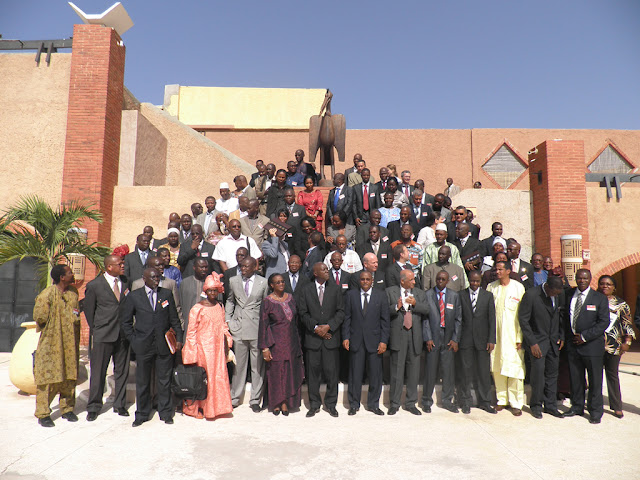
This morning, there was a certain buzz in the venue hosting IFAD's fifth West and Central regional implementation workshop. It was like a big family reunion with all the West and Central Africa IFAD-funded projects coming together for this annual event. Everyone was happy to see each other and to catch up.
Despite our fear of holding an "internet-less" meeting - because of a cable being cut in the neighbourhood - thanks to all the internet Gods and angels, we were blessed with connectivity!!! You can follow us on this blog, on IFAD's Facebook page and also on IFAD's twitter channel. If you tweet, please use hastag #wca2010

The minister highlighted that Senegal and IFAD's partnership goes back to more than 30 years ago. His Excellency mentioned that thanks to this excellent partnership Senegal is making big strides in achieving food security and reducing rural poverty. In his remarks, Minister Gueye said: " IFAD-funded projects and programmes in Senegal are deemed among some of the best rural development projects in West and Central Africa".
His Excellency also commended IFAD's participatory approach in developing Senegal's 2011-2015 Country Strategic Opportunities Programme. He congratulated participants for designing a demand-driven workshop, where for the first time, the project themselves had taken ownership of the process - a workshop by IFAD-funded projects and programmes for IFAD-funded projects and programmes.
Minister Gueye concluded his remarks by saying: "We're looking forward to the outcome of your workshop so that we can transform and diversify African agriculture make it both modern and efficient".

- exchange, discuss, share and learn from each other
- improve project implementation
- discuss the challenges and opportunities for implementing sound value chain projects and programmes
"We will use the outcome of this workshop to inform future IFAD interventions in the region".
Later during the day, at the press conference attended by almost 30 journalists, Beavogui said: "We need to communicate to bring about change and to change means to learn". He then made a strong case for investing in African agriculture by saying: "Africa has 52% of world's arable land and has the potential to feed the world in 2050, what it needs, are solid institutions and sound policies"
We used the press conference opportunity to inform the journalists present that on 6 December, IFAD will be launching The Rural Poverty Report 2011: New realities, new challenges: new opportunities for tomorrow's generation.

During the inaugural session, in her statment, Ms Bintou Djibo, UN resident coordinator said: "The fact that IFAD has recently opened an office in Senegal is a testimony to IFAD's commitment to eradicate poverty". Djibo reminded the audience that both the international development community and developing countries still need to overcome a number of challenges to achieve the MDGs.
"The recent economic down-turn and the looming population growth are posing new challenges for the development world in general", said Djibo. "This means to achieve results, we need to not only mobilize additional resources but continue using our resources in the most efficient and effective manner".
In his opening remarks, Mr Thierno Ba, director of IFAD-funded PRODAM project in Senegal, asked the gathering and especially his fellow project coordinator to focus more on results and to systematically show impact of development projects. "Let's put all our experience and innovations to ensure food security for our country and Africa", concluded Ba.

My take away messages from this morning's session which finished with a chat show on challenges and opportunities for integrating value changes into operations, are the following:
- Women in Africa constitute the majority of farmers, yet they receive less than 10 percent of small farm credit and own only 1 percent of land. Yet they are the ones that make sure there is food on the table and only if they had the same level of education and experience as men they could increase the yield of their crop by 22 percent
- Africa can feed the world. It has 52% of arable land. What it needs solid institutions and sound policies
I am now sitting in a working group where participants are discussing the linkages between value chains and rural entrepreneurship. Looking around the room and listening to the experiences of colleagues from Senegal, Ghana and other countries it is obvious that this continent has so many good experiences that it can use to build a better future not only for itself, but as Mohamed Beavogui mentioned also feed the world.
When there is a will there is a way!!!
Sunday, October 31, 2010
Navegando el río juntos con el FIDA
por Regina Guex
 Nos encontramos todos/todas en el Salón de reuniones, en el día de la fecha, estábamos un poco trasnochados/trasnochadas luego de la cena y la bailanta en el salón de baile KONTIKI, con ocasión de la clausura de la jornada del II Conversatorio de Mujeres Rurales en Procesos Productivos: Generación de Valor y Distribución de Beneficios.
Sin embargo la calidez y buena predisposición de Maija, con el apoyo de Sandra y Timoteo, nos ayudó a entrar en la temática, llevándola adelante involucrándonos en la misma con facilidad, despertando nuestro interés desde el inicio mismo.
Luego del saludo inicial, se presentó el programa del día, sometiendo a consideración el mismo, ajustándolo, e, incluso consensuando la propuesta metodológica del tratamiento de los contenidos, lo cual nos pareció interesante.
La reunión se desarrolló, metafóricamente hablando, de manera parecida a desplazarse por un río desde el manantial, que es su misma naciente, hasta la desembocadura en el mar, pues, todo lo hablado empezaba desde ellas y para ellas “la gente beneficiaria” de los Proyectos FIDA, posicionándonos como actores clave en el proceso llevado adelante.
El viaje a través del río se iniciaba en las fuentes y extrañamente tenia avances y retorno a las mismas, seguíamos por los meandros, en sus vueltas y revueltas, refiriéndonos al paisaje particular de su recorrido, nos deteníamos en los afluentes, identificando aliados que podían alimentar al río con más caudal promoviendo mayor velocidad en su recorrido, pero cuidando que no se vuelva muy torrentoso arrastrándonos en su incontrol, descansábamos en manantiales de gran transparencia. Cuando la reunión tenía aportes de gran calidad desde las/los compañeros, nos sorprendíamos gratamente con la creatividad de procesos sobre todo con las poblaciones vulnerables, pero en el recorrido también encontramos aguas profundas, que exigió de nosotros mucha habilidad para sortearlas con gran cuidado, aportando estrategias que posibilitaban no desembarcar, dando por finalizado el viaje, truncando procesos en marcha, por lo cual aportábamos aspectos que posibilitarían superarlas con valor, y, avanzamos recorriendo los diferentes temas, hasta llegar a hacer altos para recuperar fuerzas y avanzar con mayor rapidez.
Retomábamos el viaje luego del compartir, en los espacios no formales, alimentando el cuerpo y el espíritu, en un ambiento altamente propositivo, las temáticas tratadas constituían nuestro cotidiano y encontrar respuestas en otras experiencias así como aportar las nuestras y en varios casos pensar juntas/juntos salidas a problemáticas comunes facilitaron en gran medida la fluidez de la reunión y nos ayudaron a llegar felizmente a destino.
Cuando llegó el momento de finalizar, ninguno/ninguna se dio cuenta, estábamos insertas en un proceso que no admitía final, habíamos arrancado tímidamente el viaje y a medida que lo vivíamos lo disfrutamos tanto que, al llegar a destino, sentíamos que estábamos unidas mas allá de una mera jornada, la suma de nuestros talentos, de nuestras vivencias, de los anhelos de hacer bien las cosas de capitalizar los recursos en bienestar, en calidad de vida, nos trascendía y ello nos completaba totalmente como personas , pero sentíamos que necesitamos más, el camino es largo y los imponderables son muchos, los cambios necesarios son culturales, generacionales, y, estructurales, por ello trascienden nuestras individualidades, tanto profesionales como de Proyectos y de País incluso, nos necesitamos, necesitamos todo lo que se pueda aportar a esta Misión. Consideramos que este encuentro nos construyó, hoy somos un poco más, gracias al aporte del otro/otra, por ello considerándolo tan importante y vital, estaremos uniéndonos en redes no formales, que continúen este inacabado proceso de formación en la acción misma nuestra y en la del otro/otra.
Gracias compañeros/compañeras, amigas/amigos, gracias Maija, Gracias Mujeres Afro, gracias FIDA,
Gracias COSTA RICA.
¡HASTA PRONTO!
Regina Guex
Proyecto Paraguay Rural
Paraguay

Sin embargo la calidez y buena predisposición de Maija, con el apoyo de Sandra y Timoteo, nos ayudó a entrar en la temática, llevándola adelante involucrándonos en la misma con facilidad, despertando nuestro interés desde el inicio mismo.
Luego del saludo inicial, se presentó el programa del día, sometiendo a consideración el mismo, ajustándolo, e, incluso consensuando la propuesta metodológica del tratamiento de los contenidos, lo cual nos pareció interesante.
La reunión se desarrolló, metafóricamente hablando, de manera parecida a desplazarse por un río desde el manantial, que es su misma naciente, hasta la desembocadura en el mar, pues, todo lo hablado empezaba desde ellas y para ellas “la gente beneficiaria” de los Proyectos FIDA, posicionándonos como actores clave en el proceso llevado adelante.
El viaje a través del río se iniciaba en las fuentes y extrañamente tenia avances y retorno a las mismas, seguíamos por los meandros, en sus vueltas y revueltas, refiriéndonos al paisaje particular de su recorrido, nos deteníamos en los afluentes, identificando aliados que podían alimentar al río con más caudal promoviendo mayor velocidad en su recorrido, pero cuidando que no se vuelva muy torrentoso arrastrándonos en su incontrol, descansábamos en manantiales de gran transparencia. Cuando la reunión tenía aportes de gran calidad desde las/los compañeros, nos sorprendíamos gratamente con la creatividad de procesos sobre todo con las poblaciones vulnerables, pero en el recorrido también encontramos aguas profundas, que exigió de nosotros mucha habilidad para sortearlas con gran cuidado, aportando estrategias que posibilitaban no desembarcar, dando por finalizado el viaje, truncando procesos en marcha, por lo cual aportábamos aspectos que posibilitarían superarlas con valor, y, avanzamos recorriendo los diferentes temas, hasta llegar a hacer altos para recuperar fuerzas y avanzar con mayor rapidez.
Retomábamos el viaje luego del compartir, en los espacios no formales, alimentando el cuerpo y el espíritu, en un ambiento altamente propositivo, las temáticas tratadas constituían nuestro cotidiano y encontrar respuestas en otras experiencias así como aportar las nuestras y en varios casos pensar juntas/juntos salidas a problemáticas comunes facilitaron en gran medida la fluidez de la reunión y nos ayudaron a llegar felizmente a destino.
Cuando llegó el momento de finalizar, ninguno/ninguna se dio cuenta, estábamos insertas en un proceso que no admitía final, habíamos arrancado tímidamente el viaje y a medida que lo vivíamos lo disfrutamos tanto que, al llegar a destino, sentíamos que estábamos unidas mas allá de una mera jornada, la suma de nuestros talentos, de nuestras vivencias, de los anhelos de hacer bien las cosas de capitalizar los recursos en bienestar, en calidad de vida, nos trascendía y ello nos completaba totalmente como personas , pero sentíamos que necesitamos más, el camino es largo y los imponderables son muchos, los cambios necesarios son culturales, generacionales, y, estructurales, por ello trascienden nuestras individualidades, tanto profesionales como de Proyectos y de País incluso, nos necesitamos, necesitamos todo lo que se pueda aportar a esta Misión. Consideramos que este encuentro nos construyó, hoy somos un poco más, gracias al aporte del otro/otra, por ello considerándolo tan importante y vital, estaremos uniéndonos en redes no formales, que continúen este inacabado proceso de formación en la acción misma nuestra y en la del otro/otra.
Gracias compañeros/compañeras, amigas/amigos, gracias Maija, Gracias Mujeres Afro, gracias FIDA,
Gracias COSTA RICA.
¡HASTA PRONTO!
Regina Guex
Proyecto Paraguay Rural
Paraguay
“Amo todo lo que sea vida…”
por Carmen Lucía Jaramillo Hoyos
 Conservo en mi recuerdo la mirada serena y sabia de Doña María Solano, nuestra anfitriona del día de ayer en su finca de Pacayas. Una mujer de poca estatura, pero con un corazón inmenso que irradia paz y vida a su alrededor.
Al llegar a su finca, rodeada de una bella vegetación que se extiende a lo largo de un terreno ondulado, resalta el orden de la casa, la belleza de sus plantas y la sonrisa de sus nietas y nietos.
La primera impresión al entrar a su casa fue la de un hogar donde los detalles son muy importantes, ningún objeto está allí puesto sin una razón, no sólo práctica, sino también estética; es evidente que ha cuidando delicadamente de crear un espacio agradable para la familia y sus visitantes. Tanto así que el camino para llegar a la porqueriza y a los cultivos de hortalizas, lo están acondicionando para que esté bordeado de flores. Allí se evidencia que el lugar de las mujeres en la familia no sólo es estratégico para la producción, sino para el bienestar de todos y todas.
Doña María y su hija Marta, dejan claro con los resultados familiares y económicos, que la importancia de la mujer en los procesos productivos no radica sólo en su papel determinante para desarrollar nuevos proyectos, ingeniarse formas de aumentar la producción y reducir costos, sino que radica también en conectarse profundamente con la vida para entender el mensaje de la tierra y sus animales y así desarrollar su negocio con un sentido profundamente vital.
Los logros a nivel productivo de la familia Guillén Solano con su finca sostenible son evidentes: un negocio de cerdos que partió con unos pocos animales, hoy cuenta con poco más de 200; con sus propios recursos iniciaron el cultivo de hortalizas y hoy tienen dos invernaderos y otros cultivos a campo abierto. Tanto es así que en 2008 doña María recibió la medalla al mérito agrícola en una premiación a nivel nacional.
Pero más allá de la certificación orgánica, los biodigestores, las cercas vivas, las curvas de nivel, el lombricompost y otros logros en el campo productivo, me llevo en el alma esa sinceridad con que Doña María dice: “amo todo lo que sea vida”, refiriéndose a la dedicación que relataba su hija sobre el cuidado de los animales. El sello propio de la producción de su finca, es el de ser productos sembrados con amor.
Esta gran obra de amor que ha ido construyendo doña María, ha sido, según sus propias palabras, por el trabajo hombro a hombro con su esposo, de quien dice con orgullo que es un hombre maravilloso, con quien lleva 47 años de matrimonio. Es así como lo más impactante de esta empresa familiar llamada “Guisol” (por los apellidos Guillén y Solano de la familia)es el valor de la unidad familiar y la autogestión como pilares fundamentales para desarrollo humano y productivo de la familia.
Este es el caso de los Estasy, Válery y Héctor Daniel, los nietos de Doña María, que a sus 10 años ya saben qué proyectos quieren desarrollar y por eso tienen codornices, conejos y pollos que cuidan con dedicación, pero también con claridad de que serán un negocio si ahorran con disciplina como lo han hecho su abuela y su abuelo.
Un aprendizaje de la visita a terreno del día de ayer es que una mirada femenina sobre las mujeres en los procesos productivos, no puede limitarse sólo a los datos sobre volúmenes de producción, generación de ingresos, tiempo dedicado a las labores, distribución de tareas productivas y reproductivas, sino que debe incluir también una perspectiva sobre la felicidad que puede producir el trabajo, cuando este es realizado con amor y pasión en colaboración con todos los miembros de la familia.
Carmen Lucía Jaramillo Hoyos
Programa Oportunidades Rurales – Ministerio de Agricultura y Desarrollo Rural
Colombia

Al llegar a su finca, rodeada de una bella vegetación que se extiende a lo largo de un terreno ondulado, resalta el orden de la casa, la belleza de sus plantas y la sonrisa de sus nietas y nietos.
La primera impresión al entrar a su casa fue la de un hogar donde los detalles son muy importantes, ningún objeto está allí puesto sin una razón, no sólo práctica, sino también estética; es evidente que ha cuidando delicadamente de crear un espacio agradable para la familia y sus visitantes. Tanto así que el camino para llegar a la porqueriza y a los cultivos de hortalizas, lo están acondicionando para que esté bordeado de flores. Allí se evidencia que el lugar de las mujeres en la familia no sólo es estratégico para la producción, sino para el bienestar de todos y todas.
Doña María y su hija Marta, dejan claro con los resultados familiares y económicos, que la importancia de la mujer en los procesos productivos no radica sólo en su papel determinante para desarrollar nuevos proyectos, ingeniarse formas de aumentar la producción y reducir costos, sino que radica también en conectarse profundamente con la vida para entender el mensaje de la tierra y sus animales y así desarrollar su negocio con un sentido profundamente vital.
Los logros a nivel productivo de la familia Guillén Solano con su finca sostenible son evidentes: un negocio de cerdos que partió con unos pocos animales, hoy cuenta con poco más de 200; con sus propios recursos iniciaron el cultivo de hortalizas y hoy tienen dos invernaderos y otros cultivos a campo abierto. Tanto es así que en 2008 doña María recibió la medalla al mérito agrícola en una premiación a nivel nacional.
Pero más allá de la certificación orgánica, los biodigestores, las cercas vivas, las curvas de nivel, el lombricompost y otros logros en el campo productivo, me llevo en el alma esa sinceridad con que Doña María dice: “amo todo lo que sea vida”, refiriéndose a la dedicación que relataba su hija sobre el cuidado de los animales. El sello propio de la producción de su finca, es el de ser productos sembrados con amor.
Esta gran obra de amor que ha ido construyendo doña María, ha sido, según sus propias palabras, por el trabajo hombro a hombro con su esposo, de quien dice con orgullo que es un hombre maravilloso, con quien lleva 47 años de matrimonio. Es así como lo más impactante de esta empresa familiar llamada “Guisol” (por los apellidos Guillén y Solano de la familia)es el valor de la unidad familiar y la autogestión como pilares fundamentales para desarrollo humano y productivo de la familia.
Este es el caso de los Estasy, Válery y Héctor Daniel, los nietos de Doña María, que a sus 10 años ya saben qué proyectos quieren desarrollar y por eso tienen codornices, conejos y pollos que cuidan con dedicación, pero también con claridad de que serán un negocio si ahorran con disciplina como lo han hecho su abuela y su abuelo.
Un aprendizaje de la visita a terreno del día de ayer es que una mirada femenina sobre las mujeres en los procesos productivos, no puede limitarse sólo a los datos sobre volúmenes de producción, generación de ingresos, tiempo dedicado a las labores, distribución de tareas productivas y reproductivas, sino que debe incluir también una perspectiva sobre la felicidad que puede producir el trabajo, cuando este es realizado con amor y pasión en colaboración con todos los miembros de la familia.
Carmen Lucía Jaramillo Hoyos
Programa Oportunidades Rurales – Ministerio de Agricultura y Desarrollo Rural
Colombia
Friday, October 29, 2010
“¡Yo puedo valerme sin mi esposo, pero no puedo valerme sin mis anteojos!”
por Lucía Valverde (MIES-IEPS Corredor Central , Ecuador
 En Costa Rica son las 6 de la mañana, éste el segundo día de conversatorio y un bus nos espera para llevarnos a conocer el lugar de los hechos: los campos que las actoras habían descrito el día anterior y donde no sélo han generado procesos productivos o han trabajado en cadenas de valor, pues han desarrollado sus vidas…..
Después de un sorteo rápido, estaré en el grupo que irá a visitar la finca orgánica de Hannia Villalobos. Hannia es una mujer muy extrovertida con un alto sentido del humor y con un compromiso por lo que está haciendo, ello de pronto le dio la sociología -carrera que estudió -, pero sin duda eso también le dio su preciada tierra, su finca, sus semillas, sus animales…
Mientras nos movilizamos hacia allá, Hannia hizo de guía turística mostrándonos los lugares importantes de su país; ello me reveló que nuestra querida campesina-socióloga tuvo que hacerse multidiscliplinaria. Pues reconoce que no sabe muchas cosas que desde su actividad debería saberlo, pero también es muy enfática cuando habla de que las mujeres tienen siempre que preparase y estar en el ultimo grito de la moda en cuanto a procesos productivos, en aquellas palabras técnicas, pues, como bien dice ella “si no se aprende eso, estamos jodidas”, porque aprender las cosas técnicamente le genera mayor valor agregado a lo que se produce, y entonces se posee capacidad para informarle al consumidor los valores nutricionales, las propiedades y características de lo que va a comer.
Mientras dura la visita, veo que la broma de los anteojos indispensables más que su esposo se va desvaneciendo, Rodolfo, un economista que dejó su empleo en el banco y se lanzó al campo, ha sido el compañero de su vida.
Rodolfo es quien le pone los números, los cálculos y los costos a la finca orgánica de la familia, esa es buena combinación; sociología, economía y naturaleza juntas permiten comprender que lo importante en la finca no es el dinero, pues cuando se ha hecho las cosas bien y se vende buenas kales, chuchuas, culantros, remolachas, espinacas, tomates, cebollas etc. y se trabaja la tierra con el amor que lo hacen, el dinero para vivir simplemente es consecuencia de lo que se trabaja.
La finca de Hannia y Rodolfo forma parte de APROZONOC, una organización que está trabajando hortalizas con producción orgánica, su finca está certificada y es un oasis de vida en Tierra Blanca de Cartago, en medio de plantaciones de cebolla que se cultiva con agroquímicos.
Una vez que se cosecha, se venden los productos en la feria del agricultor en San José los días viernes. Tienen clientes desde hace muchos años, y la calidad de sus productos ha desembocado en que más que clientes se han hechos sus amigos. Un arquitecto consumidor les diseñó su casa, el gerente de la Nissan también consumidor les ayudó para que a través de un crédito conveniente, puedan tener un carro nuevo. Son amigos de muchos años los conocen tanto que la producción que se pone a la venta suele durar tres horas en la feria.
Hannia siempre está pensando en que uno de los factores del éxito son las articulaciones institucionales, pues así se puede aprovechar mejor los recursos y evitar la duplicación de esfuerzos, también señala que hay que formar y consolidar redes; redes de producción pero también de ayuda mutua, desde la cuales se intercambie desde opiniones hasta semillas, pues eso en realidad es pensar desde la solidaridad.
Al final, luego de verla en acción y envidiar de alguna forma su manera de exponer sus productos, regala las semillas con las cuales ha podido formar un banco, ésa es su pasión porque genera soberanía y seguridad alimentarias y permite el intercambio de producción con las demás asociadas.
La visita de campo no sólo demostró la finca orgánica, los productos y la deliciosa comida que nos ofrecieron; además de respirar la naturaleza, de admirar el verdor de su terreno, la tecnología orgánica de su abonos, se notó el amor que Hannia y Rodolfo sienten el uno por el otro, y entonces pensé que todo lo que está hecho con amor tiene éxito. Esas son las mujeres rurales que le encuentran sentido a su vida y con la cual da gusto compartir toda clase de opiniones, esas mujeres rurales son las que tienen la película clara de cómo entenderse en la territorialidad de su espacio. Pero además cuentan con la capacidad de ponerse en el espacio de los demás, y eso es pensar desde el largo debate del verdadero discurso del género, ellas lo resuelven fácil, porque lo viven, pero están concientes de que hay que seguir trabajando por aquellas mujeres que aun siendo dueñas de su terreno, no pueden disfrutar de su tierra, su familia y su mundo.
Concluyo finalmente que la analogía de Hannia es muy sabia: anteojos y esposo son lo que ella ha definido como bueno para su vida.
Lucía Valverde
MIES-IEPS, PDCC (650-EC)
Ecuador

Después de un sorteo rápido, estaré en el grupo que irá a visitar la finca orgánica de Hannia Villalobos. Hannia es una mujer muy extrovertida con un alto sentido del humor y con un compromiso por lo que está haciendo, ello de pronto le dio la sociología -carrera que estudió -, pero sin duda eso también le dio su preciada tierra, su finca, sus semillas, sus animales…
Mientras nos movilizamos hacia allá, Hannia hizo de guía turística mostrándonos los lugares importantes de su país; ello me reveló que nuestra querida campesina-socióloga tuvo que hacerse multidiscliplinaria. Pues reconoce que no sabe muchas cosas que desde su actividad debería saberlo, pero también es muy enfática cuando habla de que las mujeres tienen siempre que preparase y estar en el ultimo grito de la moda en cuanto a procesos productivos, en aquellas palabras técnicas, pues, como bien dice ella “si no se aprende eso, estamos jodidas”, porque aprender las cosas técnicamente le genera mayor valor agregado a lo que se produce, y entonces se posee capacidad para informarle al consumidor los valores nutricionales, las propiedades y características de lo que va a comer.
Mientras dura la visita, veo que la broma de los anteojos indispensables más que su esposo se va desvaneciendo, Rodolfo, un economista que dejó su empleo en el banco y se lanzó al campo, ha sido el compañero de su vida.
Rodolfo es quien le pone los números, los cálculos y los costos a la finca orgánica de la familia, esa es buena combinación; sociología, economía y naturaleza juntas permiten comprender que lo importante en la finca no es el dinero, pues cuando se ha hecho las cosas bien y se vende buenas kales, chuchuas, culantros, remolachas, espinacas, tomates, cebollas etc. y se trabaja la tierra con el amor que lo hacen, el dinero para vivir simplemente es consecuencia de lo que se trabaja.
La finca de Hannia y Rodolfo forma parte de APROZONOC, una organización que está trabajando hortalizas con producción orgánica, su finca está certificada y es un oasis de vida en Tierra Blanca de Cartago, en medio de plantaciones de cebolla que se cultiva con agroquímicos.
Una vez que se cosecha, se venden los productos en la feria del agricultor en San José los días viernes. Tienen clientes desde hace muchos años, y la calidad de sus productos ha desembocado en que más que clientes se han hechos sus amigos. Un arquitecto consumidor les diseñó su casa, el gerente de la Nissan también consumidor les ayudó para que a través de un crédito conveniente, puedan tener un carro nuevo. Son amigos de muchos años los conocen tanto que la producción que se pone a la venta suele durar tres horas en la feria.
Hannia siempre está pensando en que uno de los factores del éxito son las articulaciones institucionales, pues así se puede aprovechar mejor los recursos y evitar la duplicación de esfuerzos, también señala que hay que formar y consolidar redes; redes de producción pero también de ayuda mutua, desde la cuales se intercambie desde opiniones hasta semillas, pues eso en realidad es pensar desde la solidaridad.
Al final, luego de verla en acción y envidiar de alguna forma su manera de exponer sus productos, regala las semillas con las cuales ha podido formar un banco, ésa es su pasión porque genera soberanía y seguridad alimentarias y permite el intercambio de producción con las demás asociadas.
La visita de campo no sólo demostró la finca orgánica, los productos y la deliciosa comida que nos ofrecieron; además de respirar la naturaleza, de admirar el verdor de su terreno, la tecnología orgánica de su abonos, se notó el amor que Hannia y Rodolfo sienten el uno por el otro, y entonces pensé que todo lo que está hecho con amor tiene éxito. Esas son las mujeres rurales que le encuentran sentido a su vida y con la cual da gusto compartir toda clase de opiniones, esas mujeres rurales son las que tienen la película clara de cómo entenderse en la territorialidad de su espacio. Pero además cuentan con la capacidad de ponerse en el espacio de los demás, y eso es pensar desde el largo debate del verdadero discurso del género, ellas lo resuelven fácil, porque lo viven, pero están concientes de que hay que seguir trabajando por aquellas mujeres que aun siendo dueñas de su terreno, no pueden disfrutar de su tierra, su familia y su mundo.
Concluyo finalmente que la analogía de Hannia es muy sabia: anteojos y esposo son lo que ella ha definido como bueno para su vida.
Lucía Valverde
MIES-IEPS, PDCC (650-EC)
Ecuador
Thursday, October 28, 2010
Mujeres con muchas voces que no se quieren callar
por María del Carmen Maciel Cruz
 Miradas reveladoras, risas compartidas, interés por conocer de ellas y todas con un mismo objetivo: SER RECONOCIDAS.
Un comentario de mi compañera mexicana “¿Conversatorio? Más bien diríamos “Chismerío”… al momento que esperamos el elevador para iniciar la búsqueda de alzar nuestra voz, sin gritar, pero ¡fuerte! para ser escuchadas.
Así da inicio el II Conversatorio Internacional “Las mujeres rurales en los procesos productivos: Generación de valor y distribución de beneficios” en San José, Costa Rica.
Alrededor de 80 personas, un 95% de mujeres, nos reunimos en la Sala Milt del Hotel Balmoral, para “conversar” como nos gusta, entre mujeres.
Los caballeros un poco apenados, participaron atentos pero callados, seguramente al sentir el poder femenino, reunido en un mismo salón.
 Sabemos que las mujeres nos hemos enfrentado, desde nuestros antepasados, a la discriminación social, política, cultural.
Y nos preguntamos: ¿Por qué nuestras actividades no son reconocidas, no tienen prestigio, poder? ¿Tenemos derechos? ¿Cuáles son? ¿Hasta cuándo seremos valoradas por nuestras capacidades?
Padecemos las consecuencias de una subordinación discriminatoria, presentando analfabetismo, sumisión, violencia intrafamiliar, agresión sexual, humillaciones y subvaloración de manera cotidiana.
Es el hombre quien da este singular “valor” a la mujer, quién es el protagonista, el hacedor de la cultura. La sociedad conoce y acepta esta condición privilegiada porque “así ha sido siempre”.
Tenemos el compromiso de continuar promoviendo la participación de la mujer y su acceso, en igualdad de condiciones, a los recursos y a los programas de apoyo ofertados en el sector adecuado de nuestro país.
Todas tenemos grandes talentos y habilidades, tareas por hacer, cosas por aprender y más acciones que emprender.
Somos mujeres trabajadoras de familia, que hacemos actividades no remuneradas y con poco reconocimiento social, como el cuidado y la educación de los hijos, la limpieza y manutención de la casa; mientras que las funciones de producción que muchas veces requieren de mayor fuerza física, se asignan al hombre, y no sólo son ampliamente valoradas y remuneradas, sino que además generan poder, autoridad y estatus social.
Una mujer empresaria tiene que lidiar con el hecho de que a veces su marido puede apropiarse de sus ingresos para sus propios fines. También puede ocurrir que su marido retire su contribución al hogar sosteniendo que ya no es necesario, puesto que su mujer tiene sus propios ingresos. Como resultado, la mujer podría tener que utilizar todos los ingresos procedentes de su negocio para el mantenimiento diario de sus hijos, encontrándose ante la imposibilidad de reinvertir a niveles adecuados. El capital activo de su empresa podría entonces desaparecer.
Esto implica que el verdadero desafío está en la democratización de estructuras familiares mediante la distribución equitativa de responsabilidades, tanto económicas como del cuidado y atención de los hijos en una asociación armoniosa y libre de violencia, tanto al interior de la familia como en la comunidad en su conjunto, éste reto trascendente significa necesariamente una revolución cultural que rompe con los esquemas de vida de tradiciones indígenas comparable con el proceso de evangelización que sufrieron hace quinientos años, y cuyos resultados positivos no pueden pensarse a corto plazo.
El crecimiento de las empresas en manos de mujeres se ve limitado por las relaciones desiguales de poder dentro del hogar, esto se manifiesta a través de la división del trabajo por género y del control ejercido por los hombres en la economía doméstica. Debido a que las tareas domésticas son asignadas casi siempre a las mujeres, tienen que dividir su tiempo entre dichas tareas y sus actividades empresariales, las cuales se ven afectadas por no ser atendidas.
Entonces, cuál es nuestra “identidad” si tenemos múltiples roles, como mujeres, esposas, madres, hijas, empresarias.
Recapacitemos y pensemos, vamos a defendernos, hacer valer nuestros derechos, pero hagámoslo de manera constructiva y propositiva.
Considero que este encuentro nos servirá para abrir los ojos, y no sólo los propios, si no los ojos del mundo, porque es una problemática que aqueja a toda la población de diferentes comunidades con diversidad cultural, pero del mismo género, MUJER, al frente de proyectos productivos que pueden surgir ahora, y que a través del fortalecimiento y apoco económico, podrán crecer.
María del Carmen Maciel Cruz
Proyecto PRODESNOS (674-MX)
 México

Un comentario de mi compañera mexicana “¿Conversatorio? Más bien diríamos “Chismerío”… al momento que esperamos el elevador para iniciar la búsqueda de alzar nuestra voz, sin gritar, pero ¡fuerte! para ser escuchadas.
Así da inicio el II Conversatorio Internacional “Las mujeres rurales en los procesos productivos: Generación de valor y distribución de beneficios” en San José, Costa Rica.
Alrededor de 80 personas, un 95% de mujeres, nos reunimos en la Sala Milt del Hotel Balmoral, para “conversar” como nos gusta, entre mujeres.
Los caballeros un poco apenados, participaron atentos pero callados, seguramente al sentir el poder femenino, reunido en un mismo salón.

Y nos preguntamos: ¿Por qué nuestras actividades no son reconocidas, no tienen prestigio, poder? ¿Tenemos derechos? ¿Cuáles son? ¿Hasta cuándo seremos valoradas por nuestras capacidades?
Padecemos las consecuencias de una subordinación discriminatoria, presentando analfabetismo, sumisión, violencia intrafamiliar, agresión sexual, humillaciones y subvaloración de manera cotidiana.
Es el hombre quien da este singular “valor” a la mujer, quién es el protagonista, el hacedor de la cultura. La sociedad conoce y acepta esta condición privilegiada porque “así ha sido siempre”.
Tenemos el compromiso de continuar promoviendo la participación de la mujer y su acceso, en igualdad de condiciones, a los recursos y a los programas de apoyo ofertados en el sector adecuado de nuestro país.
Todas tenemos grandes talentos y habilidades, tareas por hacer, cosas por aprender y más acciones que emprender.
Somos mujeres trabajadoras de familia, que hacemos actividades no remuneradas y con poco reconocimiento social, como el cuidado y la educación de los hijos, la limpieza y manutención de la casa; mientras que las funciones de producción que muchas veces requieren de mayor fuerza física, se asignan al hombre, y no sólo son ampliamente valoradas y remuneradas, sino que además generan poder, autoridad y estatus social.
Una mujer empresaria tiene que lidiar con el hecho de que a veces su marido puede apropiarse de sus ingresos para sus propios fines. También puede ocurrir que su marido retire su contribución al hogar sosteniendo que ya no es necesario, puesto que su mujer tiene sus propios ingresos. Como resultado, la mujer podría tener que utilizar todos los ingresos procedentes de su negocio para el mantenimiento diario de sus hijos, encontrándose ante la imposibilidad de reinvertir a niveles adecuados. El capital activo de su empresa podría entonces desaparecer.
Esto implica que el verdadero desafío está en la democratización de estructuras familiares mediante la distribución equitativa de responsabilidades, tanto económicas como del cuidado y atención de los hijos en una asociación armoniosa y libre de violencia, tanto al interior de la familia como en la comunidad en su conjunto, éste reto trascendente significa necesariamente una revolución cultural que rompe con los esquemas de vida de tradiciones indígenas comparable con el proceso de evangelización que sufrieron hace quinientos años, y cuyos resultados positivos no pueden pensarse a corto plazo.
El crecimiento de las empresas en manos de mujeres se ve limitado por las relaciones desiguales de poder dentro del hogar, esto se manifiesta a través de la división del trabajo por género y del control ejercido por los hombres en la economía doméstica. Debido a que las tareas domésticas son asignadas casi siempre a las mujeres, tienen que dividir su tiempo entre dichas tareas y sus actividades empresariales, las cuales se ven afectadas por no ser atendidas.
Entonces, cuál es nuestra “identidad” si tenemos múltiples roles, como mujeres, esposas, madres, hijas, empresarias.
Recapacitemos y pensemos, vamos a defendernos, hacer valer nuestros derechos, pero hagámoslo de manera constructiva y propositiva.
Considero que este encuentro nos servirá para abrir los ojos, y no sólo los propios, si no los ojos del mundo, porque es una problemática que aqueja a toda la población de diferentes comunidades con diversidad cultural, pero del mismo género, MUJER, al frente de proyectos productivos que pueden surgir ahora, y que a través del fortalecimiento y apoco económico, podrán crecer.
María del Carmen Maciel Cruz
Proyecto PRODESNOS (674-MX)

Wednesday, October 27, 2010
Reflecting on Agknowledge Africa Knowledge Share Fair #sfaddis

An African event for Africans
Well, for one thing, it was an African event, organized primarily by African for Africans. I do not have the list of participants handy, but I think I am correct to say that 90% of the participants came from Africa! We did a spectogram in the water pathway - where we organized ourselves between North and South pole. It was amazing to see that only 3 people were from the North and the rest came from the South!!
Fully immersed in Ethiopian culture
In true spirit of knowledge sharing, the organizers - the incredible ILRI team - did a remarkable job of weaving in the local culture in almost every aspect of the Share Fair. Starting with the wonderful Bunna ladies serving us coffee, to the Ethiopian horn blower - our official time keeper - to creating an Ethiopian market place where participants spent an entire afternoon learning and sharing with each other and last but not least the exquisite Ethiopian food.
Share Fair footprint
Often as KM practitioners we are asked to show the impact of our work. The Addis Share Fair provided numerous opportunities to see the impact and footprint of our collective knowledge management and knowledge sharing efforts.
For example, no matter which session you attended, be it a pathway or a focus group, we saw quite a number of highly engaged and passionate African colleagues facilitating the different sessions using different knowledge sharing methods. We also had a relatively big and vibrant social reporting team. What was wonderful was how participants immediately embraced and put to practice what they learnt on day zero.
We started off with almost no audio coverage. Thanks to Day Zero "I know how day", we ended up having a great podcasting site on Podomatic, a flourishing video section, an equally flourishing blog, many participants contributed to the photo gallery, we had an extraordinary buzz on Twitter.
Inspiring keynote address
Unlike other events that have a rigid and stiff opening session - with lots of rhetoric and formal speeches - the opening session for Addis Share Fair ended up being pretty informal and genuine. All those who took the floor talked about how their respective organizations are engaged with and have embedded knowledge sharing in their core business.
 Owen Barder - a charismatic and compelling speaker - delivered an inspiring speech on the importance of knowledge for development. Listening to him talk about importance of concentrating on making knowledge in development more evolutionary and the fact that perhaps we do not really need authoritative answers but rather diversity in answers and as he said "We need diversity, engagement and feedback process", made me realize that if had more people like Owen who can so eloquently offer different perspectives, people who think and conceptualize out of the box, people who bring something new to the table, perhaps we would make huge leaps in achieving both our development and knowledge goals.
Owen is perhaps one of the kind, but at least his refreshing and unconventional talk inspired many of us to the point that we are still talking about it and sharing the gems with colleagues. So who knows, maybe as a result of his talk, we will start a change process within our respective organizations and a year from now, we can claim that this too is a result and footprint of the Agknowledge Africa Share Fair!
Learning pathways and focus groups

On the last day of the fair, we heard a short summary of the learning and sharing that happened in the various learning pathways. While all the participants seemed to have enjoyed the experience and learnt from each other, perhaps we could have got more mileage from this new learning and sharing paradigm by providing a space for the pathways to intersect. For example, we could have organized a joint session between the land, water and livestock pathways. This would have allowed participants to exchange and cross fertilize ideas and would have provided the space to get to know more about each others' work, aspirations and challenges - and who knows perhaps we would have achieved different outcomes!
Another innovation in this share fair where the numerous focus groups which provided an opportunity to discuss and share experiences on a wide variety of topics - ranging from reporting on agriculture, to use of mobile telephony, the future of telecentres, process of write shops, how to make sure content travels, challenges and opportunities of working with researchers, and the hot topic of how to engage with young people and what is that we need to do to make living in rural areas enticing!
I think we should definitely replicate the focus groups at future share fairs and if we have hot topics such as youth, we should try and see how to have repeat sessions or even better, how we can have multiple sessions building on each other.
Lessons learnt
Talking of lessons learnt, at the penultimate session of the Share Fair, we finally had the pleasure of hearing the voices of farmers - the very people that we serve. The farmers were indeed the "missing link" in the Share Fair. Perhaps the biggest lesson learnt for future share fairs is to make sure that we have adequate representation from all the people who we work with and serve - this means smallholder farmers, producers but also decision makers.
When we talk about decision makers, I do not necessarily mean exclusively policy makers - that is ministers of agriculture or finance - but also our organizational decision makers. I believe senior colleagues would have benefited from experiencing the buzz and energy of the Share Fair. They undoubtedly would have learnt from the participants and it goes without saying that they would have had a lot to offer. So perhaps for next time, collectively we should make sure that these events make it to their busy agendas and they take the time to participate in similar events.
As mentioned above, it was really great to see our African colleagues facilitating the various sessions. What we need to do now, is to make a concerted effort to train and build the skills of a new cadre of African facilitators, so that at the next share fair we see new African colleagues taking the lead in training participants and facilitating many more sessions.
Building on this extraordinary experience, we should try and organize more regional events organized by the region for the region and involve much more stakeholders both at grassroots and decision making levels.
What next?
Almost a week after the share fair, I am still living off its energy - and believe me this is really extraordinary! I think I can safely say that as a result of this event, we all managed to expand and extend our networks. We met new colleagues and for sure we'll be calling on each other as and when needed.
So when will be coming back together in another Share Fair? We're all working towards orchestrating a global knowledge share fair late 2011. In the meantime, hopefully there will be more regional and why not more focused thematic share fairs.
Last but not least, I hope that the #sfaddis blogposts have managed to transmit the spirit of learning and sharing, openness, fun and satisfaction of building colleagues capacity to take on new roles and become agents of change.
Subscribe to:
Posts (Atom)
Popular Posts
-
 ADL Board Member's Grandson Transformed as "al Qaeda" Agent Threatens "Islamofascist" Attack on U.S.CAIRO, Egypt -- An American member of al-Qaida warned President Bush on Tuesday to end U.S. involvement in all Muslim lands or face an attac...
 -
According to the account given below, Monsignor Pacelli (later Pius XII) facilitated a meeting between the British Zionist, Mark Sykes, and ...
-
Paul Shamplina, founder of Landlord Action, a company specialising in tenant eviction, comments on the latest Government proposal to make su...
-
 Newsweek has published an except from Benedict XVI's new book, Jesus of Nazareth which he has earlier stated is written as a dialog wit...
 -
The research and writing presented on this blog is not intended as entertainment for a small group of readers. This is an informative blog a...