Showing posts with label wca2010. Show all posts

Sunday, November 14, 2010

Farming as a business: not a mirage, but a reality


By Moses Abukari, Daniela Cuneo and Roxanna Samii

One of the highlights of  the 2010 West and Central Africa regional implementation workshops was the field trip. While we were sorry that we could not visit an IFAD-funded project and programme, we were excited to visit the modern village farm of Djilakh - government financed activity  in cooperation of the Spanish government, covering the entire agricultural, production and marketing value chain.


We had an early wake up call, with departure scheduled for 8:00am. Two buses made their way through Dakar’s heavy early morning traffic. Two hours later we reached “Ferme villageois Aoderme de Djilakh”.

At IFAD, we talk about farming, regardless of size or scale, as a business, and smallholder farmers as small-scale business owner rather than poor rural people. There is now a growing recognition and understanding that smallholder farmers and their rural communities are a major part of the solution for food security and rural poverty eradication. As development workers, our goal is to help smallholder farmers go beyond subsistence farming and help them turn farming into a viable business.

The Djilakh farmers we met personified the concept of farmers as small-scale business owners and farming as a business.

The idea of Djilakh farm goes back to 2007. It was born in response to the urgent need to reverse the trend of migration from rural to urban areas and at the same time to address the challenge of young people migrating to Spain.

“Our objective was to create the conditions so that smallholder farmers, including the young farmers would stay in the rural areas, re-engage with and in agriculture and have a secure source of income”, said  Sabacar Faye, the Farmer Association Executive Director.

To make sure that the farmers really embraced agriculture and dedicated their efforts to farming, the government had to ensure that they were employed all year long.

“Before this farm, we were lucky if we farmed for a maximum of 5 months a year. As a result what happened, was that men, women and the young people left their villages to go to urban areas for seasonal work”, says Faye.

The social impact of this outmigration was strongly felt. Households were divided. Women had to abandon their children and the young people ventured into urban areas or in extreme cases, took the dangerous route of the sea – often a journey of no return.

The Djilakh farm is approximately 100 hectares and is located in the administrative region of Thies in the Department of Mbour. The 100 farmers, aged between 18 and 35, use rainfed technique for cereal cultivation and irrigated agriculture for fruit and horticulture.

“This diversification has allowed us to ensure reasonable harvest and employment opportunity all year long”, says Faye.

The farm is lucky enough to avail of relatively good rural infrastructure. It may not be fully mechanised, but has a tractor which is used for heavy-duty work. The drip irrigation system is in place and the farm is connected to the main road, through a dust road.

We were quite impressed to find out that 50% of the farmers on the farm were women. Women always talk from their heart and have no qualms sharing their challenging in talking with Madame Gaye, a lady farmer who joined the farm in 2008 she told us: “I am happy that the farm is connected to the main road through a dust road, but as you saw, the farm is located 3 kilometres from our village. It would be so nice if we could have some means of transportation so that we can spare a 6 kilometre walk every day”.


“We can become more productive, if we could use a milling machine to process the sorghum as opposed to doing it manually”, remarked Gaye. “And, I hope sooner rather than later, they will provide us with some protective gears, such as wellington boots so that when working in the farm and preparing the land we are protected from snakes and scorpions”.

The farms governance structure was also equally impressive. The farmers come together in a general assembly to plan and decide on what to plant when and what to produce for which market.

The farm produces fruit, horticulture and cereals for three different markets. Their primary market is exporting fruit and horticulture to Spain. We were told that the farmers process and package their products for export on the farm, but were unable to independently verify this.

Their second market is the local one - partially horticulture but mainly cereals. Last but not least, the third market is for their own household consumption.

For the farming year 2010-2011, the plan is to cultivate:

  • 35 hectares for exporting tomatoes, watermelon, squash and okra to Spain
  • 20 hectares to sell pimento (spice) tomatoes, peppers and squash in the local market
  • 50 hectares of sorghum and 12 hectares of maize for local and household consumption


Last farming year (2009-2010), the farm:

  • Exported 1099 tonnes of fruits and horticulture products for a total of 39,168,380 FCFA
  • Produced 55 tonnes for local market, which it sold for approximately 8,406,000 FCFA
  • Produced 75 tonnes for local consumption for a total of 9,375,000 FCFA thus ensuring food security for numerous households

The farm has a steering committee composed of village elders, civil society, farmers, women and youth association and meets on a weekly basis. The steering committee has a chairperson, a vice-chair, a treasurer and is supported by the following of technical committees:

  • irrigation
  • plant protection
  • hygiene
  • marketing
  • infrastructure
  • implementation support
  • packaging and distribution

The steering committee determines the selection criteria for choosing the farmers who will work on the farm. To ensure adequate income for all, the size of the farm determines how many farmers will be selected.

As small-scale business owners, farmers do not have monthly salaries, rather they get their money when they sell their products, which can be every 3 to 4 months. This means, the farmer entrepreneur needs to manage their cash intelligently and responsibly.

To make agriculture enticing and to ensure that young people do not abandon rural areas or for that matter give up agriculture for going into urban areas, the government’s vision is to ensure an annual income of 1,440,000 FCFA – approximately $3200 – for farmers working in similar types of farms.

“Our vision is for the farm to become a rural agriculture engine. To achieve our vision, we know we need to diversify. By diversification I mean, we need to also expand to husbandry, increase our yield and also reach out to and market our products and services to the surrounding farms and villages. For example, we could sell seeds and fertilizer to the neighbouring farms and if we manage to hook them up to our power grid, provide them with electricity and charge for this service”, explains Faye.

“For us, smallholder farming is very important and the last thing we want to do is to undermine this sector. This is why, we encourage the farmers to continue farming their own land”.

In an effort to continuously improve and better meet the needs of the different markets, the farm’s sophisticated governance structure also provides a feedback mechanism to assess the social, financial and technical impact of their work. Furthermore, the implementing agency provides the farmers with a technical, financial and marketing of extension services.

The goal is for this farm and others like it to become fully sustainable. Thus the farmers are learning how to run and manage the farm, manage and maintain infrastructure, avail themselves of credit, engage in service agreements with contractors and negotiate prices with exporters.

“We’ve adopted a  win-win business model when it comes to the export market”, explains Faye. “We sit down with the exporters and find out what are their needs. We negotiate the price and once we’ve reached an agreement, then and only then we start cultivating. This way, we know what is needed, we do not over cultivate and we sell whatever we produce”.

The export market may be a relatively well-oiled machine, however, the local market remains a challenge. This is mainly because the local market is highly disorganized with too many middlemen. To overcome this challenge, the government assists the farmers to sell their products in weekly markets just outsides of urban suburbs.

Mbaye Tine, youngest farmer – 23 years old - told us that he joined the farm in 2008. “Before that I spent three years in the city looking for a job as driver. Life was really hard and miserable. I am really pleased to be working as a young farmer and have a secure income”, says Tine. “I am  determined to continue as farmer and I am no longer planning to go to the city looking for a job!”

As our visit was coming to a close, a number of us had an “Aha moment”. We finally saw first-hand what it really means when we talk about farming as a business. These farmers were indeed businessmen and women.

And this was echoed in Mohamed Beavogui’s closing remarks. In thanking the farmers, Beavogui said: “On behalf of everyone present here, I want to thank you for dedicating so much time to us. We know this meant you cannot be on farm and not working on the farm means not making money!”

“We wish you all the best and we are confident that this farm not only will grow and prosper, but will also become a model for many  more to follow”.

As we were leaving, we commented that farming as a business is not just a concept, it can be and is a reality.

Thursday, November 11, 2010

Country presence brings IFAD even more closer to the people it serves and works with

On Sunday, after 6 hours without internet, some of us started suffering from acute withdrawal symptoms. So, we decided to make a trip to the IFAD-Senegal office to use their internet facilities. Connectivity has a cost – and the cost in this particular case was a heavy negotiation with the cab driver on the fare!!! Once that was settled, reading our emails was no longer a mirage but was soon going to become a reality.

IFAD-Senegal office is housed in the new United Nations building. One of the many challenges of establishing an office, is that as part of the UN family, the premises should be complaint to minimum security and safety measures – and this building meets all those criteria.

After depositing our ID cards with the security cards, we made our way to the second floor. I remember when the former Secretary-General Kofi Annan visited IFAD, he said: “When you are part of the UN family, no matter where you are, you always have a home”. And that is how we felt. Yes, we had a home and we were home!

Setting up country offices has its share of challenges. For example, as I am writing this blogpost, the Government of Senegal and IFAD are negotiating the terms of the Country Agreement.

“Tuesday, I met with the minister and I hope we’ve ironed out the last couple of pending issues, so that we can soon finalize the agreement and formally open the IFAD-Senegal country office”, says Mohamed Beavogui, the IFAD’s Director of West and Central Africa division.

I was pleased to see the IFAD-Senegal office in person and to see that it was so nicely branded. IFAD publications were prominently displayed, the office was decorated with IFAD posters and thanks to ICT colleagues and in particular to  Fabio Bencivenga, we could access all IFAD corporate applications as if we were at headquarters. But all of this did not happen overnight, nor was it necessarily an easy ride.

On the second day of the West and Central Africa workshop, during the decentralization working group session participants discussed the challenges and opportunities of country presence. At this session Beavogui mentioned “the impact of country presence is very clear. In those countries where we are present we are fully embedded in the national dialogue policy and are working closely with the government and other partners, our portfolio is performing much better, because we are able to provide continuous and systematic face-to-face implementation support”.


Ghachem  Kadari, the interim Senegal Country Presence Officer, during his presentation, said: “Thanks to country presence, today IFAD has a prominent place at the table and is fully embedded in the national policy dialogue process and attends strategic meetings.”

“IFAD not only is now much better known and more visible, but also plugged in to all the UN and International Financial Institution initiatives. Thanks to country presence, IFAD’s presence is now felt in the country.”

“By early 2011, we hope that the Senegal office will be staffed with an outposted country programme manager, country presence officer, programme assistant and a regional gender focal point”, says Beavogui.

“Our vision in the West and Central Africa region is to create four regional hubs – one of them being Senegal, serving Gambia, Guinea Bissau, Mauritania and Senegal”, mentioned Beavogui.

During the working group session, a number of participants underscored the importance of training and having a good understanding of IFAD processes early on.

Echoing this sentiment, Kadari said: “Opening an office does not simply mean renting a place and buying some furniture. We need to recruit and train staff”.

Training is an important crucial aspect, as country presence colleagues need to understand what it means to be working for a specialized UN agency and International Financial Institutions. At the same time they need to understand and learn IFAD business, IFAD processes, make sure they understand what it means to be part of the UN and what does country presence mean.

While all this takes time, working in the field presents an additional complexity – that of not being in headquarters and having access to the knowledgeable people who can answer queries and help solve problems.

To overcome this challenge, Richard Aiello from IFAD took the floor and announced that "IFAD is finalizing an orientation programme and this will be made available in the coming months". "We are also planning to bring all country office staff to headquarters at least once year so that they get an opportunity to meet and interact with colleagues".

Nothing in the world can face-to-face meeting. It really makes  a night and day difference when you meet colleagues in person and you establish a real, as opposed to a virtual working relationship. The participants wholeheartedly welcomed the proposition of this type of annual meeting.

During the working group discussion, country presence officer highlighted that once you’ve established yourself in the country as IFAD representative, everyone will be calling at your door and would like you to participate in meetings. This poses a challenge in terms of time management.

“We have to remember that our job as country programme officer is to assist in project implementation and improve the quality of IFAD-funded projects and programme. This means we have to manage our time in such a way  so that attending various meetings do not interfere or get in the way of doing our job”, says Kadari.

Country presence has allowed IFAD to be closer to projects and programmes, has given IFAD more visibility and at the same time has allowed the organization to draw on local expertise and talent.

“Once you are established in a country, you have access to local resources”, says Kadari. “For example what we’re doing more and more is to recruit local consultants for supervision and implementation support missions and this has led to considerable cost savings”.

All the country presence officers present at the working group unanimously agreed that thanks to country presence, today they had a much better relationship with government.

Being very pragmatic people, those intimately involved in this endeavour shared a number of challenges, which at the end of the working group everyone, including IFAD, committed to address, namely:

  • Organize regular training and refresher courses for country office staff
  • Prepare a comprehensive resource manual covering strategic, operational, administrative and other related process and procedural matters
  • Organize regular meetings bringing country office staff to Rome

I asked Kadari to share his lessons learnt vis-à-vis setting up a country office. “You need to give space and resources to the person who is tasked to open the office. And it would really help if you open the office where there is at least some minimum foundation”.

“We’ve seen that IFAD’s investment in Senegal office has paid both in terms of efficiency and effectiveness”, explains Kadari. “Today we are hosting more missions, number of workshops organized in Senegal have increased because colleagues know there is an office, an infrastructure that can provide them support and the number of partners visiting us keeps increasing".

“Opening an office can be very challenging, but it is highly exciting. If there is one lesson I learnt, that is, you need to manage your time, choose a good partner, be a good communicator and negotiator, have good people skills, establish good working relationship with everyone and be humble”, explains Kadari with a smile.

Tuesday, November 9, 2010

Ghana has another Yaa Asantewaa: A powerful lady cassava producers and community leader sets up shop in rural Ghana

The best part of my job is meeting, talking with and interviewing some of the remarkable people who have benefitted from an IFAD-funded project and programme.

Yesterday, at the 2010 West and Central Africa Implementation workshop,  I attended the Rural Entrepreneurship session where I met an extraordinary lady by the name of Faustina Agyeiwaa Sakyi. This morning, thanks to Moses’  facilitation, I interviewed Agyeiwaa – an extraordinary Ghanaian community and woman leader.

Agyeiwaa, 42 years old, lives in Techiman municipality in the Brong Ahafo Region of Ghana.  She is married with three children of 12, 9 and 3 years old.

“When I was eight years old, I remember seeing my mother spending her days processing cassava by hand”, says Agyeiwaa.  “We were so poor that everyone had to help or else we would not be able to make ends meet”.

When Agyeiwaa finished primary school she benefitted from vocational training. But she had to stop going to school and start working.  For two years she became a seamstress.

“I am a cassava processor at heart. It is in my blood. So being a seamstress was not really my vocation”, explains Agyeiwaa.

When she got married she decided it was time to fulfil her dream of becoming a leading cassava processor. After consulting with her husband, Agyeiwaa, a head-strong and strong-willed lady, decided to set up her rural business.

In 1998, she managed to mobilize 250 Ghana Cedi and bought a cassava processing machine. A leader that she is, Agyeiwaa, took it upon herself to visit the ladies in her village. She went door to door offering the ladies who had little or no income an employment opportunity.  She managed to mobilize 36 ladies who joined her newly born business.

In 2003, she requested a rural bank for a loan of 3,800 GhCedi and received 3,400. Agyeiwaa used this money to help the 36 ladies to plant and process cassava.

“I was lucky enough, because the ladies already owned land, so I did not need to worry about renting or buying land”, says Agyeiwaa.

“I gave 1 GhCedi to those with 2 acres of land and 0.5 Cedi to those with less than 2 acres.” 

The women used this money to hire labourers to do the heavy work on the land. The remaining money was used to buy the necessary inputs for planting, harvesting and processing the cassava. Agyeiwaa visited the ladies on a monthly basis to buy their produce and collect money due to her. 

This great entrepreneur adopted a “win-win” business model. She created a situation whereby the women had both a secure source of employment and income and she, herself, had a secure source of processed cassava. 

Agyeiwaa proves to be not only a charismatic leader, but also an excellent book-keeper. She kept track of who had given what, and having a business flair, she knew what was produced and how much each women owed her. This way she made sure that everyone was treated equally and no one paid more than what they had to.


“I take pride of what I’ve managed to do. You know, some of the women who worked with me, now have gone independent and together we have formed an association with 12 members!”, says Sakyi with a big smile on her face.

This remarkable entrepreneur who firmly believed in her vision, in 1998 bought her factory’s land from the village head for 80 GhCedi and paid 40 GhCedi to the village chief to start her business. Today she processes, packages and stores  her cassava products in her  factory and her factory  is recognized as a “good practice centre”. 

“I produce gari – which is processed cassava. The processing stages are peeling, washing, grating, fermenting, pressing, roasting, sieving and finally storing what we’ve produced”, explains Agyeiwaa.

“I have 12 people peeling who are paid 1.5 Cedi per day, 1 person in charge of washing who earns 2 GhCedi a day and 1 person who does the grating. I pay 16 GhCedi for 5.2 tonnes”.

“Afterwards, we proceed with the storage routine. The gari is stored in transparent polyethen bags. This type of bag acts like a preserving agent. This way the cassava keeps its taste and freshness. The bags are then put in a juke bag”.

Every week, Agyeiwaa produces 20.8 tonnes of different types of cassava.  “I produce both normal and a more sour version of processed cassava, which is achieved by a more prolonged fermentation period.”

“I package the processed cassave in bags of 150 kilos which I sell them for 90GhCedi. My factory makes on average 40 bags a week. If the quality is not too good, then I earn 20 GhCedi. What is great is that I often manage to sell everything I produce, when I do not, these remain in storage”, concludes Agyeiwaa. 

Agyeiwaa spirit of “rural entrepreneurship” has made her  a successful businesswoman. Her business is flourishing. As a child, she did not have money to go to school and back then, she promised herself that she would not allow her own children go through the same hardship. “I want my children to go to university and lead a much better life”, says Agyeiwaa – the mother!

Thanks to her cassava processing business, today her three children go to private schools, she owns her home, she has a pick-up truck and every year she makes approximately 187,200 GhCedi.

When the IFAD-funded Root and Tuber Improvement and Marketing Programme started its work in 2005, one of the first things the programme did, was to scout for local talents. And they identified Faustina Agyeiwaa Sakyi. The programme was so impressed by Agyeiwaa’s achievement that they started inviting her to meetings, workshops and events, so that she could share her story and experience. Today she is one of the two ladies who sit on the steering committee of the programme.

Recognizing her remarkable achievements and the high quality of her products, Agyeiwaa ‘sfactory was awarded as a “Good Practice Centre”.

“Since I’ve received this reputable award, my name is on the list of certified sellers”, says Agyeiwaa proudly. “This means, I do not have to go market, rather customers to me. At the same time, I am selling my products higher than the market price, because I produce better quality!”

In 2008, Techiman municipality  awarded Agyeiwaa as the Best Cassava Famer. The municipality has now nominated her for the 2010 best processor award.

“These awards are very important, because I not only get some money, new equipment, but most importantly I get a seal which are like Royal Warrants that the Queen awards!!!”  

“I am very proud of the what I’ve achieved, it is very satisfying to see that I’ve managed to provide a viable and sustained employment opportunity to the women of my village and to see them become independent and join our association!”

I ask this amazing lady, if she were to close her eyes and project herself in 5 years, where would she like to be. Without any hesitation, she said: “I want to be the big and best cassava processor in Ghana”.  I am sure this will happen SOONER rather than later.

The world has many more Faustina Agyeiwaa Sakyi. We just need to find them, provide them that “little push” so that they can get going and as you can see, the sky will be the limit!

Dear Faustina GOOD LUCK. I am sure you’ll soon be awarded as Ghana’s best cassava processor.

Second day of West and Central Africa regional implementation workshop: A pledge to have more performing projects in 2011!

On the second day of the West and Central Africa workshop participants were already sharing and exchanging their experience and knowledge at breakfast! After all that is the best moment of the day to share “fresh” ideas and the ‘thoughts’ you’ve slept on - and be ready to hear the reports of the four different working groups who the previous day had discussed the following topics.
The 4 working groups did an excellent job in identifying the fundamental pillars of successful value chain projects. They did an equally great job in identifying how the above four topics could and should be seamlessly integrated in the design and implementation of value chain projects.

The presentations sparked an animated and informed discussion during the plenary session. It was great to see the strong will of participants and their desire to succeed and work together so that next year the list of s
uccessful projects would become longer and longer.

Wondering why they got almost a standing ovation? Because they were the best top six 2010 performing projects in the West and Central Africa portfolio.

With 2011 just a couple of months away, the plenary discussed the challenges of how to improve project implementation so that next year the list of poor performing projects comes smaller or better even completely disappears and the list of top performers becomes even longer, thus offering more participants to share their successful stories and experiences.

This led to the afternoon sessions, where the participants discussed: the following topics:

  • Monitoring and evaluation
  • Withdrawal applications and procurement procedures
  • Decentralization of IFAD
  • Upscaling

Stay tuned, we’ll blog the outcomes of these discussions in the next couple of days. Tomorrow we’ll be going to the field and will be visiting a government funded projects.

Monday, November 8, 2010

Africa can feed the world: it needs solid institutions and sound policies #wca2010


This morning, there was a certain buzz in the venue hosting IFAD's fifth West and Central regional implementation workshop. It was like a big family reunion with all the West and Central Africa IFAD-funded projects coming together for this annual event. Everyone was happy to see each other and to catch up.

Despite our fear of holding an "internet-less" meeting - because of a cable being cut in the neighbourhood - thanks to all the internet Gods and angels, we were blessed with connectivity!!! You can follow us on this blog, on IFAD's Facebook page and also on IFAD's twitter channel. If you tweet, please use hastag #wca2010

We were honoured to have H.E. Khadim Gueye, Senegal's Minister of Agriculture who officially opened IFAD's fifth West and Central regional implementation workshop and welcomed the over 170 participants coming from 24 West and Central African countries.

The minister highlighted that Senegal and IFAD's partnership goes back to more than 30 years ago. His Excellency mentioned that thanks to this excellent partnership Senegal is making big strides in achieving food security and reducing rural poverty. In his remarks, Minister Gueye said: " IFAD-funded projects and programmes in Senegal are deemed among some of the best rural development projects in West and Central Africa".

His Excellency also commended IFAD's participatory approach in developing Senegal's 2011-2015 Country Strategic Opportunities Programme. He congratulated participants for designing a demand-driven workshop, where for the first time, the project themselves had taken ownership of the process - a workshop by IFAD-funded projects and programmes for IFAD-funded projects and programmes.

Minister Gueye concluded his remarks by saying: "We're looking forward to the outcome of your workshop so that we can transform and diversify African agriculture make it both modern and efficient".

Mr Beavogui, director of West and Central Africa division in welcoming participants underscored the purpose of annual regional implementation workshop, namely to:
  • exchange, discuss, share and learn from each other
  • improve project implementation
  • discuss the challenges and opportunities for implementing sound value chain projects and programmes
In his welcoming speech, recognizing the important role women and young people play in agriculture and especially in African agriculture  Beavogui said: "We need to build the future of agriculture and make farming an attractive business both for women and young people."

"We will use the outcome of this workshop to inform future  IFAD interventions in the region".

Later during the day, at the press conference attended by almost 30 journalists, Beavogui  said: "We need to communicate to bring about change and to change means to learn". He then made a strong case for investing in African agriculture by saying: "Africa has 52% of world's arable land and has the potential to feed the world in 2050, what it needs, are solid institutions and sound policies"

We used the press conference opportunity to inform the journalists present that on 6 December, IFAD will be launching The Rural Poverty Report 2011: New realities, new challenges: new opportunities for tomorrow's generation.

During the inaugural session, in her statment, Ms Bintou Djibo, UN resident coordinator said: "The fact that IFAD has recently opened an office in Senegal is a testimony to IFAD's commitment to eradicate poverty".  Djibo reminded the audience that both the international development community and developing countries still need to overcome a number of challenges to achieve the MDGs.

"The recent economic down-turn and the looming population growth are posing new challenges for the development world in general", said Djibo. "This means to achieve results, we need to not only mobilize additional resources but continue using our resources in the most efficient and effective manner".

In his opening remarks, Mr Thierno Ba, director of IFAD-funded PRODAM project in Senegal, asked the gathering and especially his fellow project coordinator to focus more on results and to systematically show impact of development projects. "Let's put all our experience and innovations to ensure food security for our country and Africa", concluded Ba.

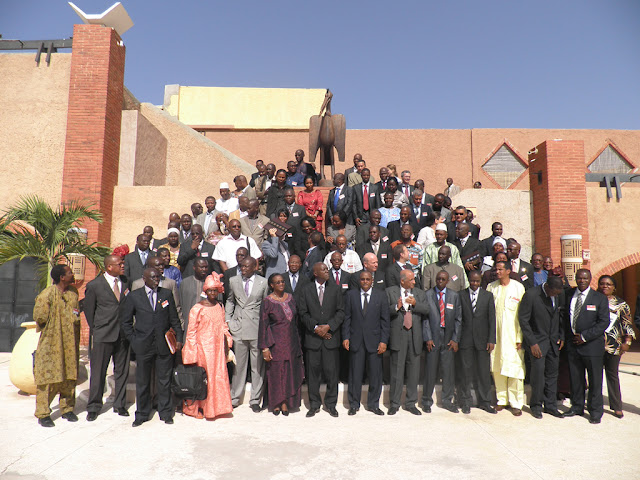
After the inaugural session everyone came together for the customary "family photo". These mementos are highly cherished and in a way also they mark certain milestones both in our professional and personal lives. For one thing, we can see how much we've aged or how much we have not changed!!!!

My take away messages from this morning's session which finished with a chat show on challenges and opportunities for integrating value changes into operations, are the following:
  • Women in Africa constitute the majority of farmers, yet they receive less than 10 percent of small farm credit and own only 1 percent of land. Yet they are the ones that make sure there is food on the table and only if they had the same level of education and experience as men they could increase the yield of their crop by 22 percent
  • Africa can feed the world. It has 52% of arable land. What it needs solid institutions and sound policies
I am now sitting in a working group where participants are discussing the linkages between value chains and  rural entrepreneurship. Looking around the room and listening to the experiences of colleagues from Senegal, Ghana and other countries it is obvious that this continent has so many good experiences that it can use to build a better future not only for itself, but as Mohamed Beavogui mentioned also feed the world.

When there is a will there is a way!!!

Popular Posts