Showing posts with label farmer. Show all posts

Sunday, November 21, 2010

Berlin calling: Development world, please wake up. There is an urgent need to put back #ICT4D on the global development agenda

The ICT for Rural Economic Development conference jointly organized by GTZ and BMZ from 18-19 November 2010 in Berlin, concluded on Friday 19 November with an engaging panel discussion on “What role can development cooperation play in ICT for rural economic development?”

The two day event brought together numerous practitioners, policy makers, donor organizations and private sector players. The event allowed colleagues to interact, network and share their rich experience and at the same time put on the table a number of challenges.

I think, it is safe to say that there was quite a bit of apprehension about the fact that some major donors have abandoned ICT4D sector. For those of us in the agriculture world, this is a déjà vu. But if there is one lesson to learn from our experience, that is under-investing in this sector – similar to under investing in agriculture -  will have negative impact in the lives of poor rural people.  We’ve learnt that ICTs are tools and for these to add value and improve the livelihoods of poor rural people, they need to be:
  • Affordable
  • Scalable
  • Self-sustaining
  • Sensible
  • Appropriate
We also learnt that we need to:
  • Focus on PEOPLE and not technology
  • Ensure ownership and appropriation
  • Develop local content
  • Ensure language and cultural pertinence
  • Ensure participation
  • Mainstream ICT4D activities as part of development projects
  • Build local capacity and scout for local talent and local innovations
This is the message that came out loud and clear from the concluding panel, moderated by Corinna Kuesel, Head of section for economic policy and private sector development of GTZ.

Ms Kuesel kicked off the panel discussion by sharing her impressions about the event. “I am impressed to see what an important role ICTs play in economic development and at the same time perhaps I am a bit concerned that development cooperation is moving out of ICT4D”, said Kuesel.

While recognizing that development agencies are competing for funds and funds are getting scarce, Kuesel made the case that this should not lead to abandoning ICT4D, because we’ve now have the evidence that ICTs can indeed make a difference in the lives of poor rural people.

Kuesel underscored the importance of public-private partnership and called on development world to:
  • play a facilitation role in forging partnership
  • build the capacity national governments, grass-root organization and poor rural people
  • create an enabling environment so that ICT4D initiatives can be implemented and scaled up
Susanne Dorasil, head of division economic policy, financial sector of BMZ underscored the importance of using ICTs to get better outcomes. Recognizing that the ICT4D community has a challenge of being heard, she talked about:
  • importance of working towards putting in place regulations to reach the goal of universal access
  • challenges and opportunities of linking up and broadening cooperation with the private sector to develop a robust ICT sector
  • importance of showing impact and showing how ICTs contribute to and add value to “hot development topics”  such as rural development, food security, rural finance and more
Ekwow Spio-Garbrah, CEO of Commonwealth Telecommunications Organization talking about private-public partnership brought in the missing dimension – namely PEOPLE. He talked about public-private-people partnership. Spio-Garbrah talked about importance of involving not only national governments, but also local governments. He talked about not exclusively partnering with multinational private sector, but local enterprises and grass-root entrepreneurs. And most importantly he talked about the very PEOPLE, who we work with and work for – the poor rural people and civil society.

Wow, what a concept….. During the course of the two days, I must admit, we focused primarily on technology and perhaps not enough on People. So thank you Dr Spio-Garbrah for putting PEOPLE in the forefront and for sharing your vision of intra-institutional cooperation.

Giacomo Rambaldi, Senior Programme Coordinator, Technical Centre for Agricultural and Rural Cooperation, CTA echoing Dr Spio-Garbrah reminded the audience of the need to involve the civil society. Rambaldi talked about the risks of ICTs and how ICTs could both help disseminate/preserve but also usurper indigenous knowledge.

He talked about how ICTs have provided access to information that previously was not readily available and how ICTs have democratized access to information, citing the examples of services such as YouTube or Google maps have given a voice to the previously voiceless segment of the population.

Rambaldi reminded us of the importance of generating localized and relevant content.  He talked about how as development workers, we have to make sure that ICTs actually add value and contribute to knowledge generation and becoming a catalyst to disseminate locally generated knowledge.

After all we have to remember that  ICTs are tools and if they are not used to generate and disseminate relevant and local content, they are nothing but a useless device which can end up gathering dust!!

David Grimshaw, Head of International Programme: New Technologies with Practical Action and Senior Research Fellow, DFID, made the case for mainstreaming ICT4D initiatives where we have solid evidence that these have improved the livelihoods of poor rural people. Grimshaw underscored that technology has no magic power and is not a silver bullet. It is what we do with technology and how we use it that will make the difference.

“We need to focus on the HOW and on the process to move to ICT for DEVELOPMENT”, said Grimshaw.
Challenging the development world, he said: “You cannot work with logframes when you are doing a research project. These types of projects are different”. Concluding his remarks, Grimshaw said: “We need to focus on the process and focus on people’s need.”

Anton Mangstl, Director of the Office of Knowledge Exchange, FAO, underscored the importance of conducting impact assessments and learning from existing activities and pilots. He urged us to work with governments and other key stakeholders to scale up those activities that have worked. He reminded the audience that similar to development projects, for  ICT4D projects  to succeed they too need be sustainable.

Given the key role that ICT4D activities play in rural development, Mangstl put his finger on a crucial challenge, namely why have bilateral development donors such as DFID and SDC stopped their ICT4D programmes and investments.

Mangstl echoing the other panellists made the case, that donor agencies – be it bilaterals or multilaterals – need to mainstream ICT4D activities in their core activities and integrate these more and more with their respective knowledge sharing and communication for development activities.

Ilari Lindy, Advisor, Ministry of Foreign Affairs, Finland asked the fundamental question of whether ICT4D activities were well positioned to show impact in rural development and agriculture related activities.

He urged the participants to pay attention to policy and regulatory frameworks when designing and implementing ICT4D activities and repeated Mr Mangstl’s call for action – that is the need to improve knowledge sharing on ICT4D activities and integrating ICT4D activities with organizational knowledge sharing activities.

Lindy pointed out that to innovate, there is a need to bring together and create bridges between development and scientific communities. He also talked about the importance of convergence between North-South networks and last but not last the fundamental prerequisite of responding to grass-root demands.

Our colleague Tobias Eigen from Kabissa, reminded the audience that Africa is the hot bed of innovation and made the case that we should have more African innovators in events such as these.

Madam Dorasil from BMZ in her closing remarks reiterated the following fundamental points:
  • there are no silver bullets in development
  • we need to listen to and cater to the needs of the people who we work with and work for
  • we need to build local capacity and groom local talents
  • we need to get better in documenting, sharing and capturing the impact of ICT4D projects and feed these back into the learning and development loop
  • we need to have indicators that clearly demonstrate how ICTs are changing the lives of poor rural people
  • as a development community, we need to join hands to make sure that developed and developing countries governments and decision makers understand the importance of ICT4D activities and assist them in putting in place an enabling environment so that these activities flourish and replicate
  • we need to raise awareness about ICT4D and make a concerted effort to put this topic on the G20 agenda
  • we need to adopt an integrated approach and mainstream ICT4D activities in rural development projects and programmes
  • we need to show how ICTs are reaching those living in the “bottom of pyramid”
As the event came to a close, I asked myself – how long will it take for ICT4D to make it back to the global development agenda? Do we need two decades of under-investment in this sector before we hear the wake-up call – or can we show that we learnt from the negative impact of under-investing in agriculture and start mainstreaming and investing in scaling up ICT4D activities?

At this event I talked about "Development 2.0: Putting ICT4D Lessons into Action to Make M-Development a Reality" and shared IFAD's experience in Zambia with the Zambia National Farmers Union - better known as ZNFU4455!

Sunday, November 14, 2010

Farming as a business: not a mirage, but a reality


By Moses Abukari, Daniela Cuneo and Roxanna Samii

One of the highlights of  the 2010 West and Central Africa regional implementation workshops was the field trip. While we were sorry that we could not visit an IFAD-funded project and programme, we were excited to visit the modern village farm of Djilakh - government financed activity  in cooperation of the Spanish government, covering the entire agricultural, production and marketing value chain.


We had an early wake up call, with departure scheduled for 8:00am. Two buses made their way through Dakar’s heavy early morning traffic. Two hours later we reached “Ferme villageois Aoderme de Djilakh”.

At IFAD, we talk about farming, regardless of size or scale, as a business, and smallholder farmers as small-scale business owner rather than poor rural people. There is now a growing recognition and understanding that smallholder farmers and their rural communities are a major part of the solution for food security and rural poverty eradication. As development workers, our goal is to help smallholder farmers go beyond subsistence farming and help them turn farming into a viable business.

The Djilakh farmers we met personified the concept of farmers as small-scale business owners and farming as a business.

The idea of Djilakh farm goes back to 2007. It was born in response to the urgent need to reverse the trend of migration from rural to urban areas and at the same time to address the challenge of young people migrating to Spain.

“Our objective was to create the conditions so that smallholder farmers, including the young farmers would stay in the rural areas, re-engage with and in agriculture and have a secure source of income”, said  Sabacar Faye, the Farmer Association Executive Director.

To make sure that the farmers really embraced agriculture and dedicated their efforts to farming, the government had to ensure that they were employed all year long.

“Before this farm, we were lucky if we farmed for a maximum of 5 months a year. As a result what happened, was that men, women and the young people left their villages to go to urban areas for seasonal work”, says Faye.

The social impact of this outmigration was strongly felt. Households were divided. Women had to abandon their children and the young people ventured into urban areas or in extreme cases, took the dangerous route of the sea – often a journey of no return.

The Djilakh farm is approximately 100 hectares and is located in the administrative region of Thies in the Department of Mbour. The 100 farmers, aged between 18 and 35, use rainfed technique for cereal cultivation and irrigated agriculture for fruit and horticulture.

“This diversification has allowed us to ensure reasonable harvest and employment opportunity all year long”, says Faye.

The farm is lucky enough to avail of relatively good rural infrastructure. It may not be fully mechanised, but has a tractor which is used for heavy-duty work. The drip irrigation system is in place and the farm is connected to the main road, through a dust road.

We were quite impressed to find out that 50% of the farmers on the farm were women. Women always talk from their heart and have no qualms sharing their challenging in talking with Madame Gaye, a lady farmer who joined the farm in 2008 she told us: “I am happy that the farm is connected to the main road through a dust road, but as you saw, the farm is located 3 kilometres from our village. It would be so nice if we could have some means of transportation so that we can spare a 6 kilometre walk every day”.


“We can become more productive, if we could use a milling machine to process the sorghum as opposed to doing it manually”, remarked Gaye. “And, I hope sooner rather than later, they will provide us with some protective gears, such as wellington boots so that when working in the farm and preparing the land we are protected from snakes and scorpions”.

The farms governance structure was also equally impressive. The farmers come together in a general assembly to plan and decide on what to plant when and what to produce for which market.

The farm produces fruit, horticulture and cereals for three different markets. Their primary market is exporting fruit and horticulture to Spain. We were told that the farmers process and package their products for export on the farm, but were unable to independently verify this.

Their second market is the local one - partially horticulture but mainly cereals. Last but not least, the third market is for their own household consumption.

For the farming year 2010-2011, the plan is to cultivate:

  • 35 hectares for exporting tomatoes, watermelon, squash and okra to Spain
  • 20 hectares to sell pimento (spice) tomatoes, peppers and squash in the local market
  • 50 hectares of sorghum and 12 hectares of maize for local and household consumption


Last farming year (2009-2010), the farm:

  • Exported 1099 tonnes of fruits and horticulture products for a total of 39,168,380 FCFA
  • Produced 55 tonnes for local market, which it sold for approximately 8,406,000 FCFA
  • Produced 75 tonnes for local consumption for a total of 9,375,000 FCFA thus ensuring food security for numerous households

The farm has a steering committee composed of village elders, civil society, farmers, women and youth association and meets on a weekly basis. The steering committee has a chairperson, a vice-chair, a treasurer and is supported by the following of technical committees:

  • irrigation
  • plant protection
  • hygiene
  • marketing
  • infrastructure
  • implementation support
  • packaging and distribution

The steering committee determines the selection criteria for choosing the farmers who will work on the farm. To ensure adequate income for all, the size of the farm determines how many farmers will be selected.

As small-scale business owners, farmers do not have monthly salaries, rather they get their money when they sell their products, which can be every 3 to 4 months. This means, the farmer entrepreneur needs to manage their cash intelligently and responsibly.

To make agriculture enticing and to ensure that young people do not abandon rural areas or for that matter give up agriculture for going into urban areas, the government’s vision is to ensure an annual income of 1,440,000 FCFA – approximately $3200 – for farmers working in similar types of farms.

“Our vision is for the farm to become a rural agriculture engine. To achieve our vision, we know we need to diversify. By diversification I mean, we need to also expand to husbandry, increase our yield and also reach out to and market our products and services to the surrounding farms and villages. For example, we could sell seeds and fertilizer to the neighbouring farms and if we manage to hook them up to our power grid, provide them with electricity and charge for this service”, explains Faye.

“For us, smallholder farming is very important and the last thing we want to do is to undermine this sector. This is why, we encourage the farmers to continue farming their own land”.

In an effort to continuously improve and better meet the needs of the different markets, the farm’s sophisticated governance structure also provides a feedback mechanism to assess the social, financial and technical impact of their work. Furthermore, the implementing agency provides the farmers with a technical, financial and marketing of extension services.

The goal is for this farm and others like it to become fully sustainable. Thus the farmers are learning how to run and manage the farm, manage and maintain infrastructure, avail themselves of credit, engage in service agreements with contractors and negotiate prices with exporters.

“We’ve adopted a  win-win business model when it comes to the export market”, explains Faye. “We sit down with the exporters and find out what are their needs. We negotiate the price and once we’ve reached an agreement, then and only then we start cultivating. This way, we know what is needed, we do not over cultivate and we sell whatever we produce”.

The export market may be a relatively well-oiled machine, however, the local market remains a challenge. This is mainly because the local market is highly disorganized with too many middlemen. To overcome this challenge, the government assists the farmers to sell their products in weekly markets just outsides of urban suburbs.

Mbaye Tine, youngest farmer – 23 years old - told us that he joined the farm in 2008. “Before that I spent three years in the city looking for a job as driver. Life was really hard and miserable. I am really pleased to be working as a young farmer and have a secure income”, says Tine. “I am  determined to continue as farmer and I am no longer planning to go to the city looking for a job!”

As our visit was coming to a close, a number of us had an “Aha moment”. We finally saw first-hand what it really means when we talk about farming as a business. These farmers were indeed businessmen and women.

And this was echoed in Mohamed Beavogui’s closing remarks. In thanking the farmers, Beavogui said: “On behalf of everyone present here, I want to thank you for dedicating so much time to us. We know this meant you cannot be on farm and not working on the farm means not making money!”

“We wish you all the best and we are confident that this farm not only will grow and prosper, but will also become a model for many  more to follow”.

As we were leaving, we commented that farming as a business is not just a concept, it can be and is a reality.

Thursday, October 21, 2010

All good things come to an end: Chronicle of last day at Agknowledge Africa Share Fair #sfaddis


I am now sitting at the penultimate session of the Agknowledge Africa Knowledge Share Fair - Focus on Farmers. I am sorry the event is coming to an end. The purpose of this share fair was to share and learn and I believe that we've achieved this goal. I hope that the fair has left a footprint in the hearts, minds and souls of the participants. 


Earlier in the day I attended the radio and telecentre focus groups. The radio session was a great example of the impact of the Share Fair. The room was packed with participants who before the share fair did not know anything about podcasting, podcasting/audio software and hardware. Three days later here they were showing us the audio files they have created, sharing tips on how to conduct an effective interview and discuss challenges of interviewing with the help of an interpreter and avoiding being lost in translation.

We closed the radio session with one of the participants saying: "YES WE CAN. I now know HOW TO."  That was such a wonderful way of finishing the session and showed the footprint of the share fair.

Often we are asked "what has been the impact of events such as share fair". The impact of these events are transformative. They change the way people work. They open your mind and remove the cobwebs in your mind and as a result you inevitably change behaviour which is transformative.

The telecentre session discussed issues of sustainabililty and how to generate local content. I think we came out of the session agreeing that we should rebapitze telecentres to "Knowledge hubs"  or "Service centres". 

On issue of sustainability, Paul offered some pragmatic advice on how to create a sustainable service centre, namely make sure:
  • your services are competitive
  • have a number of subsidized services so that you can keep your competitive edge
  • provide a number of free services - especially services that really add value and improve the livelihoods of the smallholder producers, smallholder farmers and rural people
During the session participants mentioned that farmers are willing to pay for information and knowledge which is relevant to them. Personally, I have a problem with that, as we should consider knowledge is public global good and should be made available free of charge. But I stand to be corrected.

The group talked about how in Africa the village experts do not recognize themselves as experts and this is one of the reasons why local knowledge is  not documented and shared. We talked about how Africans should exploit and make sure to systematically use their oral culture, their tradition of drama and songs to share local content.

One of the best reflections of this session was the fact that often indigenous knowledge is not valued and challenged by experts/researchers. This made me reflect that  it seems to be human nature to underestimate one's own knowledge, perhaps this is why sharing tacit knowledge is a challenge?

We just finished the small group reflection and learning session and have successfully summarized the footprint and impact of this remarkable event in a tweet. Stay tuned and we'll be tweeting them live shortly. Follow #sfaddis

Tuesday, February 16, 2010

The third global meeting of Farmers' Forum thanks IFAD for establishing the Forum

On Tuesday afternoon, 70 farmers' leaders from around the world, representing millions of smallholders and rural producers from all over the world concluded their work at the third global meeting of the Farmers' Forum.

In their synthesis of deliberations they reiteriated the fact that since the last Farmers’ Forum, the world has experienced multiple crises, exacerbated by the global recession and climate change and as a result more people are poor and hungry.

They acknowledged the significance of family agriculture in the world and pledged to campaign for a UN Declaration for International Year of Family Farming.

The farmers indicated that they want agriculture to be controlled by them, the VERY people who cultivate the land and are feeding the world.

In sharing the summary of their deliberations with IFAD's 33rd Governing Council, they indicated there is no effective response to the challenges of food security for all, eradication of extreme poverty and mitigation of climate change without more and better investment in farms and rural communities and more supportive policies for rural development.

They commended IFAD for forging a strong partnership with Farmers’ Organizations and embedding them in Country Programmes. They told IFAD's membership that they highly appreciated the real progress in the consultation and partnership between IFAD, governments and farmer organizations.

They made the following recommendations to IFAD:

  • Extend the partnership to all countries where IFAD is operating, taking into account the diversity of the organizations of poor rural people.
  • Systematically include at least one national apex organization in the IFAD Country Programme Management Team in order to contribute to the steering of the IFAD country programme (COSOP formulation, project and programme design and implementation, policy dialogue and other initiatives).
  • Create a flexible, demand-led facility within IFAD’s budget for facilitating the participation of farmers’ organizations in the COSOP and the project cycle.
  • Develop operational guidelines to support the systematic engagement of farmers’ organizations at country level; in particular in the monitoring and implementation of IFAD programmes.
  • Ensure that the already strong practice of consultation with farmers’ organizations is systematized; in this regard, IFAD and regional/international farmers’ organizations could maintain a roster of organizations that should be systematically invited when IFAD is about to embark on project design.
  • Take stock of important lessons from programmes with farmers’ organizations, with a view to replication and upscaling, and to promote south-south exchanges and knowledge among the farmers. (In this regard, we recommend exploring the possibility replicating the programme ‘Learning Routes’, which was successfully implemented in Latin America.)

Last but not least, both farmer leaders and IFAD President stressed the importance of investing in young farmers. Farmer leaders recommended that IFAD:

  • Map young farmer and rural youth organizations and their networks (national and regional).
  • Hold a Farmers’ Forum event similar to the one held for women this year, and ensure more representation of young people in subsequent Farmers’ Forums.
  • Designate within IFAD a focal point for youth.
  • Hold a global workshop on youth involvement in Sustainable Agriculture and Rural Development during this year (UN Year of Youth ).
  • Mainstream youth in all IFAD policies and programmes, with a gender balance and an emphasis on developing capacity-building and enhancement programmes for rural youth to engage in sustainable food production and agriculture and rural employment.
  • Launch pilot projects supporting rural youth.
  • Organize youth exchanges for experience-sharing on best practices and learning.

Monday, February 15, 2010

Farming is a business: A unanimous call from farmers from all over the world attending the third global meeting of Farmers' Forum

The third global meeting of the Farmers' Forum is now underway. This morning IFAD President welcomed 70 farmers' leaders from around the world, representing millions of smallholders and rural producers from all over the world.

In his statement the President made a strong case for investing more in agriculture and smallholder farmers. The President said: "if we know that 85% of all farmland worldwide is less than 2 ha in size (in the developing world it is as low as ¼ ha); if we know that 500,000 million smallholders produce 80% of the food we consume in the developing world; that they live in rural areas and make up the majority of the rural poor; and if we know that over 60% of the rural population is made of youths with over 50% being young women and girls. If we know all this, I ask you, ladies and gentlemen, who will feed the world in 2020, in 2030 or in 2050 by which time we would have added another 3 billion people, 50%, to our population?" He continued to say: "We must invest in the rural youth of today, the farmers of tomorrow".

The President talking about Africa said: "I am also absolutely convinced that Africa can feed itself, just as Viet Nam and China have done. Africa has the human and natural resources it needs to achieve agricultural growth and food self-sufficiency. What is needed is committed local leadership.... And this is what I have been calling to African leaders. "

"And I will repeat my call: No nation, no people achieved economic development unless it comes from within and agriculture is the foundation for it; after all, development is an intrinsic and endogenous process."

The President concluded by mentioning that "there are still a number of countries were IFAD’s cooperation with farmers organizations is limited. He indicated that we need to reach out further and deeper and develop these connections."

"We must work together to strengthen the linkages of your organizations with the grassroots levels and invest in the village-level advocacy to have an impact at the ground level and to improve the inclusive basis of our partnerships", said Nwanze.

"We need to develop the advocacy role of the farmers’ organizations in the national policy debate". The President concluded his statement by stating that "we need to engage rural youth in agricultuture; help them organise themselves into young farmers associations, provide opportunities for capacity building and training; institutional linkages and market informations. They are the food producers of tomorrow. "

Following the President's statement, the members of the steering committe (IFAP, LVC, WFFP, WFF, AFA, COPROFAM, ROPPA) made short statements echoing:


  • the need to focus on women and youth in developing agricultural policies
  • the need to focus on issues such as land entitlement and ownership
  • the fact that commercialization of smallscale agriculture is the way forward

During the course of the day, the participants interacted with IFAD staff and selected partners and attended regional working group sessions to share the progress achieved to date and discuss future goals for partnerships with farmer organizations at national and regional levels.

Stay tuned on this channel! The social reporting team will be bringing live soundbites and stories from this workshop and from the Third Global Farmers' Forum. Follow us on Twitter (@ifadnews) and on this social reporting blog (http://ifad-un.blogspot.com/).

Sunday, February 7, 2010

Farmers' Forum embraces social networking: Follow us on Twitter (@ifadnews) and on IFAD social reporting blog

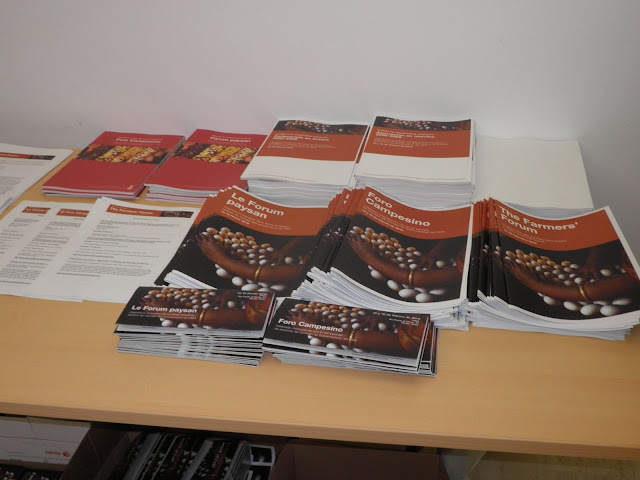
The third global meeting of the Farmers' Forum will place on 15 and 16 February 2010 in conjunction with the Thirty-third session of IFAD's Governing Council. The Forum will bring together more 70 farmers' leaders from around the world, representing millions of smallholders and rural producers from all over the world who will interact with IFAD staff and selected partners. The Forum will be opened by the President of IFAD, Kanayo Nwanze.

The forum will use social reporting, which is an emerging philosophy which mixes journalism, facilitation and social media. It goes beyond posting agendas, papers, presentations and speeches on corporate websites. It is based on collaboration and live reporting from events by involving those "not in the room" to follow and contribute to the event. Social reporting uses a variety of techniques and tools such as story-telling, interviews, videos, photography, blogs, twitter, podcasts, posting documents to slideshare to tell the story.

The social reporter team will report live from the various sessions, allowing colleagues who cannot attend to participate virtually. You can start posing your questions using Twitter (send your questions to @ifadnews) or post a comment on this introductory blogpost.

What is the Farmers' Forum?
The Farmers’ Forum process was born in 2005. It is an on-going, bottom-up process of consultation and dialogue between small farmers’ and rural producers’ organizations (FOs), IFAD and governments, focused on rural development and poverty reduction. The Forum is rooted in concrete partnership and collaboration at the countryand regional levels. The Forum meets every two years for a global consultation, in conjunction with the Governing Council of IFAD.

The 2010 edition will be focusing more on operational matters. To that end, two sessions will be organised by IFAD operational divisions:
  • the first one Monday afternoon on operational collaboration between IFAD and farmers’ organisations at country and regional levels;
  • the second one Tuesday morning on the themes of (a) food security in a context of growing competition on access to land, (b) roles of farmers’ organisations in empowering small farmers in value chains, and (c) differentiated policies and investment programmes in support of smallholder agriculture.

Popular Posts