Showing posts with label social reporting. Show all posts

Sunday, February 19, 2012

#IFAD President shares his expectations of #ifadgc

We're 72 hours away from #ifadgc. There is a lot of buzz and excitement in the building. Over the weekend 30 young people came together to discuss the opportunities and challenges of agriculture and what it takes to make agriculture a profitable business.

Tomorrow, the Fourth global meeting of the Farmers' Forum will kick off. And on Wednesday our building will host world leaders, prominent guests, global movers and shakers.

As part of our "back story" and interview series, we had the opportunity to have a conversation with IFAD President and ask him what are his expectations for this session of #ifadgc.

In this interview, the President shared his excitement about having a first class international meeting  focusing on the hot topic of climate change  with renown panelists and prominent guests. He also mentioned he is looking forward to this event being an open one thanks to social media and webcasting.

You can imagine the smile on my face, when the President mentioned that #ifadgc is almost like what we experienced last September with the Share Fair! (The spirit of #sfrome is alive and kicking!)


The President, one of our best social media advocates, is looking forward to an interesting exchange of ideas and interaction on social media. Have a look at how, yesterday during the youth in agriculture session, he engaged in a conversation with WFP's Executive Director, Josette Sheeran.

This is your chance to interact with the renown panelists and guests. Send us your questions for Bill Gates and the other panellists. Join us in making #ifadgc a memorable event!

Help us show the world and the skeptics the power and potential of social media! We count on YOU and look forward to having an engaging and compelling conversation.


Friday, February 17, 2012

Getting ready for what promises to be an exciting #ifadgc

In our #ifadgc back story series Andreina and Paolo  talked about the evolution of IFAD Governing Council over time.

But what are these changes? We asked James Heer of the Communications division to walk us through the changes and transformations of #ifadgc.


We've tried our best to make #ifadgc an exciting event. Now we need YOU to take part in this  interactive event. As you know, this event has a strong social media component. Social reporters will keep the outside world informed through blogs, tweets, posting interviews and pictures on the following IFAD social media channels.


To stimulate the conversation, live tweets will be displayed on the Twitter wall in the Plenary Hall, in the meeting rooms and in the atrium.

The virtual audience - YOU - can follow the proceedings and interact with the prominent guests such as Bill Gates (@billgates) and panellists on the above social media channels and via webcasting.

Please send us your questions and rest assured that the social reporters will make sure these are put forward!! And follow the event via webcasting.

Check out the #ifadgc programme for more information.


Thursday, February 16, 2012

Getting up close and personal with #ifadgc social reporters

The clock is ticking. Six days to go to #ifadgc and the social reporters who are your eyes and ears are already at work.

Irshad Khan (@Khantabile) our resident photographer has been keeping you abreast of the construction of the tent. Daniela Cuneo (@dnlcuneo), Beate Stalsett (@beatews), Tim Ledwith (@timledwith), Sundeep Vaid (@sundeepvaid) are drumming up interest on Twitter.

Christiane
Christiane Kuhn, one of our great social media champions has been blogging about the Farmers' Forum and the high-level panels. She has adopted blogging as a way to share knowledge and keep others abreast of what she is up to. She is one of those unique people who embraces change with open arms and has contributed to transforming IFAD. Thanks to her pioneer work, her division has embraced knowledge sharing methods and she herself is now a great resource and a wonderful facilitator.

Over the course of next week, she will keep YOU, the virtual audience, informed through blogposts and via Twitter (@ChristianeKuhn).

Bob

Bob Baber joined the social reporting team last year. At first he was intrigued and a bit puzzled by Twitter. Through out the course of the year, he appreciated more and more the power and potential of conveying and communicating with 140 characters. I was so pleased to see he finally signed up on Twitter to get his own personal account (@bobNrome). He has started tweeting and will be tweeting live from a number of sessions.

Monica
Monica Romano  is one who enjoys coming out of her comfort zone and try new things. Used to writing reports and research papers, she is looking forward to blog from some key sessions. She will be covering  Minister Riccardi's keynote address. I guess the next step for Monica would be to join  the twittersphere. Hopefully this will happen sooner rather than later.

Theveteran social reporters - Maria Elena Mangiafico,  Silvia Sperandini, Willem Bettink, Christian Assogba, David Paqui, Rima Alcadi, Jeff Brez, Sabine Pallas, Amedeo Paglione, Marcello Barnaba and Suyun Kim are coaching and mentoring the new members of the team - Vincent Sineau, Tomas Donnelly, Michelle Tang, Dimitra Stamatopoulos, Maria Luisa Saponaro, Ilaria Firman, Ines Cabello and Barbara Bellogini.


A number of social reporters from other sister UN agencies will join us to spread the word. Make sure you follow us via webcast, via Twitter (follow #ifadgc) and on Facebook. Send your questions for the various panellists and for Bill Gates.


Beate and Tim
Maria Elena
Silvia
Tomas
Dimitra
Willem
Barbara
Ilaria and Beate
Daniela
Christian
Sundeep

Wednesday, February 15, 2012

Steve Jobs legacy takes centre stage at #ifadgc

IFAD's social reporting team - Yes this is a DREAM TEAM!
The readers of this blog know that #ifadgc promises to be an interactive event thanks to a number of social media components and the wonderful social reporting team. This dream team will keep the outside world informed through blogs, tweets, posting interviews and pictures on the following IFAD social media channels.

This  blogpost is about two out-of-the-box, innovative and open-minded colleagues working in our IT division: Marcello Barnaba  (@vjt) and Amedeo Paglione (@amedeo).

Amedeo and Marcello at work!!
Marcello is the mind behind IFAD's cool webcasting application which beats Livestream. Last September, during the Second Global AgriKnowledge Share Fair (#sfrome), he got a standing ovation for this very application. Since September, Marcello together with other colleagues have further refined the application. A number of our sister UN agencies consider this application as  a model to follow!!!

Amedeo is one of those folks who has vision. He is one of our best partners in crime when it comes to introducing innovative approaches. And he played a crucial and instrumental role in bringing the web2.0 revolution to IFAD.

Against all odds, Marcello and Amedeo introduced us to new ways of computing by adopting opensource paradigm. And guess what, they broke the tabu and introduced Mac computers. To say they are early adopters is an under statement. Their mantra is THREE apples - iPhone, iPad, Macbook-  a day, keep a doctor away.

On 23 February at 10 a.m. CET, Amedeo and Marcello will be two of the many social reporters who will be reporting live from Bill Gates centre stage and share with the rest of the world Mr Gates perspectives on the importance of agriculture and how sustainable productivity improvements can reduce poverty in developing countries.

We encourage YOU to follow us via webcast and  interact with the prominent guests and panellists on Twitter and Facebook using #ifadgc hashtag. 

Please send us your questions and comments for the various panellists, including Bill Gates.

Tuesday, June 14, 2011

Another example of how social media is rural development's best friend


On 1 June 2011, IFAD launched its Environment and Natural Resource Management (ENRM) policy with a webcast discussion on “How to scale up investments in sustainable intensification of agriculture.” We decided to do a social media campaign to market the event, create awareness around the issue, and showcase our policy and case studies. The response was amazing!

We managed to create a lively discussion at IFAD HQ with UN agencies, NGOs, Civil Society, Private Sector, Media, and Academia colleagues and interested people from all over the world. These virtual participants were far from passive viewers. They engaged in the conversation by posting comments on our website and sending their questions via Twitter and Facebook.
Why use social media?
From the beginning we asked ourselves: How can we spread the word about ENRM issues? How can we engage others outside of IFAD in the discussion? How can we make people aware of the conclusions of the policy?

ENRM’s depth and breadth is immense and it is a topic that is of interest not only to experts but also to many others. So the challenge was how can we make sure to get everyone on board? How can we discuss the issues in an inclusive manner without excluding anyone?

We decided that using social media as a channel would enable us to interact with people in a dynamic way. Our decision was based on the fact that effective communications is not a one-way avenue, but rather it’s about the dialogue and interaction. And social media gives everyone with internet and/or cell phone access a voice and opportunity to contribute and join the conversation.

How did we create the social media campaign?
We started working on the campaign 4 weeks before the event. We created a landing page on the IFAD website. This page included information on the policy, on the event, and on the webcast and the social media activities that would take place. We included pictures, videos, and case studies of IFAD’s work in ENRM.

Then we formulated our main messages in tweets (max 140 characters). This is the tricky part. How can we capture the essence of a policy of 30 pages, to a tweet-friendly message in 140 characters? Well, the good thing is that you don’t need to limit yourself to one tweet. We created a number of tweets, some contained information about the event and webcast, some contained statistics from the policy, and others contained questions to the audience to get their feedback on how to scale up.

We sent out the first tweet 10 days before the event, and in the following days we continued sending tweets to spread information and encourage action and feedback. Our UN social media partners engaged and sent out our tweets, spreading the word to all their followers. The Environment and Climate Division informed their networks, and encouraged them to contribute to the discussion. Then on the big day of the launch, during the webcast, we could pose the comments and questions live to the discussants in the room. We connected ideas, and added new voices to a conversation that otherwise would have been limited to the IFAD HQ.

What did we achieve?
  • Reached over 50 000 people with over 300 tweets
  • People engaged interactively by re-tweeting our messages, and also by sending us comments and questions. We got approximately 100 new followers on Twitter during the campaign, and we were pleased to see that the private sector was engaged in the debate.
  • The ENRM site had 1300 unique visitors during the campaign, peeking to about 600 visitors on the day of the event
Our lessons learnt
For a social media campaign to be successful you need to:
  • Plan and prepare
  • Be clear about: what you want to say, who you want to reach, what you want as an outcome
Most importantly, to be successful on social media, you need to:
  • Provide good content that engages people
  • Respond to the questions and feedback
Our colleagues at the Environment and Climate Division did an excellent job in engaging with the audience. They asked follow-up questions, and replied to the technical questions. They created a dialogue.

If you missed the event (and even if you participated in the event), make sure you:

A #HighFive to Jeff Brez and his team, the Communications team, the excellent moderator Kevin Cleaver, IFAD Associate Vice-President of Programmes as well as all the people out there who followed us and engaged in the conversation. We all look forward to the next IFAD webcast and social media chatter. Until then, make sure you keep in touch with us via our Twitter, Facebook, Blog, YouTube, Blip.TV and Slideshare channels.

Sunday, February 20, 2011

IFAD social reporting team: messengers of soundbites calling for action

The first day of 34th session of IFAD’s Governing Council was both intense and exciting!

IFAD was honoured to have a number of distinguished keynote speakers and the IFAD social reporting team had the privilege of using social media to bring the words of our esteemed guests to millions of people.

A silent revolution has happened at IFAD. 18 months ago, who would have imagined that one day social reporting would be mainstreamed in IFAD activities and processes? Well, now it is. The very fact that social reporters had seats assigned to them in the plenary hall is a testimony of this fact!

Thanks Andreina for reserving a strategic corner for us and given the success we are sure next year we'll have a bigger one!

Today, thanks to social media and social reporting we were able to share the moving words pronounced by Her Royal Highness Princess Haya Al Hussein United Nations Messenger of Peace; share the wise words of Mr Kofi Annan, Chairman of the Alliance and IFAD President’s call for action.

24 hours later, the soundbites of HRH Princess Haya, Kofi Annan and IFAD President have gone viral and the virtual world is talking about important issue such as the need for:
  • passion and commitment at international level to solve the hunger problem
  • more investments in agriculture
  • more investments in political capital to spearhead a transformation of the rural sector to expand financial services in rural areas and ensure they have access to infrastructure
  • more investments in human capital to develop and equip poor people, particularly the young people
  • a change in the mind set to turn agriculture into profitable business in particular for young people
The panel discussion on “Feeding future generations – Young rural people today, prosperous farmers tomorrow” that took place in the afternoon was also an intense experience. The challenging questions posed by the moderator, Tumi Makgabo, engaged the audience in the room and on social media for over 2 hours.

We had an overwhelming response on Twitter and Facebook with tweets flying in from all over the world and questions being posed on our Facebook page.

The interventions of the audience in the room - the panellists, IFAD governors and young farmers and entrepreneurs - are still vibrating on the internet – better known as the “cloud”.

With his passionate interventions, Carlo Petrini, definitively did an excellent job in engaging and more importantly challenging the ministers and governors present in the room.

Two hours was not enough to answer questions such as:
  • “What can be the role of young farmers to ensure we can feed 9.0 billion people in 2050”
  • “What are the reasons, and what are the solutions for the relative neglect of young people – men and women – in national agricultural programmes, given their critical role in feeding the world tomorrow?
  • Why do young people not want to get involved in agriculture?
At the end of the panel, there was a general consensus on the need to listen much more to young people and involve them in paving the way towards a better world.

Petrini was kind enough to grant the IFAD social reporting team an interview. Make sure you tune in and listen to his call for action!


Now we’re getting ready for the second day which will focus on discussing challenges and opportunities of young people in Asia, Africa, Latin America and Near East and North Africa.

I have just walked in the plenary hall and was pleasantly surprised to see the President sitting next to the social reporters. We could not miss the photo opportunity and also to have him on the team just for few minutes.

Make sure you stay tuned!

Browse the photo gallery on IFAD's Facebook page

IFAD Social Reporting Team

Wednesday, February 17, 2010

Interview with CNN anchor Jim Clancy: How has social media changed mainstream media

By now those following this social reporting blog know that this afternoon, during the thirty-third session of IFAD’s Governing Council, CNN anchor Jim Clancy will moderate a high-level panel discussion "From summit resolutions to farmers' fields: Climate change, food security and smallholder agriculture".

I had the honour and pleasure to meet Jim on Monday to work out how we could solicit questions for the panel using social media. Yesterday, I asked if I could interview him about social media. Jim, being very modest, said he does not know much about social media.... But I can tell you he knows A LOT and he's an advocate for social media.

This morning he kindly agreed to grant an interview. You can't imagine my excitment. A little nobody interviewing the famous Jim Clancy.

I must say, it was a pleasure to work with Jim. He is such a pleasant and humble person. People walking up our corridor come to us and say: "hey is that Jim Clancy working in the open space ? "

Over the last days Clancy interviewed IFAD President, Kevin Cleaver and today he interviewed some of the panelists, amongst which Dr Nahed Mohammed Taher and Prime Minister Mizengo Peter Pinda.

This afternoon he'll be moderating the panel discussion.... and the IFAD social reporting team will be bringing it live to you. Follow us on Twitter (@ifadnews) and also check this social reporting blog.

Thursday, February 11, 2010

IFAD's Governing Council, an occasion for many debuts

For the first time in IFAD's history we are holding our annual Governing Council at our headquarters. Like any debut, the making of the GC is an exciting and unique experience. For the first time, all of us, and not only those closely involved in the preparations are experiencing the making of the Governing Council. Many colleagues have commented that "now that we are seeing it all happening under our nose, we feel part of it".
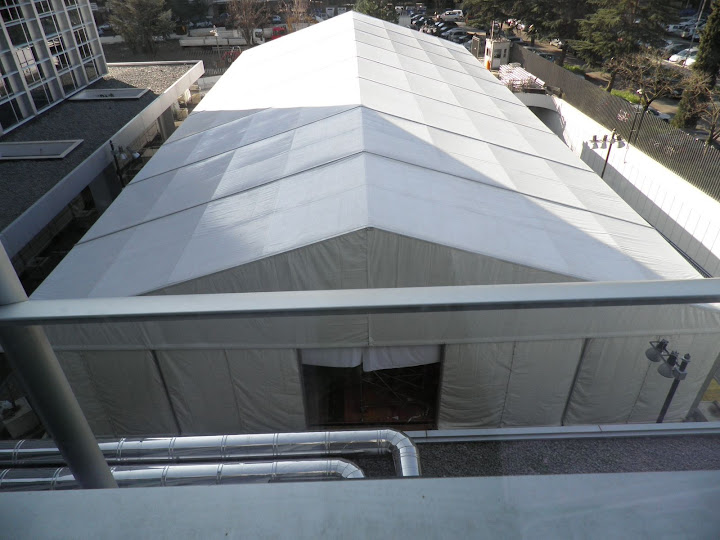
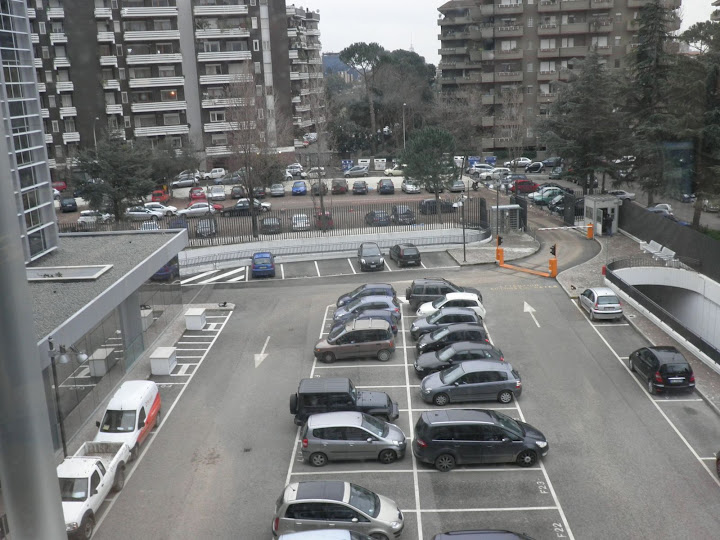
On Monday morning, when we came to the office we saw a tent erected in our outside parking space. This was the first visible sign of the GC preparations. Everyone was amazed how in just less than 48 hours the workers had managed to put up the tent. The tent will be the heart of the event serving as the plenary hall.
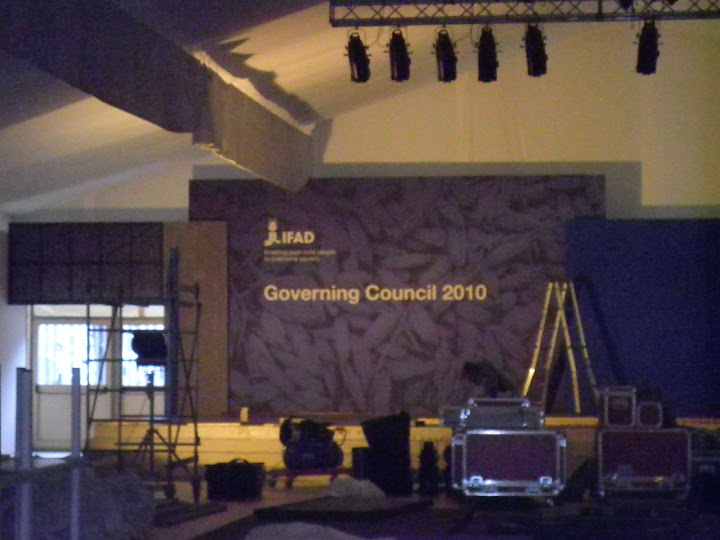
For safety reasons, administrative services declared the whole area off-limits. But your social reporting team was granted special access to visit the construction site on regular intervals to share with you the making of the GC.

Over the last couple of days, we've seen the tent come life and I must admit both the outside and inside the tent looks absolutely fabulous. My colleague who provided the creative inspiration and my administrative services colleagues were telling me that they been receiving so many compliments.
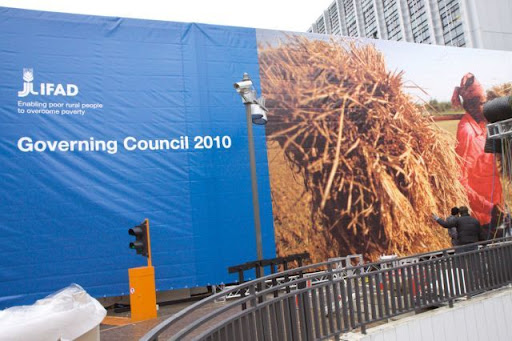
This whole undertaking is another testimony of the commitment, inventiveness and passion of IFAD staff. Everyone is doing their bit to make this debut a smashing success.

In another debut, this year the IFAD social reporting team will use social media to report live from the Third Global Meeting of Farmers' Forum and the Thirty-third session of the Governing Council. We'll be using Twitter and this social reporting blog to share the highlights of the Farmers' Forum and the Governing Council. Make sure you follow us on Twitter @ifadnews and you can use the blog and Twitter to pose your questions and comments.

Looking forward to "hearing from you".


Watch the making of the GC tent

Sunday, February 7, 2010

Farmers' Forum embraces social networking: Follow us on Twitter (@ifadnews) and on IFAD social reporting blog

The third global meeting of the Farmers' Forum will place on 15 and 16 February 2010 in conjunction with the Thirty-third session of IFAD's Governing Council. The Forum will bring together more 70 farmers' leaders from around the world, representing millions of smallholders and rural producers from all over the world who will interact with IFAD staff and selected partners. The Forum will be opened by the President of IFAD, Kanayo Nwanze.

The forum will use social reporting, which is an emerging philosophy which mixes journalism, facilitation and social media. It goes beyond posting agendas, papers, presentations and speeches on corporate websites. It is based on collaboration and live reporting from events by involving those "not in the room" to follow and contribute to the event. Social reporting uses a variety of techniques and tools such as story-telling, interviews, videos, photography, blogs, twitter, podcasts, posting documents to slideshare to tell the story.

The social reporter team will report live from the various sessions, allowing colleagues who cannot attend to participate virtually. You can start posing your questions using Twitter (send your questions to @ifadnews) or post a comment on this introductory blogpost.

What is the Farmers' Forum?
The Farmers’ Forum process was born in 2005. It is an on-going, bottom-up process of consultation and dialogue between small farmers’ and rural producers’ organizations (FOs), IFAD and governments, focused on rural development and poverty reduction. The Forum is rooted in concrete partnership and collaboration at the countryand regional levels. The Forum meets every two years for a global consultation, in conjunction with the Governing Council of IFAD.

The 2010 edition will be focusing more on operational matters. To that end, two sessions will be organised by IFAD operational divisions:
  • the first one Monday afternoon on operational collaboration between IFAD and farmers’ organisations at country and regional levels;
  • the second one Tuesday morning on the themes of (a) food security in a context of growing competition on access to land, (b) roles of farmers’ organisations in empowering small farmers in value chains, and (c) differentiated policies and investment programmes in support of smallholder agriculture.

Popular Posts